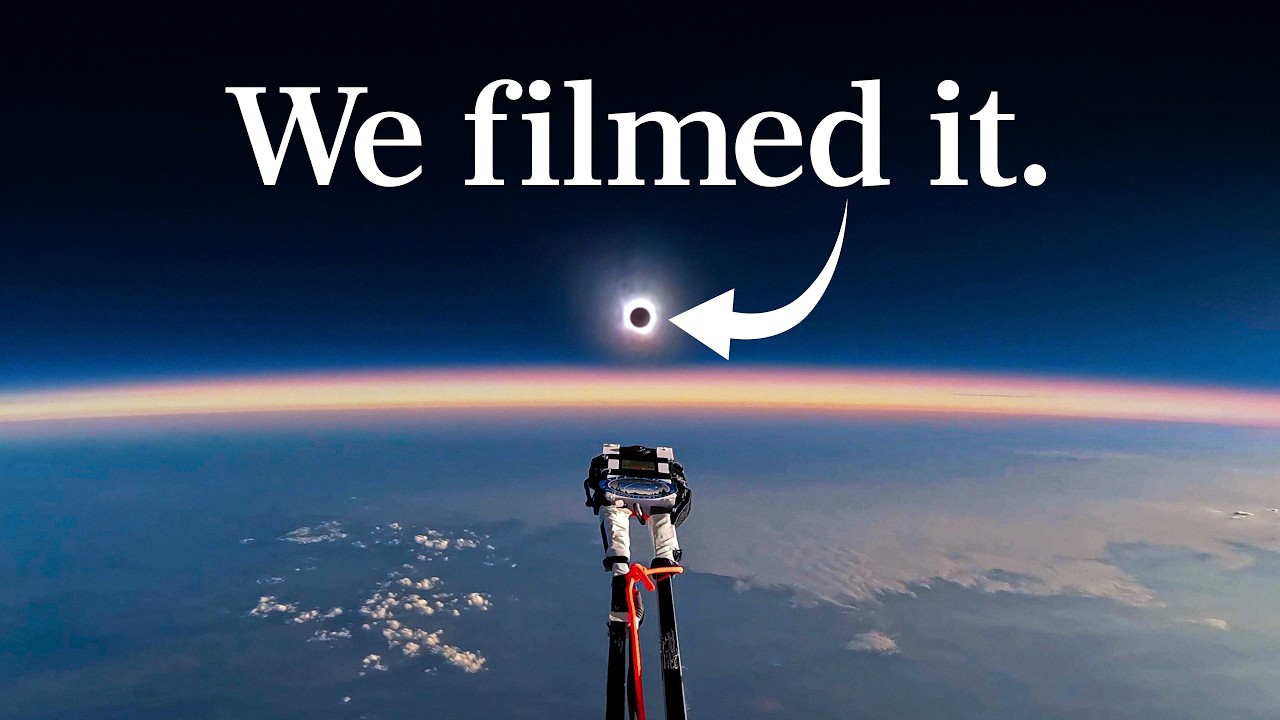
We Sent a Camera to Space to Film the Solar Eclipse
This documentary details an expedition to Spain to film the 2026 total solar eclipse from the edge of space. The project involved launching a camera to capture the celestial event from a high-altitude perspective, providing a unique vantage point for observing the eclipse’s progression and associated phenomena. The film explores various scientific aspects of solar eclipses, including their frequency, the visual effects observed during totality, and historical scientific misconceptions related to these events.
The production incorporates footage and insights from collaborators such as the Montana State University NASA Ballooning Team, who assisted with the high-altitude camera deployment, and the Exploratorium Team, which provided additional observational data. Experts from NASA’s Goddard Space Flight Center also contributed information regarding eclipse missions. The documentary examines specific visual effects like shadow bands and the apparent color changes of the sun during totality, offering explanations for these occurrences.
Key Themes & Topics Examined
- The visual characteristics of a total solar eclipse from Earth’s upper atmosphere.
- The astronomical mechanics influencing the frequency and geographical distribution of solar eclipses.
- The optical phenomena observed during an eclipse, including the appearance of the solar corona and shadow bands.
- Historical scientific interpretations and misinterpretations of eclipse-related observations.
- The methodologies and challenges involved in high-altitude scientific imaging of celestial events.
Archival & Investigative Sources
- Footage and data from the Montana State University NASA Ballooning Team.
- Insights and footage from the Exploratorium Team.
- Consultations with experts from NASA’s Goddard Space Flight Center.
- Discussions with independent researchers and scientific collaborators.
Frequently Asked Questions
What is the primary objective of filming a solar eclipse from the edge of space?
The primary objective is to obtain a unique perspective of the eclipse, allowing for observations of atmospheric effects and the solar corona with reduced atmospheric interference, which can enhance scientific understanding of the event.
What are ‘shadow bands’ observed during a solar eclipse?
Shadow bands are faint, rapidly moving, wavy lines of alternating light and dark that can be seen on plain surfaces just before and after a total solar eclipse. They are believed to be caused by atmospheric turbulence refracting the thin sliver of sunlight from the crescent sun.