
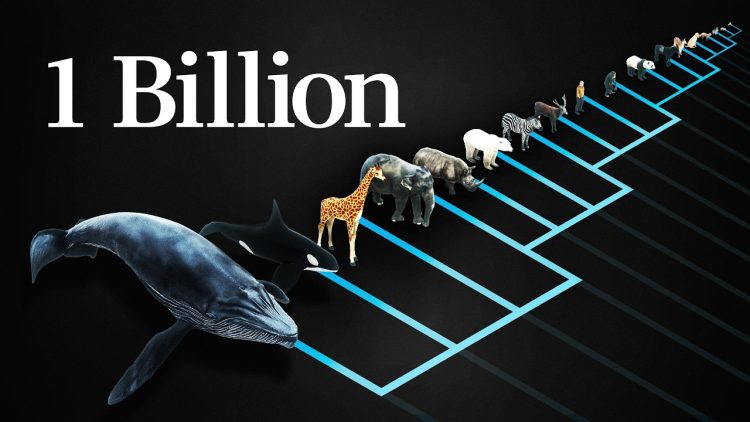
Why Does Every Mammal Get 1 Billion Heartbeats in Their Life?
Most mammals, large and small, get roughly a billion heartbeats in a lifetime. This Veritasium film looks at the pattern behind that number: how size governs metabolic rate, and the mathematics that links a mouse to an elephant.
The film explains Kleiber’s Law — the three-quarter-power scaling of metabolic rate with body mass — and the West, Brown and Enquist theory that tries to explain it, with contributions from Brian Enquist, Van Savage, Steven Strogatz and Peter Sheridan Dodds. The question it leaves open is what these constraints mean for longevity itself.
Key Themes & Topics Examined
- Metabolic scaling across species
- Around a billion heartbeats in a lifetime
- Kleiber’s Law and the three-quarter-power rule
- The West, Brown and Enquist theory
- What scaling laws mean for longevity
Archival & Investigative Sources
- Geoffrey West’s book, Scale, served as a primary inspiration.
- Research and insights from experts including Brian Enquist, Van Savage, Steven Strogatz, and Peter Sheridan Dodds.
- References to scientific literature on metabolic scaling and allometry.
Recommended Companion Viewing
Explore authoritative investigative documentaries on related historical events and investigative subjects.

Bigfoot Caught on Camera?
Testosterone — new discoveries about the male hormone
Is Spider Web Really Stronger Than Steel?
Frequently Asked Questions
What is Kleiber’s Law?
Kleiber’s Law states that an animal’s metabolic rate scales to the three-quarters power of its body mass. This means that larger animals, while having a higher total metabolic rate, have a lower metabolic rate per unit of body mass compared to smaller animals.
What is the West, Brown, and Enquist (WBE) theory?
The WBE theory proposes a mechanistic explanation for the observed three-quarter-power scaling in biology. It suggests that the fractal-like branching networks within organisms, such as circulatory systems, are optimized to minimize energy dissipation and maximize surface area for resource distribution, leading to these scaling relationships.
Why do mammals appear to have a similar number of heartbeats in their lifetime?
This observation is a consequence of metabolic scaling. Smaller mammals have faster heart rates and higher metabolic rates per unit of mass, leading to shorter lifespans. Larger mammals have slower heart rates and lower metabolic rates per unit of mass, resulting in longer lifespans. When heart rate is multiplied by lifespan, the product tends to be approximately one billion beats across many mammalian species, suggesting a fundamental biological constraint or scaling principle.

