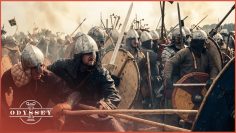
How Did Viking Raiders Turn Into Europe’s Greatest Medieval Rulers?
This documentary examines the historical transformation of Viking raiders into the Normans, a group that significantly influenced medieval European political and military structures. The program traces this evolution from the strategic settlement of Rollo in northern France to William the Conqueror’s invasion of England in 1066.
The documentary explores how Norman culture integrated Scandinavian warfare tactics with European statecraft. It investigates key historical elements such as the construction of castles, the depiction of events in the Bayeux Tapestry, and the establishment of structures like the Tower of London, illustrating the Normans’ impact on the course of history.
Key Themes & Topics Examined
- The transition of Viking raiders to the Norman identity.
- The strategic settlement of Rollo in northern France.
- The Norman Conquest of England in 1066, including the Battle of Hastings.
- The synthesis of Scandinavian military practices with European governance.
- The architectural legacy of the Normans, including castles and the Tower of London.
- The historical significance of the Bayeux Tapestry as a primary source.
Archival & Investigative Sources
- Historical accounts of Viking settlements in France.
- Records pertaining to William the Conqueror and the Norman Conquest.
- Analysis of the Bayeux Tapestry.
- Architectural studies of Norman castles and fortifications.
Recommended Companion Viewing
Explore authoritative investigative documentaries on related historical events and investigative subjects.

Dan Snow Tests 1,000 Years Of Deadly Medieval Weapons
Archeologists Investigate Evidence Of The 6,000 Lost Vikings Of Greenland
Archeologists Investigate The Medieval Masons Who Built Gothic Europe
Archaeologists Re-examine Artifacts From Post-Roman Britain
Frequently Asked Questions
Who were the Normans?
The Normans were descendants of Viking (Northman) settlers who established themselves in Normandy, a region of France, during the 10th century. Over time, they adopted French language and culture while retaining elements of their Scandinavian heritage.
What was the significance of the Battle of Hastings?
The Battle of Hastings, fought in 1066, was a pivotal conflict in which William the Conqueror’s Norman army defeated the English forces led by King Harold Godwinson. This victory led to the Norman Conquest of England, fundamentally altering English language, culture, and political systems.
How did the Normans influence European statecraft?
The Normans introduced a centralized feudal system, advanced administrative practices, and sophisticated military organization to the territories they conquered. Their architectural innovations, particularly in castle building, also had a lasting impact on European defense and governance.