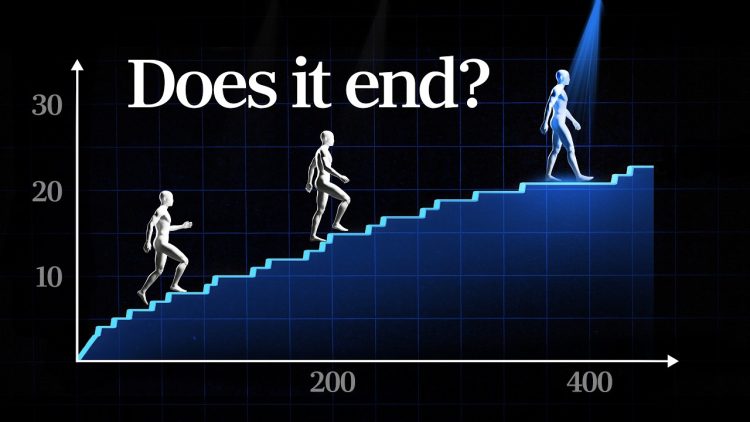
We’re 99.9% Sure This Pattern Is True, But No One Can Prove It
Are there infinitely many pairs of prime numbers that differ by two — twin primes? It is one of the great unsolved problems in number theory, and mathematicians are 99.9% sure the answer is yes, without being able to prove it. This Veritasium film explains why.
The film traces the search from the Sieve of Eratosthenes to the recent breakthroughs on bounded gaps between primes, including the work of Yitang Zhang, James Maynard and the Polymath project. It is a story of a pattern everyone can see, and a proof no one has found.
Key Themes & Topics Examined
- The Twin Prime Conjecture
- Twin primes and the Sieve of Eratosthenes
- Bounded gaps between prime numbers
- Yitang Zhang, James Maynard and Polymath
- Why the conjecture remains unproven
Archival & Investigative Sources
- Expert interviews with mathematicians Alex Kontorovich, Andrew Granville, James Maynard, Roger Heath-Brown, Dimitris Koukoulopoulos, Debmalya Basak, and George Shakan.
- Mathematical concepts and theories related to number theory and prime numbers.
Recommended Companion Viewing
Explore authoritative investigative documentaries on related historical events and investigative subjects.

You've (Likely) Been Playing The Game Of Life Wrong
What Happens If You Drop 0.125 Grams of Antimatter?
What If Space And Time Are NOT Real?
What Happens If You Keep Slowing Down?
Frequently Asked Questions
What is the Twin Prime Conjecture?
The Twin Prime Conjecture posits that there are an infinite number of prime number pairs that differ by two (e.g., 3 and 5, 5 and 7, 11 and 13).
Who is Yitang Zhang?
Yitang Zhang is a mathematician who made a significant breakthrough in 2013 by proving that there is a finite bound on the gaps between prime numbers, a step towards understanding the Twin Prime Conjecture.
What is the Sieve of Eratosthenes?
The Sieve of Eratosthenes is an ancient algorithm for finding all prime numbers up to a specified integer. It works by iteratively marking as composite (i.e., not prime) the multiples of each prime, starting with 2.