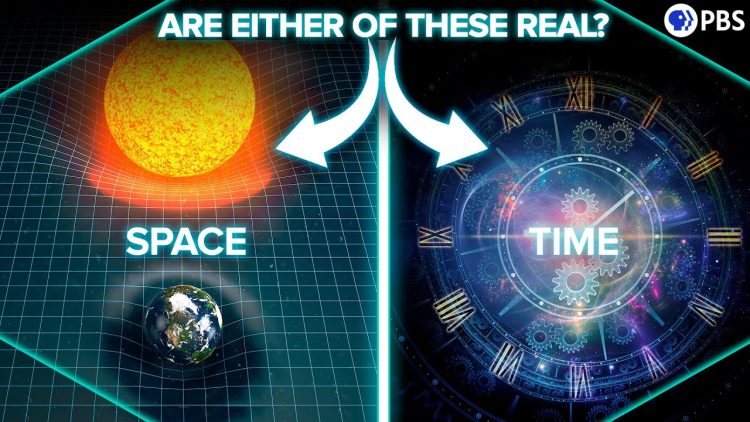
What If Space And Time Are NOT Real?
Physics progresses by breaking our intuitions, but we are now at a point where further progress may require us to do away with the most intuitive and seemingly fundamental concepts of all: space and time. That is the opening of this PBS Space Time episode, hosted by Matt O’Dowd, and it is not a rhetorical flourish.
The problem starts with the two great theories of modern physics, and the fact that they do not agree. General relativity, Einstein’s theory of gravity, describes space and time as a smooth, continuous fabric, a spacetime that bends and warps around mass and energy. Quantum mechanics describes the very small in terms of probabilities and discrete jumps, and it works perfectly in a fixed, flat background of space and time. Put the two together, at the centre of a black hole or at the beginning of the universe, and they contradict each other. The smooth fabric of relativity breaks down at the Planck length, about 1.6 x 10^-35 metres, a scale so small that the very idea of distance stops making sense.
The episode works through the evidence for that proposal, and the strongest of it comes from black holes. In the 1990s, physicists discovered that the amount of information a region of space can contain is not proportional to its volume, as common sense would suggest, but to the area of its boundary. That is the holographic principle, and its sharpest form is the AdS/CFT correspondence, discovered by Juan Maldacena in 1997, which shows that a theory of gravity in a volume of space can be exactly equivalent to a theory without gravity at all, living only on the boundary of that volume. If the volume and its gravity can be fully described by something that lives on a surface, then the volume, and the space inside it, is not fundamental.
The second thread is quantum entanglement. When two particles are entangled, measuring one instantly affects the other, no matter how far apart they are, and physicists have begun to suspect that this strange connection is not a curiosity but the very stuff that space is made of. The ER=EPR conjecture, proposed by Juan Maldacena and Leonard Susskind in 2013, suggests that entangled particles are connected by tiny wormholes, Einstein-Rosen bridges, and that the fabric of spacetime is, in a real sense, woven out of entanglement. The Ryu-Takayanagi formula, which relates the entanglement entropy of a quantum system to the area of a surface in the gravitational theory, gives that idea a precise mathematical form: the geometry of space is a record of how entangled its parts are. Take away the entanglement, and the space itself would fall apart.
What it claims is that those distances and durations are not the bottom layer of reality, but a higher-level description, like temperature, which is real and measurable but is not fundamental: it is what you get when you average over the motion of trillions of molecules. Space and time, on this view, are what you get when you average over the entanglement of trillions of quantum degrees of freedom. The film ends where the physics ends, with an open question: if spacetime emerges, what is it emerging from, and what does a theory of that deeper reality look like?
What the film explores
The first part of the episode sets out the conflict. General relativity needs a smooth spacetime; quantum mechanics needs a fixed background. The film explains why both theories are so successful, and why their disagreement at the Planck scale is not a minor technical problem but a sign that at least one of them is not telling the whole story. The Planck length is introduced not as a small distance but as a limit: below it, the concepts of space and time themselves stop working.
The second part is the holographic principle and AdS/CFT. The film explains the black hole information puzzle, the discovery that a region’s information capacity scales with its surface area rather than its volume, and Maldacena’s 1997 discovery that a gravitational theory in a space can be equivalent to a non-gravitational theory on its boundary. The point is made with care: this is not an analogy. The two descriptions are, as far as physicists can tell, the same physics written in two different languages, and one of those languages has no gravity and no interior space at all.
The third part is entanglement and ER=EPR. The film explains what entanglement is, why Einstein called it spooky action at a distance, and how Maldacena and Susskind’s conjecture turns it into the building material of spacetime. The Ryu-Takayanagi formula is presented as the bridge between the two pictures: the area of a surface in spacetime is a measure of how entangled the quantum system on either side of it is. The episode closes by asking what comes next, and it is honest that nobody knows yet.
Key Themes
- General relativity and quantum mechanics, and why they disagree.
- The Planck length, where space and time stop making sense.
- The holographic principle: information scales with area, not volume.
- AdS/CFT, Maldacena’s 1997 correspondence between gravity and a boundary theory.
- Quantum entanglement as the possible building material of space.
- ER=EPR: entangled particles connected by wormholes.
Production and Background
The episode is from PBS Space Time, the PBS Digital Studios series written and hosted by astrophysicist Matt O’Dowd and produced by Kornhaber Brown, first published in February 2023.
Space Time’s approach is to take one idea from modern physics and work through it carefully, with graphics and plain language rather than equations.
Recommended Companion Viewing
Explore authoritative investigative documentaries on related historical events and investigative subjects.

The Crystal That Could Destroy All Medicine
We're 99.9% Sure This Pattern Is True, But No One Can Prove It
The Science Behind Fire and Explosions
Can Humans Sense Magnetic Fields?
Frequently Asked Questions
What does it mean to say space and time are not real? It does not mean they are illusions. It means they may not be fundamental.
What is the holographic principle? The discovery, from the study of black holes, that the maximum amount of information a region of space can contain is proportional to the area of its boundary, not its volume.
What is AdS/CFT? A correspondence discovered by Juan Maldacena in 1997, showing that a theory of gravity in a particular kind of space is exactly equivalent to a quantum theory without gravity living on the boundary of that space.
What is ER=EPR? A conjecture by Juan Maldacena and Leonard Susskind, published in 2013, proposing that quantum entanglement (EPR) and wormholes (Einstein-Rosen bridges, ER) are the same phenomenon.
Is any of this proven? No. The ideas are supported by mathematics and by their consistency with what is known, but there is no direct experimental test of emergent spacetime yet.
More to watch
- Relativity is so much weirder than we thought…
- I finally saw quantum physics with my own eyes… (It’s spookier than I expected)
- Invisible Forces that Shape Our Reality — How the Universe Works
- What If an Asteroid Hit New York City? | How the Universe Works
- Can Humans Sense Magnetic Fields?
For the theory that started all of this, Relativity is so much weirder than we thought… shows how Einstein’s ideas reshaped physics in the first place.