The Complete History Of The Maya Empire: Secrets Of Mesoamerica’s Supercities
Long before Europe’s great cities, Mesoamerica had supercities: vast urban centres of pyramids, plazas, and temples, built by societies that tracked the stars with extraordinary precision. This documentary tells the complete history of the Maya Empire through those cities — Chichén Itzá, Tikal, and Teotihuacan — tracing their rise, their brilliance, and their eventual decline.
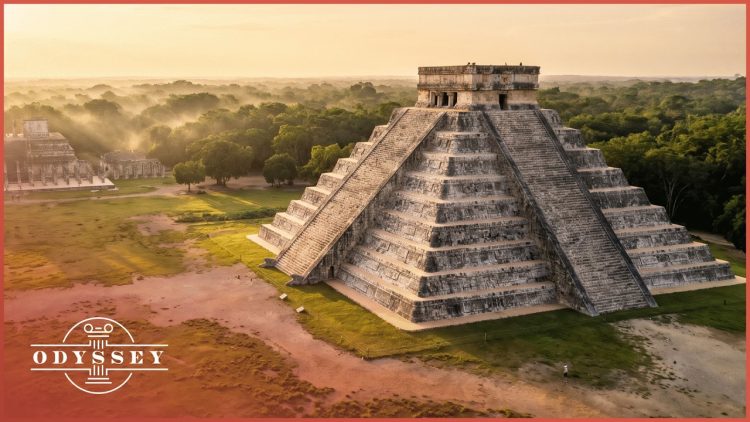
The film begins with the scale of the achievement. The Maya built monumental architecture without the wheel, without iron, and without the draft animals that other civilisations relied on — and yet they raised pyramids that still dominate the landscape, aligned with the movements of the sun and the stars. The documentary explores how that was possible: the organisation of labour, the knowledge of astronomy, and the political and religious systems that could command such effort over generations.
Chichén Itzá, Tikal, and Teotihuacan each get their own treatment, and the film is careful to show how different they were. Teotihuacan, the great city of the highlands, was one of the largest cities in the ancient world. Tikal, in the lowland jungle, was a Maya capital of towering temples and royal tombs. Chichén Itzá, rising later, blended Maya and Toltec traditions into something new. The documentary uses archaeology, architecture, and the interpretation of Maya texts and iconography to reconstruct what these cities were: not only ceremonial centres, but living cities of markets, houses, and ordinary people.
The film also confronts the question that has fascinated historians for a century: why did the great Maya cities decline? It examines the interplay of factors — environmental change, warfare, political fragmentation — without settling for a single cause. The collapse, the film argues, was not a sudden apocalypse but a long unwinding, and the Maya themselves did not disappear: their descendants live in Mesoamerica today, and the documentary treats the story as one of transformation as much as of loss.
What the Film Explores
The documentary explores what made the Maya cities possible and what made them vulnerable. The same things that powered their rise — intensive agriculture, large populations, powerful kings, and an ideology that tied political authority to the cosmos — also created fragility. When the rains failed or the wars multiplied, the systems that had built the pyramids could not adapt fast enough, and the film follows that tension through the evidence.
It also explores the sacred geography of these cities. Cenotes — the subterranean pools of the Yucatán — were not only water sources but sacred places, and the film examines their role in Maya ritual, including the sacrificial offerings found in their depths. Tunnels, tombs, and temples are treated not as curiosities but as evidence of how the Maya understood the world: a world in which the built environment was a map of the cosmos, and in which kings mediated between the human and the divine.
Key Themes & Topics Examined
- The rise and development of major Maya supercities.
- Architectural achievements and their cultural significance.
- The role of astronomical observation in Maya society.
- Military structures and their impact on imperial expansion.
- The factors contributing to the collapse of Maya urban centers.
- Archaeological evidence from Chichén Itzá, Tikal, and Teotihuacan.
- The sacred role of cenotes and subterranean sites in Maya ritual.
- The continuity of Maya culture into the present day.
Archival & Investigative Sources
- Archaeological site investigations.
- Historical and architectural analyses of ancient Mesoamerican structures.
- Interpretations of ancient Maya texts and iconography.
Recommended Companion Viewing
Explore authoritative investigative documentaries on related historical events and investigative subjects.

Facts About The Roman Empire
The Imperial History Behind Beijing’s 600-Year-Old Central Axis
Archeologists Investigate The Only Crucified Hand Ever Found
Frequently Asked Questions
What geographical region does the documentary primarily cover?
The documentary primarily covers Mesoamerica, specifically focusing on areas within Central America where the Maya civilization flourished.
Which specific ancient cities are highlighted in the program?
The program highlights Chichén Itzá, Tikal, and Teotihuacan as key examples of Mesoamerican supercities.
What aspects of Maya civilization are explored?
The documentary explores aspects such as architecture, astronomical practices, societal organization, military structures, and the factors contributing to the civilization’s decline.
Why did the Maya cities decline?
The film examines a combination of factors — environmental change, warfare, and political fragmentation — rather than a single cause, and stresses that Maya culture itself continued.