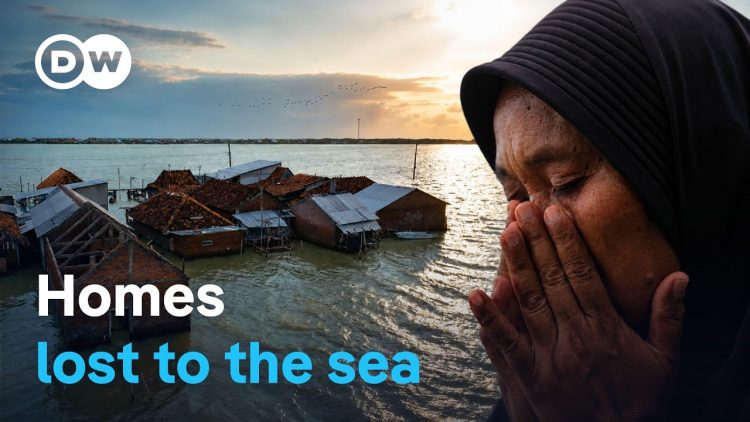
Displaced on Java – A village battling rising sea levels
In 2014, the first flood caught the sleeping residents of the Javanese village off guard. Since then, rising sea tides have kept engulfing the village. The water is still rising — up to 15 centimeters in a year.
So far, the residents of the village of Timbulsloko in Java have been able to keep pace with the rising sea levels by building their homes on higher ground. How long can that go on for? It is the question that hangs over the whole film, and over every decision the villagers make: each time they raise a house, they are buying time, and nobody in the village knows how much time is left.
Where once roads and vast rice fields stood, there is now nothing but water. The ocean has carved deep into the land, washing away everything in its path: homes, gardens, mangrove forests. The landscape the villagers grew up with has not changed gradually — it has been taken, piece by piece, by a sea that arrives a little further inland each year.
For generations, people here lived mainly from rice farming. Now they fish, and are experimenting with aquaculture. At high tide, the water in some homes comes up to your knees. The villagers have moved their beds and built walkways to make it possible for them to stay. It is adaptation in its most literal form: a whole village reorganizing its daily life around water that will not go away.
The ocean is even claiming the cemetery as it moves in on the isolated village, eroding it piece by piece. Residents here are struggling to contain the impacts. How long can they stop the water from disrupting their day-to-day living? At which point will they be forced to leave? The film does not answer those questions — it leaves them with the villagers, who are still living them.
What the Film Explores
The film explores the flood of 2014 first: the night the water caught the sleeping residents of Timbulsloko off guard, and the years since, in which the rising sea tides have kept engulfing the village. The water is still rising — up to 15 centimeters in a year — and the film makes that number feel concrete by showing what it does to a single village, year after year.
A second thread follows the village’s response. So far, the residents have been able to keep pace with the rising sea levels by building their homes on higher ground — but the film keeps returning to the question of how long that can go on for. Raising a house is not a solution to rising seas; it is a way of postponing the day when there is no higher ground left.
A third thread follows the change in how the village makes its living. For generations, people here lived mainly from rice farming. Now the rice fields are under water, and the villagers fish and experiment with aquaculture instead. At high tide, the water in some homes comes up to your knees; beds have been moved, walkways built. The film shows a community that has already changed its entire way of life — and is still not safe.
Running through the film is the cemetery. The ocean is claiming it as it moves in on the isolated village, eroding it piece by piece — a detail that carries the film’s whole argument in a single image. This is not only about houses and fields. It is about a place where people have lived, and buried their dead, for generations, and about the point at which staying becomes impossible. The villagers are struggling to contain the impacts; the film asks, without answering, at which point they will be forced to leave.
Key Themes & Topics Examined
- The flood of 2014 that caught Timbulsloko off guard
- Sea levels rising up to 15 centimeters a year
- Building homes on higher ground — and how long that can last
- Roads and rice fields replaced by water
- From rice farming to fishing and aquaculture
- High-tide water up to your knees inside homes
- Beds moved and walkways built to keep living in the village
- The cemetery being eroded piece by piece by the ocean
Production & Background
The documentary is a DW Documentary production filmed in the village of Timbulsloko in Java, Indonesia. It follows the residents as they adapt to rising sea levels — raising their homes, changing how they earn a living, and living with water that reaches into their houses at high tide.
The film’s structure follows the village’s own story: the flood, the response, the changed livelihood, and finally the cemetery — the place where the cost of staying is measured not in property but in belonging.
Recommended Companion Viewing
Explore authoritative investigative documentaries on related historical events and investigative subjects.

Frequently Asked Questions
What is this documentary about?
It follows the village of Timbulsloko in Java, where rising sea levels have been engulfing homes, fields and even the cemetery since a flood in 2014.
How fast is the sea rising there?
The water is still rising — up to 15 centimeters in a year.
How are residents coping?
So far, they have been able to keep pace by building their homes on higher ground. They have moved their beds and built walkways to make it possible to stay.
What happened to the rice farming?
For generations, people here lived mainly from rice farming. Now the fields are under water, and the villagers fish and experiment with aquaculture instead.
What is happening to the cemetery?
The ocean is claiming the cemetery as it moves in on the isolated village, eroding it piece by piece.