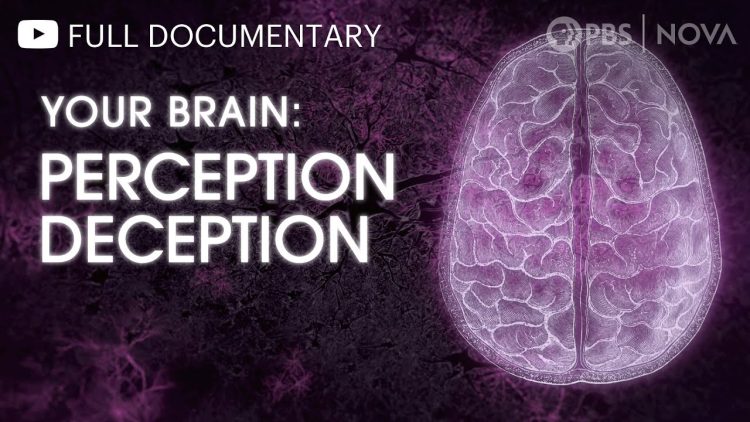
Your Brain: Perception Deception | Full Documentary | NOVA | PBS
Is what you see real? Join neuroscientist Heather Berlin on a quest to understand how your brain shapes your reality, and why you cannot always trust what you perceive. In the first part of this two-part NOVA series, the latest research shows how your brain processes and shapes the world around you, and reveals the surprising tricks and shortcuts it takes to help you survive. The film’s central claim is unsettling: your brain does not show you the world as it is.
The deception starts with vision itself. Your eyes sample only small portions of the world at a time, and you see fine detail in only about one percent of your visual field; the rest is processed in a blur, and your brain fills in the gaps with its best guess. You do not notice the blind spot where the optic nerve leaves the eye, because your brain paints over it. You believe you have a rich, continuous picture of the room around you, but that richness is an illusion: your brain is constructing it, moment by moment, from a thin stream of data and a lifetime of expectations. Optical illusions are not party tricks, the film argues.
The film’s most famous exhibits are two viral arguments. The first is the dress: a photograph posted online in February 2015 that some people saw as white and gold and others as blue and black, although the dress itself was actually blue and black. The disagreement was not about eyesight but about assumptions: your brain has to guess whether the dress is lit by warm or cool light, and it subtracts the colour it thinks the light added. Guess one way and you see blue and black; guess the other and you see white and gold. Berlin herself first saw it as blue and black, then as white and gold. The second is Yanny or Laurel, the audio clip that went viral in May 2018: the same recording sounds like “Yanny” to some listeners and “Laurel” to others, depending on which frequencies your brain picks out. Both cases make the same point, and it is the film’s point too: perception is not a recording.
From there the film moves deeper, into pain, memory and consciousness itself. Pain, it shows, is not a direct measure of damage but a construction of the brain, shaped by context, expectation and attention. Memory is not a recording either: every time you remember something, your brain rebuilds it, and the rebuilding can change it. And consciousness — the sense of being a self, looking out at a world — may itself be another construction, a controlled hallucination that the brain maintains because it is useful for survival. The film ends with a question rather than an answer: if everything you experience is edited, what is left of the real?
What the Film Explores
The film explores the gap between the world and your experience of it.
It also explores why the brain edits at all. The shortcuts are not flaws but adaptations: a brain that waited for complete information before acting would be too slow to survive, so it predicts, fills in and moves on. The blind spot is painted over because noticing it would be a distraction.
Finally, the film explores what the editing means for who you are. If your memories are rebuilt every time you recall them, if your sense of self is a construction, and if your pain depends on context, then the person you take yourself to be is, in part, a story your brain tells. Berlin’s own fascination, which the film returns to again and again, is with where thoughts come from, and the film suggests that finding the answer would be the highest human achievement to date.
Key Themes
- The edited reality: your brain builds your experience from fragments, filling gaps with guesses shaped by expectation.
- One percent vision: you see fine detail in only about one percent of your visual field; the rest is a blur your brain completes.
- The blind spot: the optic nerve leaves a hole in your vision that your brain paints over without telling you.
- The dress: the viral 2015 photograph looked white and gold to some and blue and black to others, though the dress was blue and black.
- Yanny or Laurel: the 2018 audio clip splits listeners by which frequencies their brains pick out of the same recording.
- Pain as construction: pain is not a direct measure of damage but something the brain builds from context and expectation.
Production and Background
The film is a NOVA production from WGBH in Boston, first broadcast by PBS in 2023, and the first hour of a two-part series on the brain. NOVA is American public television’s long-running science documentary strand, and this episode follows its method: a working scientist as guide, clear demonstrations, and conversations with researchers at the front of the field.
The dress and Yanny-or-Laurel episodes have become standard exhibits in the science of perception, and the research they prompted continues: brain scans of people looking at the dress showed that those who saw it as white and gold engaged more interpretive processing than those who saw blue and black.
Recommended Companion Viewing
Explore authoritative investigative documentaries on related historical events and investigative subjects.

Our memory - A phenomenal storage system
Behind the Mask: Real Stories of Neurodivergence
The secret to concentration - How to increase your attention span
Killing time - The science of boredom
Frequently Asked Questions
What colour was the dress really? The dress in the viral 2015 photograph was actually blue and black.
What is Yanny or Laurel? It is an audio clip that went viral in May 2018. The same recording sounds like the word “Yanny” to some listeners and “Laurel” to others, depending on which frequencies their hearing and brain emphasise.
Why do we have a blind spot? The optic nerve leaves the eye through a spot on the retina that has no light-sensitive cells, creating a hole in your vision.
Who is Heather Berlin? Heather Berlin is a neuroscientist and psychologist who hosts this NOVA episode.
More to watch
- Our memory – A phenomenal storage system
- Killing time – The science of boredom
- The secret to concentration – How to increase your attention span
- How Our Brain Judges People in a Split Second
- Behind the Mask: Real Stories of Neurodivergence
If memory is a construction too, Our memory – A phenomenal storage system shows how the brain stores and rebuilds the past.