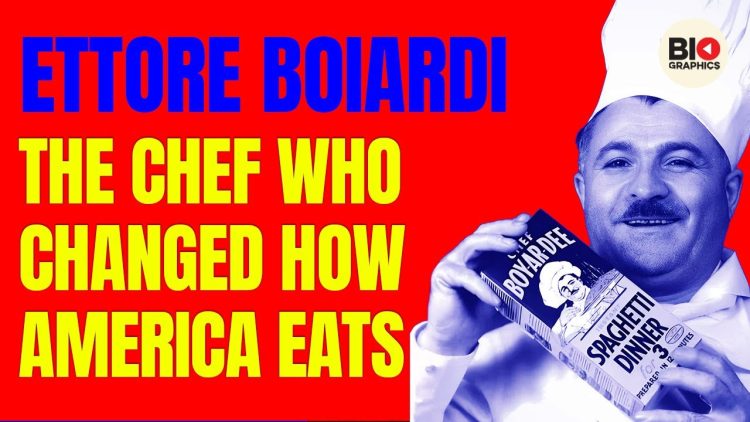
Chef Boyardee: Bringing Italian Cuisine to America
He wears a classic chef’s hat and a red kerchief around his neck, on cans of mini ravioli and beefaroni in supermarkets across America. Most people assume he is a made-up mascot, invented by an advertising department. He was not. Chef Boyardee was a real person — Ettore Boiardi, an Italian immigrant who became one of the most famous chefs in America, and who did more than almost anyone to bring Italian cuisine to the United States. This film is his story.
Boiardi was born in Piacenza, Italy, in 1897, and he was working as an apprentice in a local restaurant by the time he was eleven. He came to the United States as a teenager, through Ellis Island, and found work in the kitchens of New York’s grand hotels — including the Plaza, where he rose to become head chef. By the end of the First World War he was a chef of real standing: he supervised the welcome-home dinner for 2,000 soldiers returning from the war, a meal hosted by President Woodrow Wilson. He was, by the early 1920s, one of the best-known chefs in the country.
The turning point came in Cleveland, Ohio, where Boiardi opened his own Italian restaurant, Il Giardino d’Italia — the Garden of Italy — in the 1920s. His spaghetti dishes were such a hit that customers began asking for take-home portions, and Boiardi began sending them home with meal kits: dry pasta, a jar of sauce, and a small container of Parmesan cheese. The demand was so great that, with the encouragement of a local grocery chain, he began canning. In 1928, he and his brothers Paul and Mario opened the Chef Boiardi Food Company, selling sauces under a phonetic spelling of the family name — Boy-ar-dee — because Americans found Boiardi hard to pronounce. It was one of the first canned Italian food companies in the United States.
The company grew, and then the war came. During the Second World War, Boiardi turned his factory to the war effort, producing rations for American troops overseas and running the plant in Milton, Pennsylvania, around the clock. The factory expanded to thousands of employees, and the government later honoured him with the Gold Star, a civilian award, for his contribution. The film treats the war years as the moment the brand became a national institution: the canned pasta that fed soldiers abroad became, after the war, the canned pasta in American kitchens.
By the end, the film has followed Boiardi from an apprentice in Piacenza to a household name. After the war, he sold the company in 1946 — to American Home Foods, for a sum reported at around six million dollars — because it was the only way to keep the wartime workforce employed. He stayed on as the face of the brand, and he died in 1985, at the age of 87. The chef on the can, the film’s point, is still there — a real person, whose face on a can of ravioli is the most famous thing about a life that began in an Italian kitchen and ended as a piece of American history.
What the Film Explores
The film explores the man first, and it is the documentary’s central revelation: the chef on the can was real. Ettore Boiardi, born in Piacenza in 1897, apprenticed at eleven, an immigrant teenager at Ellis Island, a chef at the Plaza Hotel, and the man who cooked for 2,000 returning soldiers at the end of the First World War. The film treats his biography as the answer to a question most people never think to ask: who is the man on the can?
A second thread follows the restaurant, and the film is at its most charming here. Il Giardino d’Italia in Cleveland, and the customers who would not leave without the recipes — the take-home meal kits, the sauce bottled in recycled milk containers, the demand that turned a restaurant dish into a product. The documentary presents the canning business as an accident of success: Boiardi did not set out to build a food company. His customers made him build one.
A third thread follows the war, and the film treats it as the making of the brand. The Milton factory, running around the clock, the thousands of employees, the rations shipped overseas, the Gold Star — the documentary shows a small food company becoming part of the war effort, and the war effort making it a national name. The canned ravioli that fed soldiers, the film argues, is the reason the brand survived the war and became a fixture of American kitchens.
Running through the film is the question of Italian food in America, and Boiardi’s part in it. Before him, Italian cooking was a restaurant cuisine, eaten out, by people who knew it. His meal kits and canned pastas took it into the home, and into the supermarket, and made spaghetti a dish that any American family could cook. The film’s argument is that Boiardi did not just sell pasta: he introduced a generation of Americans to Italian food.
Key Themes & Topics Examined
- Ettore Boiardi, the real chef behind the can
- Piacenza, 1897, and an apprenticeship at eleven
- Ellis Island, the Plaza Hotel, and the dinner for 2,000 soldiers
- Il Giardino d’Italia, the Cleveland restaurant
- Take-home meal kits, and the sauce in recycled milk containers
- 1928, and the Chef Boiardi Food Company
- The Second World War, the Milton factory, and the Gold Star
- 1946, and the sale that kept the wartime workforce employed
Production & Background
The film is a Biographics production, from the channel’s series of biographies published at least twice a week. Biographics is the sister channel of Geographics, and this episode follows its pattern: a life, told from its beginning, and the question of what the person left behind.
The documentary’s further reading points to the histories of Boiardi’s life: the Food & Wine account of the real Chef Boyardee, the Smithsonian’s story of the Piggly Wiggly, the Tasting Table account of how his canned ravioli kept Second World War soldiers fed, and the Cleveland historical record of the Boiardi family.
Recommended Companion Viewing
Explore authoritative investigative documentaries on related historical events and investigative subjects.

Christopher Reeve: From Superman to Tragedy
Byron Major
Frequently Asked Questions
What is the film about?
Ettore Boiardi, the real chef behind Chef Boyardee — the Italian immigrant whose spaghetti introduced a generation of Americans to Italian food.
Was Chef Boyardee a real person?
Yes. He was Ettore Boiardi, born in Piacenza, Italy, in 1897, who immigrated to the United States as a teenager and became one of the most famous chefs in America.
How did the canned food business start?
Customers at his Cleveland restaurant, Il Giardino d’Italia, kept asking for take-home portions. He began selling meal kits, then, in 1928, began canning sauces and pastas with his brothers under the phonetic spelling Boy-ar-dee.
What did he do in the Second World War?
He turned his Milton, Pennsylvania, factory to producing rations for American troops overseas, running it around the clock, and was later awarded the Gold Star for his contribution.
Who made the film?
Biographics, the biography channel and sister channel of Geographics.