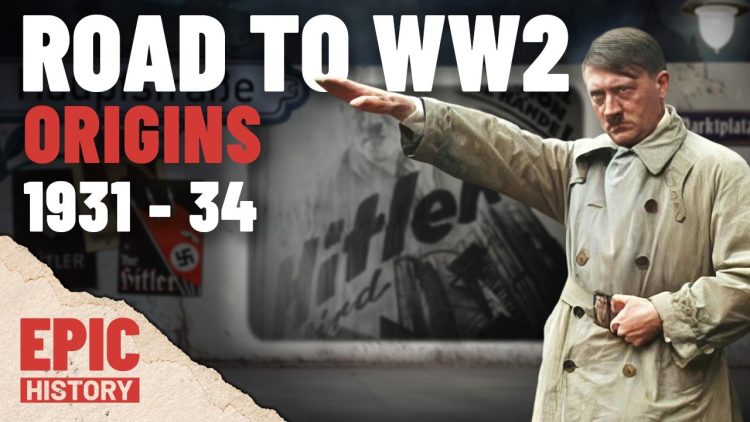
Road to WW2: 1931 – 34
In the aftermath of the First World War, the global order was once again in a state of flux. Young nations like Italy and Japan were searching for prestige through foreign conquests. Germany, which had been hit hardest by the Great Depression and the First World War peace treaty, now looked to Adolf Hitler to rebuild the nation. The victors of 1918 were dealing with their own political and economic crises, and had no appetite for further conflict. But as they failed to stem the tide of nationalism, militarism and foreign aggression across the globe, war was beginning to feel inevitable. This episode of Epic History TV, the first in its Road to WW2 series, tells the story of the years 1931 to 1934, when the road to the Second World War was laid.
The film begins in Manchuria, in the far east of Asia. In September 1931, the Japanese army staged an incident on the South Manchuria Railway and used it as a pretext to invade Manchuria, a vast territory in north-eastern China rich in resources. The League of Nations condemned the invasion, but it had no army and no will to enforce its decision. Japan simply walked out of the League in 1933 and kept the territory, renaming it Manchukuo. The film presents this as the first great failure of the post-war order: an act of aggression that went unpunished, and a lesson other would-be aggressors would remember.
From Asia the film moves to Europe, and to Germany. The Great Depression, which began with the Wall Street crash of 1929, hit Germany harder than almost any other country, wiping out savings, closing factories and throwing millions out of work. The Weimar Republic, already weakened by the humiliation of the Versailles Treaty and by political division, could not cope. In January 1933, Adolf Hitler became Chancellor, and within months he had dismantled German democracy and begun rearming a country the Versailles Treaty had forbidden to rearm. In October 1933, Germany followed Japan out of the League of Nations.
Italy is the third thread of the story. Mussolini’s Fascist regime, in power since 1922, was looking for its own empire, and the film shows how Italy’s ambitions fitted into the same pattern as Japan’s in Asia and Germany’s in Europe. Britain and France were dealing with their own crises, the Depression, political instability, and a public with no appetite for another war, and they chose to look away. The policy that would later be called appeasement was already taking shape, not as a formal doctrine but as a habit of inaction.
By the end of 1934, the film argues, the shape of the coming war was already visible. Japan had shown that aggression paid, Germany had rearmed and left the League, and the international system built after 1918 had been shown to be powerless. The film does not claim that war was inevitable from that moment, but it shows how each failure to act made the next act of aggression easier.
What the Film Explores
The film explores the collapse of the post-war order, and it does so by following three countries at once. Japan, Italy and Germany had different histories, different grievances and different ambitions, but the film shows how they converged on the same answer: expansion. It explains the economic pressures behind that convergence, above all the Great Depression, which discredited the old order in all three countries and gave radical movements their opening.
It also explores the failure of the League of Nations, and the reasons for it. The League had been designed to prevent another great war, but it depended on its members being willing to act, and when Japan invaded Manchuria, the members were not. The film shows how the League’s condemnation, unbacked by sanctions or force, taught aggressors they could act with impunity. The departures of Japan and Germany from the League in 1933 are presented as the moments when that hollowness became undeniable.
A third thread is the mood of the victors. Britain and France had won the First World War, but the victory had cost them dearly, and the film is sympathetic to their reluctance to fight again. It shows a public traumatised by the trenches, governments preoccupied with the Depression, and a genuine belief that the last war had been a mistake that must not be repeated. The film’s argument is not that the democracies were cowardly, but that their desire for peace led them to misread the regimes they were dealing with.
Key Themes
- The invasion of Manchuria in 1931 and the failure of the League of Nations
- Japan’s departure from the League in 1933
- The Great Depression and its devastating impact on Germany
- Hitler’s rise to power in January 1933 and the dismantling of German democracy
- Germany’s rearmament and its departure from the League in October 1933
- Mussolini’s Italy and the search for empire
- The reluctance of Britain and France to confront aggression
- How the failures of 1931-34 made the Second World War more likely
Production and Background
Road to WW2: 1931 – 34 is an episode of Epic History TV, a channel known for animated, map-driven military history. The film runs for about thirty-one minutes and is the opening episode of the channel’s Road to WW2 series, which follows the years leading up to the outbreak of war in 1939. The series’ historical consultant is Professor Richard Overy of the University of Exeter, and the episode draws on his work, including The Inter-War Crisis and Blood and Ruins.
The history it recounts is well established. Japan invaded Manchuria in September 1931 and left the League of Nations in 1933. Hitler became Chancellor of Germany on 30 January 1933, and Germany left the League in October of the same year.
Recommended Companion Viewing
Explore authoritative investigative documentaries on related historical events and investigative subjects.

King Thutmose II's Lost Tomb Discovered
9/11 - The Day That Changed The World
Archaeologists Discover A 7th-Century Lost Anglo-Saxon Palace
Soviet Union: Rise & Fall of the Communist Empire
Frequently Asked Questions
What happened in Manchuria in 1931? The Japanese army staged an incident on the South Manchuria Railway and used it as a pretext to invade Manchuria, in north-eastern China. The League of Nations condemned the invasion but took no effective action, and Japan kept the territory.
Why did the League of Nations fail? It had no army of its own and depended on its members being willing to enforce its decisions. When Japan invaded Manchuria, the members were unwilling to impose sanctions or use force, and the League was shown to be powerless.
When did Hitler come to power? Hitler became Chancellor of Germany on 30 January 1933. Within months he had banned opposition parties, dismantled democratic institutions, and begun rearmament in defiance of the Versailles Treaty.
What was the Great Depression’s role? The Depression, which began in 1929, hit Germany particularly hard, throwing millions out of work and destroying confidence in the Weimar Republic. It created the conditions in which radical movements, above all the Nazis, could win support.
Was the Second World War inevitable by 1934? The film does not say it was inevitable, but it argues that the failures of these years made war much more likely.