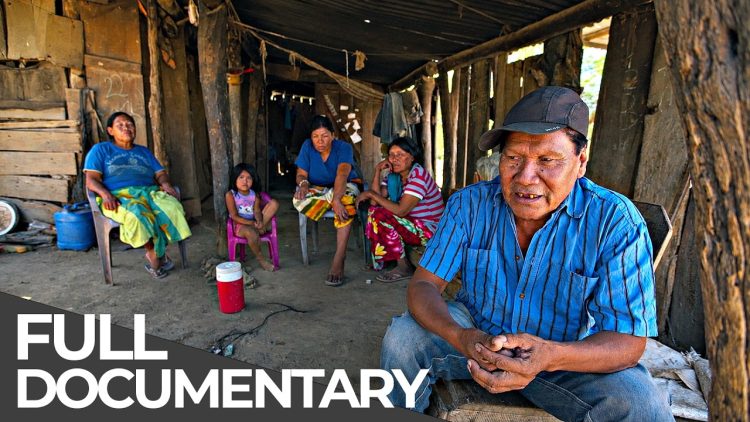
The Ayoreo People | Paraguay: Fighting to Remain Uncontacted
Deep in Paraguay’s remote Chaco forest, some of the last uncontacted Indigenous people in South America live beyond the reach of the modern world. The Ayoreo have depended on this land for generations, hunting, gathering wild fruit and honey, and fishing as they move through the forest. But the forest is disappearing, and with it the world that makes their way of life possible. This documentary follows the communities who have already felt the consequences of contact, and the new generation defending the territory and freedom of relatives who have chosen to remain isolated.
The Ayoreo are an Indigenous people of the Gran Chaco, the vast dry forest of Paraguay, Bolivia and Argentina. They are believed to be the last uncontacted people in South America outside the Amazon, and the groups still in isolation belong to the Ayoreo-Totobiegosode and other Ayoreo local groups in the north of the Paraguayan Chaco. Their nomadic life is sustained by hunting, gathering and small plots cultivated as they pass through in the rainy season, and it depends entirely on a forest large enough to feed them.
That forest is being cleared at a ferocious rate. Cattle ranching drives most deforestation in the Paraguayan Chaco, and the Gran Chaco lost some 5.3 million hectares of forest between 2001 and 2021. The Ayoreo’s ancestral territory once exceeded 1.1 million hectares. In 2001 Paraguay established the Natural and Cultural Patrimony of the Ayoreo Totobiegosode, some 550,000 hectares, and in 2018 the national forestry institute suspended all land-use plans inside it, making any clearing there illegal. Yet satellite images show thousands of hectares cleared inside the protected territory since 2023. A territory protected on paper, and cleared in practice.
The cost of contact is not abstract. The last forced contact came in 2004, when 17 Ayoreo-Totobiegosode were driven from the forest by cattle ranching, and the contacted communities carry the memory of what happened when the outside world arrived: disease against which isolated people have no immunity, the loss of the forest that fed them, and dependence on a society that took their land. The Ayoreo filed a formal land claim in 1993 and still lack title to much of their ancestral territory. In 2005 the Paraguayan Congress voted against expropriating 114,000 hectares, and most of the land used by the uncontacted groups is now in private hands, largely ranchers and investors.
The film’s central question is the one its title asks: do these people have the right to be left alone? The contacted Ayoreo are fighting for relatives they may never meet, people who have shown no desire to abandon life in the forest. Their struggle is carried on in courts, in land claims, and in the forest itself, where a new generation is learning the old knowledge — how to hunt, where the honey is, which plants heal — because that knowledge may be what keeps the uncontacted groups alive.
What the Film Explores
The film explores what voluntary isolation actually means. The uncontacted Ayoreo are not lost or undiscovered; they are people who have chosen, again and again, to stay away from the outside world, and the film treats that choice as a right rather than a mystery. It follows the contacted communities who speak for them, and shows how fragile that arrangement is: a single bulldozer, a single road, a single illness carried into the forest can end an isolation that has lasted for generations.
It also explores the machinery of deforestation, and how a protected area can be cleared anyway. The film traces the chain from the Chaco to the wider world: cattle raised on cleared forest, beef and leather sold into global supply chains, and Earthsight’s 2020 report Grand Theft Chaco, which linked leather from illegal ranches inside the protected territory to the interiors of luxury European cars. That chain makes the Ayoreo’s fight a global story.
The film looks closely at the legal and political struggle, and at how slow it has been. A land claim filed in 1993, a protected area declared in 2001, a suspension of land-use plans in 2018, and still the clearing continues, still the titles are missing. The film does not present the law as a solution that has failed but as a tool that has never been fully used, and it follows the Ayoreo-Totobiegosode’s own organisation, which keeps pressing the claim.
Finally, the film explores what is at stake beyond land. The Ayoreo’s knowledge of the forest — its plants, animals and water — is held by people who live in it, and it disappears when they are forced out. The film shows a younger generation learning that knowledge deliberately, as an act of defence, because if the forest is cleared and the uncontacted groups are driven out, no one will be left who knows how to live in the Chaco.
Key Themes
- The Ayoreo, the last uncontacted people in South America outside the Amazon.
- Voluntary isolation, and the right of Indigenous people to be left alone.
- Deforestation in the Gran Chaco, driven by cattle ranching.
- A protected territory of 550,000 hectares still being cleared.
- The 2004 forced contact, when 17 Ayoreo-Totobiegosode were driven from the forest.
- A land claim filed in 1993, still unresolved.
- The supply chain linking Chaco leather to European cars.
- A new generation defending the forest knowledge of their elders.
Production and Background
The film is a Free Documentary production about the Ayoreo of Paraguay’s Chaco, part of the channel’s strand following Indigenous peoples defending their land against extractive industry. Its account draws on the reporting of Earthsight, Survival International and Mongabay, and on the Iniciativa Amotocodie, which monitors the isolated Ayoreo groups. The film runs a little over 22 minutes, but its subject is one of South America’s longest-running Indigenous land struggles.
The Ayoreo’s fight has gone on for decades: first contacts in 1986, 1998 and 2004, each forced by ranching; the protected area in 2001; the vote against expropriation in 2005; and deforestation documented by satellite imagery into 2026. The film’s power comes from its simplicity: it does not need to exaggerate the threat, because the numbers speak for themselves.
Recommended Companion Viewing
Explore authoritative investigative documentaries on related historical events and investigative subjects.

Why Are Muslims Being Targeted in Myanmar?
Mystery Places: Siberian Mega Mine, Most Dangerous Hotel & Extreme Airport
The Mölln Attacks - Surviving Racist Terror
3,300 Women, Just 20 Guards | Inside the Philippines' Largest Women's Prison
Frequently Asked Questions
Who are the Ayoreo? An Indigenous people of the Gran Chaco in Paraguay and Bolivia. Some Ayoreo groups live in voluntary isolation in the Paraguayan Chaco, the last uncontacted peoples in South America outside the Amazon.
What threatens them? Deforestation for cattle ranching, which destroys the forest they depend on for food, shelter and medicine, and forces unwanted contact, bringing disease.
Is their land protected? In 2001 Paraguay established the Natural and Cultural Patrimony of the Ayoreo Totobiegosode, some 550,000 hectares, and in 2018 all land-use plans inside it were suspended, making clearing illegal. Satellite images nevertheless show continued deforestation inside the territory.
When was the last forced contact? In 2004, when 17 Ayoreo-Totobiegosode were driven from the forest by encroaching cattle ranching. Earlier forced contacts took place in 1986 and 1998.
Why does the film link the Chaco to European cars? Earthsight’s 2020 investigation Grand Theft Chaco traced leather from illegal ranches inside the protected territory to tanneries supplying luxury European vehicles, showing that the demand clearing the forest comes from far away.