
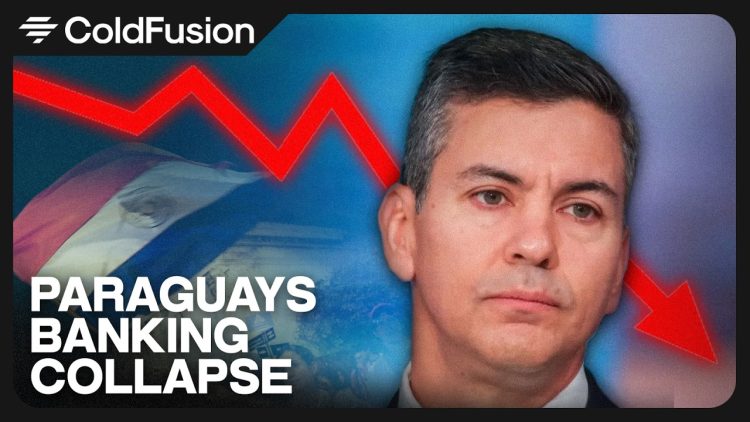
How 3 Million People Got Locked Out of their Bank
Imagine opening your banking app one morning and finding your own money frozen — unreachable, with no explanation and no date for when it might come back. That is what happened to millions of Paraguayans in November 2026, when the country’s fast-growing digital bank, ueno, collapsed. In the early hours of a Tuesday morning, the app stopped working, the cards stopped working, and the branches stayed shut. For a bank with roughly three million customers — around six in ten of Paraguay’s adults — the failure was not a private corporate event. It was a national emergency.
The film follows the collapse from the inside out. Ueno had been a homegrown success story: launched as a fintech in 2021, it became a licensed bank in November 2023 and grew with extraordinary speed, giving many Paraguayans their first ever bank account. Then, in early November 2026, the central bank stepped in. Its board voted to place ueno into resolution after finding it had breached minimum solvency requirements, and from one morning to the next, its customers were locked out.
What makes the story more than a banking failure is what happened next. Within days, the crisis had become the deepest political crisis Paraguay had faced in more than a decade. President Santiago Pena, a close ally of the United States president, tried to resign; instead, he was impeached by the lower house and removed from office by the Senate, then arrested and charged with breach of trust. The central bank’s own governor, Carlos Carvallo — who had previously chaired ueno’s predecessor — resigned, and eight bank executives were taken into custody. The bank and the presidency had grown up together, and they fell together.
At the heart of the scandal, the film shows, was public money. Ueno had grown rapidly during Pena’s presidency, helped by hundreds of millions of dollars in public funds. Paraguay’s Social Security Institute, the state pension and health fund, had around 355 million dollars invested in the bank — roughly nine percent of its whole investment portfolio. Prosecutors alleged the president had let the pension fund deposit money above the legal limit, and that the bank’s owners and its regulator were bound together by ties that should never have existed. After supervisory adjustments, the central bank said, ueno’s solvency ratio had fallen to barely half the legal minimum.
By the end, the film has become a story about what happens when the systems people trust disappear overnight. The central bank moved to pay out savers under the state deposit guarantee, and within days more than a million customers had received money — but many were still waiting. Paraguay’s new president, Pedro Alliana, promised to help those affected. For three million Paraguayans, the answer turned out to be to take to the streets — and to bring down a government.
What the Film Explores
The film explores the collapse first, and it is the documentary’s foundation. The central bank’s decision, taken late on a Monday night and announced in the early hours of Tuesday, froze the accounts of nearly three million people in a country of about six and a half million. The film follows what that meant in practice: wages that could not be withdrawn, traders who could not be paid, pensions that could not be reached. Ueno was not a niche bank for the wealthy, but the bank of ordinary Paraguay, and its failure hit ordinary life first.
A second thread follows the bank’s rise, and the film is interested in how fast it happened. From a fintech launch in 2021 to a licensed bank in 2023, ueno signed up millions of customers and processed millions of transactions a day — a point of national pride. The film’s argument is that the speed of the rise is part of the explanation for the fall.
A third thread follows the politics, and it is the film’s most dramatic material. The president’s business ties to the group behind ueno, the central bank governor’s past as chairman of the bank’s predecessor, the public money, the impeachment, the arrest — the documentary lays out the sequence as it happened, in a matter of days, and treats the political crisis as the direct consequence of the financial one. A bank failure became a constitutional crisis because the bank and the state had become entangled.
Running through the film is the question of who pays. The deposit guarantee fund moved to reimburse savers, and the central bank reported that the equivalent of 160 million dollars had been paid out to nearly 1.2 million savers within days. But the guarantee covers only a limited sum per person, and the pension fund’s losses and the criminal cases are still unfolding. The film’s closing question is whether the system that is supposed to protect savers can cope when the bank that fails is the bank that half the country uses.
Key Themes & Topics Examined
- Ueno, the digital bank that signed up nearly three million Paraguayans
- The central bank’s resolution order, and the morning the accounts froze
- A fintech success story, from 2021 launch to licensed bank in 2023
- President Santiago Pena, and the impeachment that followed the collapse
- Public money: the pension fund’s 355 million dollars in the bank
- The central bank governor, and the ties between regulator and bank
- The deposit guarantee, and the race to pay savers back
- A banking failure that became a constitutional crisis
Production & Background
The film is a ColdFusion production, created by Dagogo Altraide and produced by Tawsif Akkas and Dagogo Altraide. ColdFusion is the channel behind a long series of technology and business documentaries, and this episode follows its pattern — except that here the company is a bank, and the fall took a president with it.
The documentary’s subject is the collapse of ueno bank in Paraguay in November 2026, and the political crisis it caused. Its framing is the one the description gives: what happened when the bank locked millions out, what went wrong, and how it led to the fall of the president.
Recommended Companion Viewing
Explore authoritative investigative documentaries on related historical events and investigative subjects.

Throwing the Best Party
Female Power & Digital Empowerment - Founders Valley
Robots to the Rescue - High-Tech Helpers
SpaceX Went Public - A Disaster Waiting to Happen
Frequently Asked Questions
What is the film about?
The collapse of ueno, Paraguay’s fast-growing digital bank, in November 2026 — and how freezing the savings of nearly three million people brought down President Santiago Pena.
How many people were affected?
Ueno said it had around three million customers, roughly 60 percent of Paraguay’s adults; the central bank put depositors at about 1.8 million.
What happened to the bank?
Paraguay’s central bank placed ueno into resolution after finding it had breached minimum solvency requirements. Its app, cards and transfers stopped working overnight, and its branches closed.
What happened to the president?
Santiago Pena tried to resign, was impeached by the lower house, and was removed from office by the Senate. He was then arrested and charged with breach of trust. His vice president, Pedro Alliana, was sworn in as president.
Did savers get their money back?
The central bank reported that the equivalent of 160 million dollars had been paid out to nearly 1.2 million savers within days under the state deposit guarantee — but many were still waiting.







