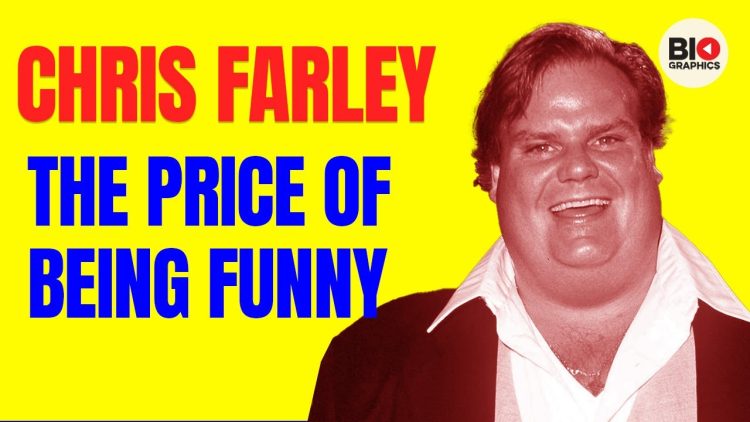
Chris Farley: Anything For The Laugh
Chris Farley would do anything for a laugh. That was his gift, and it was also, in the end, his undoing. This Biographics portrait traces the comedian from his beginnings in Wisconsin to the heights of Saturday Night Live and Hollywood, and to a death at thirty-three that still feels like a waste of a rare talent.
Farley was born in Madison, Wisconsin, in 1964, and grew up in a big, boisterous Irish Catholic family where performing was a way of getting attention. He studied at Marquette University, where he played rugby and discovered a talent for making people laugh, and after graduating he joined Chicago’s Second City, the improv theatre that has trained generations of American comedians. It was there that he learned the craft that would define him: total physical commitment, no hesitation, and a willingness to throw his large body into any joke, no matter how undignified.
Saturday Night Live hired him in 1990, and for five seasons he was one of the show’s most unmistakable presences. His best-known character was Matt Foley, the motivational speaker who lived in a van down by the river — a creation so funny that the cast reportedly struggled not to break character during the live performance. He played the Chippendales dancer opposite Patrick Swayze in one of the show’s most famous sketches, and he was the Lunch Lady, the Gap girl, and a dozen other characters built on the same principle: Farley gave everything, every time, and the audience could feel it.
Hollywood came calling, and Farley made the leap with his SNL colleague David Spade. Tommy Boy, released in 1995, turned his screen persona into a film star’s career, and Black Sheep followed in 1996. The films were not critical darlings, but audiences loved them, and Farley seemed on the verge of a long career. His final film, Beverly Hills Ninja, was released in 1997. Behind the success, though, the pressures were building. The weight, the drinking, the drugs, the schedule — the same appetite for excess that made him funny on stage was consuming him off it.
On 18 December 1997, Chris Farley was found dead in his Chicago apartment. He was thirty-three. The cause, as the New York Times reported, was a drug overdose. His brother Tom later co-wrote the biography “The Chris Farley Show”, drawing on the memories of the family and friends who had watched the rise and the fall. The book’s title is a joke Farley used to make, and it is also an epitaph: his life was a show, and the show demanded everything he had.
What the Film Explores
The film explores what made Farley funny, and why it was inseparable from what destroyed him. His comedy was physical, reckless and completely unguarded. He would fall down stairs, tear his shirt, scream, sweat and throw himself across a stage, and the audience laughed because the commitment was absolute. The film asks what that kind of performance costs, and whether the laughter it earns is worth the price the performer pays for it.
It also explores the world that made him: Second City, Saturday Night Live, and the particular pressure of being the funny fat guy. Farley knew exactly what the audience wanted from him, and he gave it to them, even when it hurt. The film traces how that bargain works — the bigger the laugh, the bigger the fall — and how hard it is to step out of a role that has made you famous. The story of John Belushi, another Second City and SNL star who died young, hangs over Farley’s story, and the film does not shy away from the parallel.
The film looks closely at Farley’s film career, and at the gap between success and happiness. Tommy Boy made him a movie star, but the films that followed did not make him feel secure. He was offered roles, including the voice of Shrek in the animated film that would later make Mike Myers famous, and he recorded dialogue for it before his death. The film treats these near-misses as part of the tragedy: a career that was still rising when it stopped.
Finally, the film explores what remains. Farley’s performances are still quoted, still imitated, still loved. Matt Foley still gets a laugh from people who were not born when the sketch aired. The film’s argument is that Farley’s comedy survives because it was genuine — he was not performing a character so much as turning himself inside out for the audience. That generosity was his genius, and the film suggests it was also what left him with nothing in reserve.
Key Themes
- Chris Farley, born in Madison, Wisconsin, in 1964, and raised in a big performing family.
- Second City in Chicago, where he learned improv and total physical commitment.
- Saturday Night Live, 1990 to 1995, and Matt Foley, the motivational speaker in a van down by the river.
- The Chippendales sketch with Patrick Swayze, one of SNL’s most famous moments.
- Tommy Boy and Black Sheep, the films that made him a movie star with David Spade.
- Beverly Hills Ninja, his final film, released in 1997.
- The parallel with John Belushi, another SNL star who died young.
- His death on 18 December 1997, at thirty-three, from a drug overdose.
Production and Background
The video is a Biographics portrait from 2025, narrated by Eric L. The channel’s primary source is “The Chris Farley Show: A Biography in Three Acts”, written by Farley’s brother Tom Farley Jr. with Tanner Colby, and the film draws on the wider record as well: Britannica, the Second City’s own history, and the New York Times report of 3 January 1998 that laid his death to a drug overdose. It is a short portrait — under twenty-four minutes — but it covers the whole arc, from a Wisconsin childhood to a Chicago apartment, and it does so with the affection of a channel that clearly regards Farley as one of the greats.
Recommended Companion Viewing
Explore authoritative investigative documentaries on related historical events and investigative subjects.

John Wayne: America’s Favorite Cowboy
Jaafar Jackson: Becoming Michael
Bernie Mac: Master of the Macabre
Frequently Asked Questions
Who was Chris Farley? An American comedian and actor, born in Madison, Wisconsin, in 1964. He was a cast member of Saturday Night Live from 1990 to 1995 and starred in the films Tommy Boy and Black Sheep.
What was his most famous character? Matt Foley, the motivational speaker who lived in a van down by the river. The sketch is one of the most quoted in Saturday Night Live history.
What films did he make? Tommy Boy (1995) and Black Sheep (1996), both with David Spade, and Beverly Hills Ninja (1997), his final film.
How did Chris Farley die? He was found dead in his Chicago apartment on 18 December 1997, at the age of thirty-three. His death was laid to a drug overdose.
What is “The Chris Farley Show”? A biography of Farley written by his brother Tom Farley Jr. with Tanner Colby, drawing on the memories of his family and friends. It is the primary source for this Biographics portrait.
More to watch
- John Belushi: From Second City and Saturday Night Live to Tragedy
- Norm MacDonald: The Comedian On The Outside
- JOHNNY CARSON: The King of Late Night TV
- Superpower laughter – How humor makes us strong