
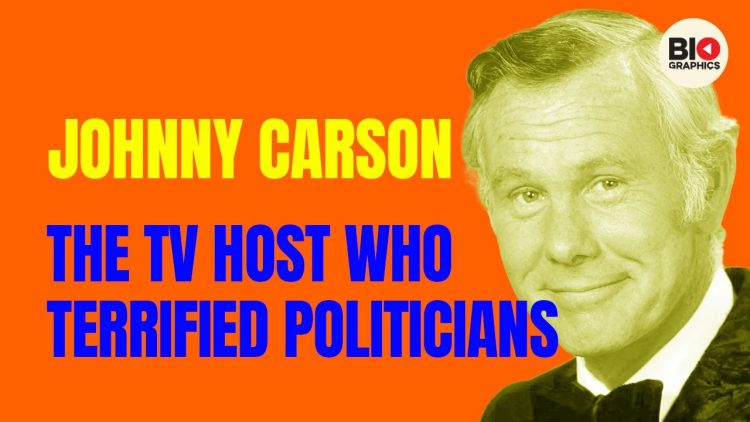
JOHNNY CARSON: The King of Late Night TV
Johnny Carson was the king of late night television. That is not a casual compliment — it is the title of this film, and the argument it makes. For a generation of viewers, late night television was Johnny Carson: the desk, the couch, the monologue, the guests, and the man at the centre of it all. The film traces the career that made him that figure, and it asks what it means to define a form so completely that everyone who comes after you is measured against you.
The film’s subject is a career built on a single idea: that late at night, millions of people wanted to be entertained by a man who seemed to enjoy their company. Carson’s gift, as the documentary presents it, was not a single talent but a combination — the timing of a comedian, the curiosity of an interviewer, and the ease of a host who made the most famous people in the world feel comfortable, and the audience at home feel included. The film follows that gift from its beginnings to the height of its power.
What makes Carson’s story worth telling, the film suggests, is the scale of it. He did not simply host a show. He hosted the show — the one that set the pattern for every late night programme that followed, and the one that made late night a place where careers were made, books were sold, and comedians were discovered. The documentary treats his tenure as an era: a period when one man, five nights a week, was the centre of American popular culture after dark.
The film also looks at the cost of that centrality. To be the king of late night is to live in public, night after night, for decades — and the documentary is interested in what that life does to a person. Carson was famously private off camera, and the film presents that privacy as part of the story: the distance between the man who talked to America every night and the man who, when the cameras stopped, wanted to be left alone. The portrait that emerges is not a simple celebration. It is a study of a man who gave his public life to the audience and kept his private life for himself.
By the end, the film has become a reflection on what late night television was, and what it became. Carson’s era ended, as all eras do, and the form he defined has been remade many times since. But the film’s argument is that the remaking always starts from him — from the desk, the couch, the monologue, and the host who made it all look effortless. The king of late night, the documentary suggests, is not a title that passes to the next person. It is a title that belongs to the man who invented the job.
What the Film Explores
The film explores the rise first: how a comedian became the host of the most important show in late night television, and how the show became the centre of American popular culture after dark. The documentary treats that rise as a story about a form finding its shape — the monologue, the desk, the couch, the guests — and about a host who understood, better than anyone before him, what the form needed.
A second thread follows the power of the show, and the film is at its most interesting here. Late night under Carson was not only entertainment. It was a platform: the place where comedians were discovered, where authors sold books, where actors launched films, and where a single appearance could change a career. The documentary presents that power as the measure of Carson’s standing — he was the king of late night not because he said so, but because everyone in show business acted as if it were true.
A third thread follows the man himself, and the film is careful about the distance between the public Carson and the private one. On camera, he was easy, curious and endlessly watchable. Off camera, he was famously private, and the documentary treats that privacy as part of the portrait rather than a gap in it. The film’s suggestion is that the ease on screen was a performance in the best sense — the work of a man who understood that the audience wanted a host, not a confession.
Running through the film is the question of legacy. Carson’s era ended, and late night has been remade many times since — new hosts, new formats, new platforms. But the documentary argues that every remaking starts from the pattern Carson set. The desk, the couch, the monologue, the guest who becomes a friend for ten minutes: these are Carson’s inventions, or at least his refinements, and they remain the grammar of late night television. The film’s closing argument is that the king of late night is not a job that gets filled. It is a standard that gets measured against.
Key Themes & Topics Examined
- Johnny Carson, the king of late night television
- The desk, the couch, the monologue — the form Carson defined
- A career that made late night the centre of popular culture after dark
- The platform: where comedians were discovered and careers were made
- The power of a single appearance on Carson’s show
- The public host and the famously private man
- The ease on screen as a performance in the best sense
- A legacy every later host is measured against
Production & Background
The film is a Biographics production, from the channel’s series of biographical portraits. Biographics publishes new videos at least twice a week, and its portraits are built around the arc of a life — the rise, the turning points, and the questions that remain.
The documentary is structured as a single portrait: the career of the man who defined late night television, told as the story of a form and the host who made it his own. Its subject is a figure whose standing in American popular culture was, for a generation, beyond argument — and whose influence on the talk show remains visible in every late night programme that followed.
Recommended Companion Viewing
Explore authoritative investigative documentaries on related historical events and investigative subjects.

Byron Major
Jaafar Jackson: Becoming Michael
Surviving Diddy: The Boule Bad Boy Docu-series - The History
Frequently Asked Questions
Who was Johnny Carson?
The king of late night television — the host whose show defined the talk show for a generation, and the man every later late night host is measured against.
What did Carson define?
The form itself: the monologue, the desk, the couch, the guests — the pattern every late night programme since has followed, and the grammar of the genre.
Why was his show so powerful?
Because it was a platform. Comedians were discovered there, authors sold books, actors launched films — a single appearance on Carson’s show could change a career.
What was Carson like off camera?
Famously private. The film presents the distance between the easy, curious host on screen and the private man off camera as part of the portrait.
Who made the film?
Biographics, the channel behind a long series of biographical portraits, published at least twice a week.







