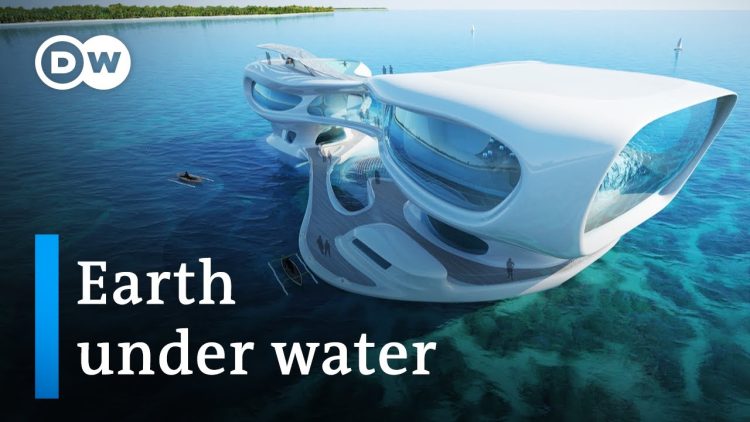
Climate change – living on the water
Sea levels are rising faster and faster, threatening the 700 million people who live on the world’s coasts. Will water become the habitat of the future? Visionary projects for a life with the tides are forging ahead worldwide — and this documentary travels to meet the people who are already building it.
The scale of the threat is hard to take in. Experts forecast that by 2100, sea levels will be two metres higher than they are today. That could force 40 percent of the world’s population out of their homes — in Mumbai, Tokyo, Guangzhou and Bangladesh, and in the United States too, where Miami, New Orleans and New York would also have to be evacuated. Entire city districts would be under water, and climate change would drastically alter our metropolitan areas.
That is why ideas that originated in science fiction have now become reality. Floating and underwater buildings could become places of refuge, and what sounds like a utopia is soon to become reality: the first pioneers are already living in floating neighbourhoods. The film asks whether the South Pacific paradise of Tahiti could also be saved in this way — and what it would mean to live with the tides rather than fighting them.
For now, much of this is still tantalizing luxury. Visionary hotel operators offer rooms with an underwater view, or dinner during which fish and marine life are a feature in floating restaurants. But behind the luxury lies a serious question about how hundreds of millions of people will live when the water comes. Many of these futuristic plans involve water in every part of daily life.
Will we be farming on the sea? Will the SeaOrbiter floating research station designed by Parisian architect Jacques Rougerie get underway soon? Or will we walk through seaports on floating boulevards? The film does not pretend to have the answers, but it shows the pioneers, the architects and the dreamers who are already working on them — and it asks the viewer to imagine a world in which the water is not the enemy, but the address.
What the Film Explores
The film explores the numbers first, and they are stark: 700 million people on the coasts, seas two metres higher by 2100, 40 percent of the world’s population potentially forced from their homes. The list of cities reads like a map of the modern world — Mumbai, Tokyo, Guangzhou, Bangladesh, Miami, New Orleans, New York — and the point is that no coastline, rich or poor, is spared. The threat is not distant or abstract; it is measured in city districts that would disappear under water.
A second thread follows the response: floating and underwater buildings as places of refuge. The film shows the first pioneers already living in floating neighbourhoods, and asks whether places like Tahiti — a South Pacific paradise built on low-lying land — could be saved the same way. What began as science fiction is becoming engineering, and the film treats these projects not as curiosities but as early answers to a question the whole world will have to face.
A third thread looks at the strange double life of the new water world. On one hand there is luxury: hotel rooms with underwater views, floating restaurants where fish and marine life are part of the dinner. On the other there is survival: farming on the sea, floating research stations like the SeaOrbiter designed by Jacques Rougerie, and floating boulevards through seaports. The film holds both together, showing that the same technology can serve the wealthy first — and that the real test will be whether it can serve everyone.
Running through it all is the question in the film’s title: will water become the habitat of the future? The documentary does not answer it with a yes or a no. Instead it shows a world already changing — seas rising faster and faster, cities that will have to be evacuated, and pioneers already living on the water — and leaves the viewer to decide whether the future will be a retreat from the sea or a new way of living with it.
Key Themes & Topics Examined
- 700 million people threatened by rising seas
- Sea levels two metres higher by 2100
- Mumbai, Tokyo, Guangzhou and Bangladesh at risk
- Miami, New Orleans and New York facing evacuation
- Floating neighbourhoods and the first pioneers living on water
- Underwater hotel rooms and floating restaurants
- Farming on the sea
- The SeaOrbiter floating research station by Jacques Rougerie
Production & Background
The documentary is a DW Documentary production that follows visionary projects for living with the tides around the world. Its subjects range from the architects and engineers designing floating buildings to the first pioneers already living in floating neighbourhoods, and its locations span the coasts under threat — from the great cities of Asia and America to the South Pacific paradise of Tahiti.
The film’s structure moves from the threat to the response: first the rising seas and the cities they endanger, then the floating buildings, underwater rooms and research stations that could become places of refuge. The SeaOrbiter, the floating research station designed by Parisian architect Jacques Rougerie, stands as its symbol of a future that is already being built.
Recommended Companion Viewing
Explore authoritative investigative documentaries on related historical events and investigative subjects.

Will renewables stop the climate crisis?
How heatwaves impact our lives
The Global North taken to court - Who pays for the climate catastrophe?
Climate change: Europe's melting glaciers
Frequently Asked Questions
What is this documentary about?
It looks at how rising sea levels threaten 700 million people on the world’s coasts — and at the visionary floating and underwater projects that could become the homes of the future.
How much will sea levels rise?
Experts forecast that by 2100, sea levels will be two metres higher than they are today.
Which cities are at risk?
Mumbai, Tokyo, Guangzhou and Bangladesh, as well as Miami, New Orleans and New York in the United States — entire city districts would be under water.
Are people already living on the water?
Yes — the first pioneers are already living in floating neighbourhoods, and the film asks whether places like Tahiti could be saved the same way.
What is the SeaOrbiter?
A floating research station designed by Parisian architect Jacques Rougerie, which the film presents as part of the future of living with the sea.