
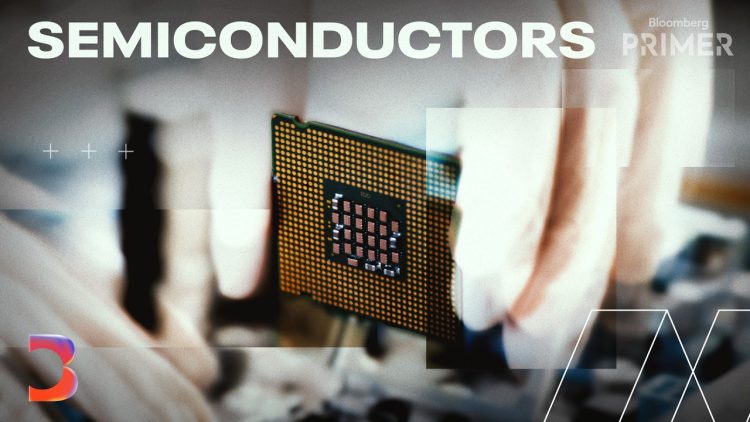
How AI Is Pushing the Semiconductor Supply Chain to the Limit | Bloomberg Primer
Every artificial intelligence system, every smartphone and every modern car runs on semiconductors, and the industry that makes them is on track to become a one-trillion-dollar market. But the supply chain behind those chips is under growing strain. Geopolitical tensions and surging demand for AI computing are forcing companies and governments to rethink how chips are made and where they come from.
The chain starts with a machine that only one company on Earth can build. ASML, based in Veldhoven in the Netherlands, makes the extreme ultraviolet lithography systems that etch the finest circuits onto silicon wafers. EUV light has a wavelength of just 13.5 nanometres, so short that it is absorbed by almost everything, including air. The machines work in a near-perfect vacuum, bouncing light off ultra-precise mirrors made by the German firm Carl Zeiss, and each one costs roughly 150 to 200 million dollars. Without ASML, no one can make the most advanced chips at all, and ASML’s order book is spoken for years in advance.
The designers come next. AMD, the Californian chip designer, makes no chips itself: it designs them and hands the blueprints to a foundry. That split between design and manufacturing is the foundation of the modern chip business, and it was pioneered by TSMC, the Taiwan Semiconductor Manufacturing Company, founded in 1987 by Morris Chang as the world’s first pure-play foundry. Today TSMC manufactures roughly 90 percent of the world’s most advanced chips, the kind that power AI systems, flagship phones and cutting-edge laptops. Its customers include Apple, Nvidia, AMD and Qualcomm.
AI demand is what is stretching the chain to its limit. Training a large AI model takes thousands of the most powerful chips running for months, and the data centres being built to house them need more silicon than the industry has ever produced. At the same time, governments have started treating chips as a matter of national security. The United States passed the CHIPS and Science Act in August 2022, setting aside 52.7 billion dollars to rebuild domestic chipmaking. TSMC is building three fabs in Phoenix, Arizona, in a 65-billion-dollar investment, the largest foreign direct investment in a greenfield project in American history; the first fab has been in volume production on 4-nanometre processes since early 2025, backed by a 6.6-billion-dollar CHIPS award. Texas Instruments, meanwhile, is building two new 300-millimetre fabs in Sherman, Texas, part of an investment of more than 18 billion dollars, with 1.6 billion dollars in CHIPS funding. China, cut off from ASML’s EUV machines by export controls, is pouring money into reshoring its own supply chain, trying to build advanced chips with older tools. The film’s conclusion is blunt: the world has built its future on a supply chain that runs through a handful of companies and one vulnerable island, and everyone involved knows it.
What the Film Explores
The film explores how a single industry became the choke point of the modern world. It shows the chain link by link, and at every link there is a concentration that would look reckless in any other industry: one lithography supplier, one dominant foundry, one island making almost all the advanced chips. The film does not present this as an accident. It is the result of forty years of specialisation, in which each step became so expensive and so technically demanding that only one or two companies could afford to do it well.
It also explores the AI boom as a demand shock. The film argues that AI has changed what the chip industry is for: where chips were once mostly about phones and laptops, they are now about the data centres that train and run AI models, and those data centres consume silicon at a scale the industry was not built for.
Finally, the film explores the geopolitical response: the American bet on reshoring, the Chinese bet on self-sufficiency, and the question of whether either can work. Building a fab in Arizona is not the same as building one in Taiwan, because the supplier networks, the skilled workforce and the decades of institutional knowledge do not move with the construction contract. The film leaves the question open, but it is clear about the stakes: whoever controls the advanced chip supply chain controls the technology of the next decade.
Key Themes
- The trillion-dollar market: the semiconductor industry is heading for a one-trillion-dollar market, driven by AI and everyday electronics.
- ASML’s monopoly: one Dutch company makes the only EUV lithography machines capable of printing the finest circuits, at 150 to 200 million dollars each.
- TSMC’s dominance: founded in 1987, TSMC makes roughly 90 percent of the world’s most advanced chips for customers including Apple, Nvidia and AMD.
- AI demand: training AI models needs thousands of top-end chips, and data centres are consuming silicon at an unprecedented scale.
- America’s reshoring bet: the 2022 CHIPS Act set aside 52.7 billion dollars; TSMC is investing 65 billion dollars in three Arizona fabs.
- Texas Instruments in Sherman: TI is building two new 300-millimetre fabs in Texas, backed by 1.6 billion dollars in CHIPS funding.
Production and Background
The film is a Bloomberg Originals production, part of the Bloomberg Primer series of short, data-led explainers on the forces shaping business and technology.
The chip story has only grown more urgent since the film was made. TSMC’s Arizona investment has since grown further, Texas Instruments has expanded its Sherman plans, and the race between American reshoring and Chinese self-sufficiency has become one of the defining contests of the decade.
Recommended Companion Viewing
Explore authoritative investigative documentaries on related historical events and investigative subjects.

Overworked Underpaid: The Strange Economics of Essential Jobs
Luxury Living and the Ultra-Rich - When Money is No Object
How to Lose $35 Billion Dollars Betting on AI
Former Adviser on Trump’s Economic Worldview
Frequently Asked Questions
Why is TSMC so important? TSMC, the Taiwan Semiconductor Manufacturing Company, is the world’s largest dedicated chip foundry. It manufactures roughly 90 percent of the world’s most advanced chips, including the processors designed by Apple, Nvidia, AMD and Qualcomm, and it makes nearly all of the chips used to train advanced AI models.
What is EUV lithography? Extreme ultraviolet lithography is the process used to print the finest circuits onto silicon wafers. It uses light with a wavelength of just 13.5 nanometres, and the machines that do it are made by only one company, ASML of the Netherlands, at a cost of roughly 150 to 200 million dollars each.
What is the CHIPS Act? The CHIPS and Science Act, signed in August 2022, set aside 52.7 billion dollars in United States federal funding to rebuild domestic semiconductor manufacturing, including 39 billion dollars in manufacturing incentives. TSMC received a 6.6-billion-dollar award for its Arizona fabs.
Why is China trying to reshore chipmaking? Export controls prevent China from buying ASML’s EUV machines, which caps its chip technology at older process nodes. Beijing is investing heavily in building its own supply chain, but matching TSMC’s capabilities with older tools remains a formidable challenge.
More to watch
- How to Lose $35 Billion Dollars Betting on AI
- Why Building AI Data Centres Isn’t Working Anymore
- The RAM Crisis Keeps Getting Worse
- Congo’s blood minerals – The high price of high-tech
- Rise of China
The chip race is inseparable from the rise of China, and Rise of China tells the story of the rival power trying to break the West’s grip on the technology.







