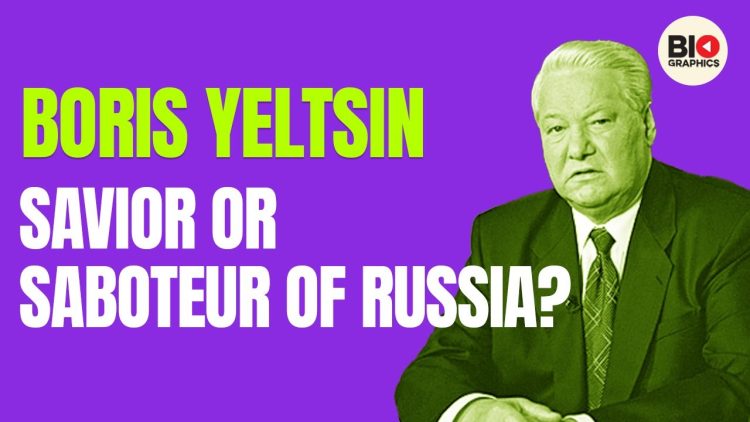
Boris Yeltsin: The First Russian President
Boris Nikolayevich Yeltsin was born on February 1, 1931, in Butka, a small village in the Ural Mountains, into a peasant family that knew hunger. He trained as a construction engineer, joined the Communist Party in 1961, and climbed the party ladder the hard way: party boss of Sverdlovsk from 1976, then, in 1985, brought to Moscow by Mikhail Gorbachev as the city’s party chief. He was a blunt, populist figure in a system built on caution, and that bluntness made him enemies.
Instead, it made him a hero. In 1989 he was elected to the new Soviet parliament by a landslide, and in May 1990 he became chairman of the Russian republic’s Supreme Soviet. A month later Russia declared its sovereignty within the Soviet Union, and Yeltsin quit the Communist Party. On June 12, 1991, he won Russia’s first popular presidential election in a landslide, becoming the first freely elected leader in Russia’s thousand-year history. Two months later came his defining moment: when hard-line communists tried to overthrow Gorbachev in August 1991, sending tanks into the streets of Moscow and placing Gorbachev under house arrest, Yeltsin climbed onto a tank outside the White House, the Russian parliament building, and rallied the resistance.
Yeltsin used the victory to dismantle the system he had served. He banned the Communist Party and seized its property, and in December 1991 he joined the leaders of Ukraine and Belarus in the Belavezha Accords, declaring the Soviet Union extinct. Gorbachev resigned on December 25, 1991, and the Soviet Union officially dissolved six days later. Yeltsin was now president of an independent Russia, and he set out to transform it: shock therapy in January 1992, freeing prices, privatising state industry, and opening the country to trade and travel. The transition was brutal.
The political cost was just as high. In October 1993, after a constitutional crisis in which parliament tried to impeach him, Yeltsin sent tanks against the White House and shelled it into submission, then pushed through a new constitution that vastly expanded presidential power. He sent troops into Chechnya in December 1994, beginning a war that would drag on for years. His popularity collapsed, but in July 1996 he won re-election against the Communist challenger Gennady Zyuganov, in a campaign his critics say was rigged. His health was failing — he had heart surgery in November 1996 — and on December 31, 1999, he stunned the nation by announcing his resignation in a televised New Year’s address, asking the Russian people for forgiveness and handing power to Vladimir Putin, his chosen successor. He died of heart failure in Moscow on April 23, 2007, aged seventy-six.
What the Film Explores
The film explores the paradox at the centre of Yeltsin’s life: the man who destroyed the Soviet Union was a product of it. He rose through the party, learned its methods, and then used them against it — and the film follows that arc carefully, from the peasant’s son in the Urals to the party boss of Sverdlovsk to the populist who resigned from the Politburo and became the champion of democracy.
It also explores the cost of the transition he led. The film does not hide the suffering of the 1990s: the hyperinflation, the looting of state industry, the collapse in living standards, and the war in Chechnya. But it also sets out what Yeltsin achieved: freedom of the press, multiparty elections, private property, open borders, and a Russia that, for all its chaos, was no longer a totalitarian state.
Finally, the film explores the ending. Yeltsin’s resignation on the last day of 1999 was the first voluntary transfer of power in Russian history, and the film presents it as his most democratic act — a leader who had amassed enormous power giving it up, and choosing a successor he believed would continue his work. That the successor was Vladimir Putin, who would recentralise authority and restrict dissent, is the irony the film leaves its audience with: the man who buried the Soviet Union handed power to the man who would bury its freedoms.
Key Themes
- From Butka: Yeltsin was born in 1931 into a peasant family in the Urals and rose through the Communist Party.
- The resignation: in 1987 he became the first person to resign from the Politburo, and it made him a populist hero.
- The tank: in August 1991 he climbed onto a tank outside the White House to defy the coup against Gorbachev.
- The end of the USSR: the Belavezha Accords of December 1991 dissolved the Soviet Union; Gorbachev resigned on December 25.
- Shock therapy: price liberalisation and privatisation in 1992 brought hyperinflation, oligarchs and falling living standards.
- October 1993: Yeltsin shelled the parliament building to end a constitutional crisis, then rewrote the constitution.
- The resignation: on December 31, 1999, he handed power to Vladimir Putin and asked the Russian people for forgiveness.
Production and Background
The film is a Biographics production, from the channel’s long-running series of biographical documentaries.
Yeltsin’s reputation remains contested. In the West he is remembered as the man who stood on the tank; in Russia he is remembered as often for the chaos of the 1990s.
Recommended Companion Viewing
Explore authoritative investigative documentaries on related historical events and investigative subjects.

Frequently Asked Questions
Who was Boris Yeltsin? Boris Yeltsin (1931-2007) was a Russian politician who served as president of Russia from 1991 to 1999. He was the first freely elected leader in Russian history and the man who presided over the dissolution of the Soviet Union.
What did Yeltsin do during the August 1991 coup? When hard-line communists tried to overthrow Mikhail Gorbachev, Yeltsin climbed onto a tank outside the White House in Moscow and rallied the resistance. The coup collapsed after three days, and Yeltsin used the victory to ban the Communist Party and dismantle the Soviet state.
What was shock therapy? It was Yeltsin’s economic programme of 1992: freeing prices, privatising state industry and opening Russia to trade. It brought hyperinflation, wiped out savings, and allowed a small number of oligarchs to acquire most of the national wealth.
When did Yeltsin resign? On December 31, 1999, in a televised New Year’s address, he announced his immediate resignation and handed power to Vladimir Putin, his chosen successor. He died of heart failure in Moscow on April 23, 2007, aged seventy-six.
More to watch
- Soviet Union: Rise & Fall of the Communist Empire
- Soviet War in Afghanistan 1979-1989 (Full Documentary)
- The Untold Story of the Reagan Presidency
- Putin’s fleet – Russian espionage in the Baltic Sea
- North Korea’s alliance with China and Russia
Yeltsin’s story is the end of the story told in Soviet Union: Rise & Fall of the Communist Empire, which traces the state he helped to bury.