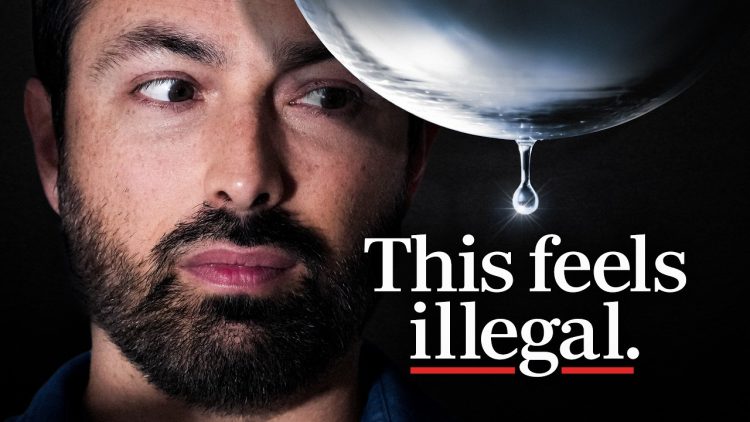
I finally saw quantum physics with my own eyes… (It’s spookier than I expected)
The world’s coldest liquid is far stranger than you would imagine. That is the promise of this film, and it delivers on it in the most direct way possible: by showing quantum physics with your own eyes. The liquid in question is helium, cooled until it becomes something no ordinary liquid can be — a superfluid, a liquid with zero viscosity, that flows without friction, climbs walls, and passes through almost anything. The film’s title is its thesis: quantum physics is spookier than you expected, and you can watch it happen.
The film begins with the impossible liquid itself, and with the race to absolute zero. Helium seemed impossible to liquefy: the lightest of the noble gases, it resisted every attempt to force it into liquid form, and the story of how it was finally liquefied is one of the great adventures in the history of physics. The documentary follows that race — the years of work, the machines built to reach temperatures no one had ever reached, and the moment when the first liquid helium was finally made.
From there, the film moves into the strangeness. Liquid helium, cooled further, becomes a superfluid: a liquid with zero viscosity that flows without any resistance at all. The film shows what that means in practice — the superfluid fountain, powered by light, in which liquid helium climbs out of its container on its own. The explanations, when they came, were quantum: the liquid was behaving not as a collection of atoms, but as a single quantum object.
The film also follows the human story behind the physics, and it is one of the most dramatic in science. Pyotr Kapitsa, who discovered superfluidity, saved Lev Landau from prison — and Landau, in turn, built the theory of superfluidity, explaining it in terms of phonons, the quantum vibrations of the liquid. The documentary treats that story as part of the science: the physics was done by people, under pressure, in difficult times, and the theory that emerged from it is one of the great achievements of twentieth-century physics.
By the end, the film has moved from liquid helium to Bose-Einstein condensates — matter cooled so far that atoms lose their individual identity and behave as one — and to the question of why helium almost never freezes. The takeaway, the film suggests, is that the quantum world is not a distant abstraction. It is something you can see, in a flask of the world’s coldest liquid, doing things no ordinary liquid can do. Quantum physics is spooky, the film argues — and it is also, quite literally, visible.
What the Film Explores
The film explores the race to absolute zero first, and it is a story of obsession. Helium seemed impossible to liquefy, and the documentary follows the years of work that went into proving otherwise — the machines, the setbacks, and the moment the first liquid helium was made. The film’s guide to that history is the work of Heike Kamerlingh Onnes, whose life and work are documented in Dirk van Delft’s book Freezing Physics, and the documentary treats the liquefaction of helium as one of the great technical achievements in the history of science.
A second thread follows superfluidity itself, and the film is at its most vivid here. Zero viscosity means a liquid that flows without friction — and the documentary shows what that looks like: helium climbing the walls of its container, flowing through the narrowest of channels, and forming a fountain powered by light. The film follows the question that superfluidity raised: how can a liquid behave this way? The answer, it shows, is quantum mechanics — the liquid is not a crowd of atoms but a single quantum state, and its behaviour is the behaviour of that state, made visible.
A third thread follows the theory, and the people who built it. Landau’s theory of phonons — the idea that the excitations of the superfluid are quantum vibrations, like sound waves made of particles — is presented as the key that unlocked the mystery. And the film tells the human story behind it: how Kapitsa saved Landau from prison, and how Landau, freed, built the theory that explained what Kapitsa had seen. The documentary presents that partnership as one of the great collaborations in physics.
Running through the film is the question of what quantum physics is for. The documentary moves from superfluids to Bose-Einstein condensates — clouds of atoms cooled until they behave as a single quantum object — and to the question of why helium almost never freezes. The film’s answer is that the quantum world is not separate from ours. It is ours, at the lowest temperatures, where the rules we take for granted stop applying — and where, if you look closely enough, you can see quantum physics with your own eyes.
Key Themes & Topics Examined
- The world’s coldest liquid, and why it is far stranger than you would imagine
- The race to absolute zero, and why helium seemed impossible to liquefy
- The first liquid helium ever made
- Zero viscosity and superfluidity — a liquid that flows without friction
- The superfluid fountain, powered by light
- Bose-Einstein condensates — atoms behaving as one
- How Kapitsa saved Landau from prison, and Landau’s theory of phonons
- Why helium almost never freezes
Production & Background
The film is a Veritasium production, written by Casper Mebius and Derek Muller, produced and directed by Casper Mebius, and presented by Derek Muller and Casper Mebius. It was made with guidance from Prof. Dirk van Delft, an expert on Onnes’ life and work, and Prof. Martin Zwierlein, who helped the team get the specifics of superfluidity and Bose-Einstein condensates right.
The documentary’s experiments were recreated by the team at the Gravity Laboratory and Nottingham University, and its archive material comes from the Rijksmuseum Boerhaave, which showed the team around its archives and Onnes’ original equipment. The film’s chapters run from the impossible liquid and the race to absolute zero through the first liquid helium, superconductivity, superfluidity, Bose-Einstein condensates, and the question of why helium almost never freezes.
Recommended Companion Viewing
Explore authoritative investigative documentaries on related historical events and investigative subjects.

What Happens If You Keep Slowing Down?
The Science Behind Fire and Explosions
Do We Know How Magnets Work Yet?
The Crystal That Could Destroy All Medicine
Frequently Asked Questions
What is the film about?
The world’s coldest liquid — liquid helium — and the quantum physics it reveals: superfluidity, zero viscosity, Bose-Einstein condensates, and why helium almost never freezes.
What is a superfluid?
A liquid with zero viscosity that flows without any friction — it can climb the walls of its container, flow through the narrowest channels, and form a fountain powered by light.
Why did helium seem impossible to liquefy?
That is the film’s opening story: the race to absolute zero, the years of work, and the machines built to reach temperatures no one had ever reached before the first liquid helium was made.
Who were Kapitsa and Landau?
Pyotr Kapitsa discovered superfluidity, and Lev Landau built the theory that explained it in terms of phonons. The film tells how Kapitsa saved Landau from prison — and how Landau then explained what Kapitsa had seen.
What are Bose-Einstein condensates?
Matter cooled so far that atoms lose their individual identity and behave as a single quantum object — one of the strangest states of matter the film explores.