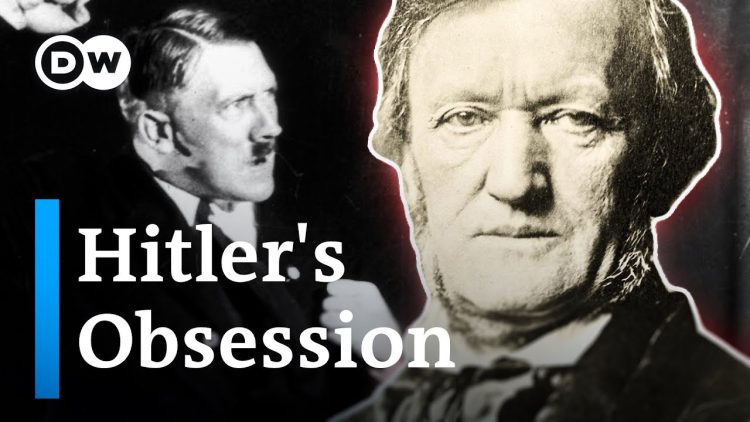
Why Hitler adored Richard Wagner
For years, Hitler was a star guest at the Bayreuth Festival, the consecration site par excellence for Wagner’s operas. The dictator saw himself as a Wagnerian and basically became a part of the Wagner family, which managed the composer’s legacy. He even interfered in the organisation of the festival, helping to decide on the programme and staging. The cult of Richard Wagner, who had died fifty years before Hitler came to power, was politically fuelled by Hitler’s presence, and Wagner’s music, in turn, fuelled Hitler’s delusions of grandeur. This episode of DW’s Arts Unveiled asks how Hitler came to idolise Wagner, and what that idolisation did to the way we hear his music today.
The film’s first answer is the stories. Wagner’s operas are built on Germanic heroic sagas, gods and heroes, curses and redemption, and Hitler, who had loved the operas since his youth in Linz and Vienna, found in them a mythology he could use. The Ring cycle offered a heroic world in which Germany could see itself, and Hitler was able to exploit that imagery for his ideology.
The second answer is personal. Hitler had once dreamed of becoming an artist, and had been rejected by the Academy of Fine Arts in Vienna. Wagner, too, had been an outsider who fought the musical establishment and triumphed through sheer will, and Hitler identified with that story. Wagner became the model of the genius who bends the world to his vision, and Hitler cast himself in the same role. The film treats this identification as one of the keys to the whole relationship: Wagner was not only a composer Hitler admired, but a life Hitler wished he had lived.
The third answer is the darkest. Both men were antisemites, and Wagner gave free rein to his hatred in his infamous pamphlet On Judaism in Music, published in 1850. The film is careful about this: Wagner’s antisemitism does not make his music a Nazi product. But it shows how Hitler used Wagner’s writings as a cultural justification for his own hatred, and how the Wagner family’s embrace of Hitler gave that justification a seal of approval.
The remaining answers are about Bayreuth and the Wagner family. The Bayreuth Festival, founded by Wagner in 1876, was the centre of the Wagner cult, and Hitler’s presence there energised it and tied it to the regime. The Wagners, above all Winifred Wagner, who ran the festival, became a surrogate family for Hitler, who had no family of his own in the ordinary sense. And Wagner’s operas became the soundtrack of dictatorship, played at party rallies and state occasions, most famously the Nuremberg rallies, where the music’s scale and solemnity gave the regime’s ceremonies their emotional force. The final reason is that Wagner encouraged Hitler’s megalomania: the operas told him history was made by great men, and that his own life was part of that story.
What the Film Explores
The film explores the relationship between art and power through one of the most troubling examples in history. It asks what it means when a dictator adopts a great artist, and what it does to the artist’s work. Wagner’s music was not written for the Nazis, and it had been loved for decades before Hitler was born, but the film shows how thoroughly the regime appropriated it, and how that appropriation still shapes the way audiences hear it.
It also explores the Wagner family, and in particular Winifred Wagner, the English-born widow of Wagner’s son Siegfried, who ran Bayreuth through the Nazi years and remained loyal to Hitler’s memory long after the war. The film shows how the festival became a social and political institution of the regime, with Hitler as its patron, and how the family’s choices tied Wagner’s legacy to the Third Reich in a way that took generations to undo.
A third thread is the question of how we deal with Wagner today. The film talks to scholars and musicians about whether the music can be separated from the man, and from the uses made of it, and it does not offer a simple answer. Some argue that the music stands on its own, others that it can never be heard innocently again, and the film lets both positions speak. Its closing point is that Hitler’s appropriation of Wagner is part of the work’s history now, and that any honest engagement with the operas has to reckon with it.
Key Themes
- Hitler’s love of Wagner’s heroic Germanic sagas
- Hitler’s dashed dreams of becoming an artist and his identification with Wagner
- The shared antisemitism and Wagner’s pamphlet On Judaism in Music
- The Bayreuth Festival and Hitler’s role as its patron
- The Wagner family, above all Winifred Wagner, as Hitler’s surrogate family
- Wagner’s operas as the soundtrack of the Nuremberg rallies and the regime
- How Wagner’s music fed Hitler’s delusions of grandeur
- What Hitler’s appropriation means for how we hear Wagner today
Production and Background
Why Hitler adored Richard Wagner is an episode of Arts Unveiled, the culture and history strand of DW History and Culture. The film runs for about twenty-six minutes and is built around interviews with scholars and musicians, archive footage of Bayreuth and the Nuremberg rallies, and excerpts from Wagner’s operas.
The history it recounts is well established. Wagner died in 1883, fifty years before Hitler came to power. Hitler attended performances of Wagner’s operas from his youth, became a regular guest at Bayreuth in the 1920s and 1930s, and was close to Winifred Wagner, who invited him to the festival and supported the regime. Wagner’s music was played at Nazi party rallies, and the Bayreuth Festival operated under the regime’s patronage throughout the Third Reich. After the war, Wagner’s music was not performed in public in Israel for decades, a boycott that only began to break down in the twenty-first century, and the question of how to hear Wagner remains a live one.
Recommended Companion Viewing
Explore authoritative investigative documentaries on related historical events and investigative subjects.

Galloping Gertie: The Turbulent Life and Death of the Tacoma Narrows Bridge
American Revolution 1776: Battles of Brooklyn Heights, Trenton & Princeton
Inside 20 Infamous Events That Changed World History Forever
Retold - History's Forgotten Stories: The Burning Sea
Frequently Asked Questions
Did Wagner support the Nazis? No. Wagner died in 1883, fifty years before Hitler came to power. But his writings, his family and his festival were all embraced by the regime, and his music was used as its soundtrack.
What is On Judaism in Music? An essay Wagner published in 1850, in which he attacked Jewish composers and argued that Jews could not create truly German art. It is one of the most notorious documents in the history of musical antisemitism.
Why was Bayreuth so important? The festival Wagner founded in 1876 was the centre of the Wagner cult, and Hitler’s patronage tied it directly to the Nazi regime. He attended regularly, helped decide the programme, and treated the Wagner family as his own.
Was Wagner’s music banned in Israel? Wagner’s music was not performed in public in Israel for decades after the war. The informal boycott has eased only gradually in recent years.
Can Wagner’s music be separated from Hitler? That is the question the film ends on, and it does not give a simple answer. Scholars and musicians disagree, and the film presents both the case for the music’s independence and the case that its history cannot be set aside.