
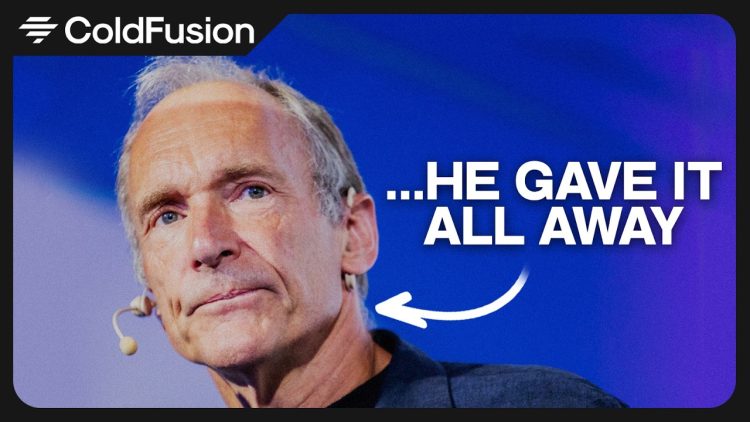
The Man Who Refused to be a Trillionaire
When a person invents something so pivotal that it changes the course of human history, and trillion dollar companies are built on top of their creation, you would probably be shocked to hear that the inventor gave it away for free. That is exactly what Sir Tim Berners-Lee did when he invented the web. This film tells the story of how he invented it, and why he gave it all away — the story of the man who refused to be a trillionaire.
The film starts with the invention itself, and with the scale of what it became. The web is not a product or a company. It is the infrastructure of modern life — the layer on which trillion dollar companies were built, and on which everything we do online depends. The documentary follows the invention to its present scale, and asks the question that makes the story extraordinary: how could something this valuable be given away?
The answer, the film shows, is that Berners-Lee never thought of the web as something to own. He invented it to solve a problem — the problem of sharing information — and he believed that the only way for it to work was for it to be open, free, and available to everyone. The documentary presents that decision not as naivety but as a design choice: the web worked because it was free, and it became universal because no one controlled it. The film’s argument is that the gift was not a sacrifice of the web’s potential. It was the reason for it.
The film also looks at the alternative — the world in which the web had been owned, licensed and charged for. Trillion dollar companies were built on top of the web, and the documentary asks what would have happened if the inventor had taken a share of each of them. The answer it offers is that the web would not have become the web: a licensed, controlled network would have been smaller, slower, and less open, and the companies built on it would have been different companies, or no companies at all. The man who refused to be a trillionaire, the film suggests, made the world richer by refusing to make himself rich.
By the end, the film has become a reflection on what invention is for. Berners-Lee’s story is unusual not only because of what he invented, but because of what he did with it — and the documentary treats that choice as the heart of the story. In a world where inventors are expected to cash in, the man who gave away the most valuable invention in history stands as a reminder that there are other ways to measure what something is worth. The web is free, the film argues, because its inventor believed it should be — and the world we live in is the proof that he was right.
What the Film Explores
The film explores the invention first: how Berners-Lee invented the web, and what problem he was trying to solve. The documentary presents the web as a solution to the problem of sharing information — a way for documents and ideas to link to each other, across machines and across the world — and it follows the invention from that simple idea to the infrastructure of modern life.
A second thread follows the decision to give it away, and the film is at its most interesting here. Berners-Lee could have owned the web, licensed it, and charged for it — and the documentary is clear about what that would have meant: a fortune beyond imagining, a trillionaire’s wealth, built on the most valuable invention in history. The film follows his refusal, and it presents the refusal as a deliberate choice, grounded in a belief that the web could only work if it was open to everyone.
A third thread follows the consequences, and the film treats them as the proof of the decision. Trillion dollar companies were built on top of the web — companies that could not have existed without it, and that exist in their present form because the web was free. The documentary’s argument is that the openness of the web is what made it universal, and that universality is what made it valuable. The gift, in other words, was not a loss. It was the creation of the value itself.
Running through the film is the question of what an inventor owes the world. The documentary presents Berners-Lee as a counterexample to the usual story of invention — the story in which the inventor cashes in, and the invention becomes a company. His story is the opposite: the invention became a commons, and the commons became the foundation of the modern world. The film’s closing argument is that the man who refused to be a trillionaire did not refuse wealth. He refused to put a price on something he believed belonged to everyone.
Key Themes & Topics Examined
- Tim Berners-Lee, and the invention that changed the course of human history
- The web as infrastructure — the layer trillion dollar companies were built on
- The problem the web was invented to solve: sharing information
- The decision to give it away for free, and why
- The alternative: a web that was owned, licensed and charged for
- Openness as a design choice — the web worked because it was free
- The companies built on top of the web, and what they owe to its freedom
- What invention is for — and how to measure what something is worth
Production & Background
The film is a ColdFusion production, created by Dagogo Altraide. ColdFusion is known for long-form explainers that take a familiar technology story and examine it in full, and this episode follows that pattern: a single subject, explored from its invention to its consequences, with the emphasis on the choice at its centre.
The documentary’s structure follows the story itself — the invention, the decision, and the consequences — and its subject is one of the most consequential choices in the history of technology: the choice to give away the web, and the world that choice made.
Recommended Companion Viewing
Explore authoritative investigative documentaries on related historical events and investigative subjects.

AI Keeps Pissing Off Mathematicians
Data, Social Media & Privacy
Amazon, Jeff Bezos and Collecting Data
Artificial Intelligence and Its Ethics
Frequently Asked Questions
Who invented the web?
Sir Tim Berners-Lee. This film tells the story of how he invented it — and why he gave it all away for free.
Why did he give it away?
Because, the film argues, he believed the web could only work if it was open, free and available to everyone. The openness was not a sacrifice of the web’s potential — it was the reason for it.
What would have happened if he had charged for it?
The film’s suggestion is that a licensed, controlled web would have been smaller, slower and less open — and the trillion dollar companies built on top of it would have been different companies, or none at all.
What is the film’s title about?
The man who refused to be a trillionaire: Berners-Lee could have owned the most valuable invention in history, and chose instead to give it to the world.
Who made the film?
ColdFusion, created by Dagogo Altraide — the channel behind long-form explainers that examine familiar technology stories in full.







