
The rise and fall of Germany’s maglev supertrain
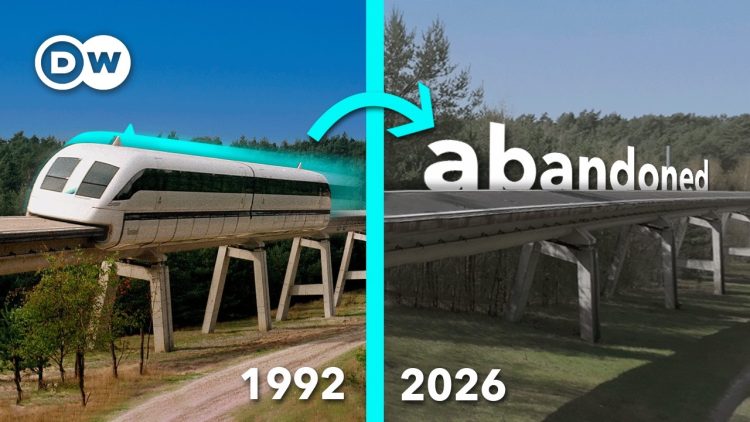
Nestled in the German hinterland sits a test site for a technology that was supposed to change how we move from A to B. The Transrapid, a levitating train, gliding along at speeds of up to 450 kilometres per hour. But today, the tracks — which once saw flocks of visitors hop on a test ride — are abandoned. What happened? That is the question this film asks, and its answer is a story about a brilliant machine, a country that could not decide what to do with it, and a future that arrived somewhere else.
The dream was simple, and it was beautiful. A train with no wheels, floating on magnets, silent and fast — a machine that could cross a country in the time a plane takes to board. The Transrapid was Germany’s answer to the future of travel, and for decades it was the pride of German engineering. The test track in the Emsland region of north-west Germany, near the small town of Lathen, became a place of pilgrimage: visitors came from around the world to ride the train that floated, and to see the future for themselves.
The film follows the machine through its generations, from the early test vehicles to the TR07, the train that proved the technology worked, and on to the TR09, the sleek final version that was meant to carry passengers in regular service. It explains how the train works: magnets that lift the vehicle off its track and pull it forward, with no contact, no friction, and no wheels at all. The engineering is the film’s pleasure — a machine that seems to break the rules of what a train can be.
Then the film turns to why it failed, and the reasons are not technical. They are political, economic, and human. The Transrapid needed new tracks, built from scratch, and new tracks cost billions. It needed a route, and every proposed route — from Hamburg to Berlin, from Munich airport to the city — ran into opposition, cost overruns, and political hesitation. And in 2006, a crash on the test track, in which a test train collided with a maintenance vehicle, killed more than twenty people and shook public confidence in the project. The film’s chapters follow the argument in order: the dream, the TR07, how it works, why it failed, and the question of a comeback.
By the end, the film has become a story about a future that went elsewhere. Germany never built a commercial Transrapid line. China did: the Shanghai maglev, built with Transrapid technology, has carried passengers since 2004, and it remains the world’s only commercial high-speed maglev in regular service. The documentary closes at the abandoned test track, with the TR09 standing as a monument to a technology that worked — and to the country that invented it, and then could not bring itself to build it.
What the Film Explores
The film explores the dream first, and it is the documentary’s foundation. A levitating train, gliding at 450 kilometres per hour, silent, smooth, and clean — the Transrapid was not just a faster train, but a different idea of what travel could be. The film wants the viewer to feel the wonder of it: the test rides, the visitors, the sense that the future had arrived in a field in north-west Germany.
A second thread follows the machine, and the film is at its most technical here. How magnetic levitation works, why a train with no wheels can go so fast, what the TR07 proved and what the TR09 was meant to be — the documentary explains the engineering clearly, and it treats the technology as a genuine achievement. The Transrapid worked. That is the tragedy of the story: the machine did what it was supposed to do.
A third thread follows the failure, and the film takes it step by step. The cost of new tracks, the political fights over routes, the opposition from communities and from the railway industry, the 2006 crash and the confidence it destroyed — each is presented as a blow, and together they explain why a working technology never became a working railway. The film’s argument is that the Transrapid did not fail as a machine. It failed as a project, in a country that could not agree to build it.
Running through the film is the question of a comeback. The Shanghai maglev proves the technology can work in service. New maglev projects are being built elsewhere, and the climate case for fast, electric, low-carbon travel has only grown stronger. The documentary’s closing question is whether Germany’s abandoned dream will stay abandoned — or whether the train that floats will one day come home.
Key Themes & Topics Examined
- The Transrapid, a train with no wheels
- Speeds of up to 450 kilometres per hour, on magnets alone
- The test track in the Emsland, and the visitors who came to ride the future
- The TR07, the train that proved the technology worked
- How magnetic levitation works, and why it is so fast
- Why it failed: cost, politics, and the 2006 crash
- The TR09, the final version that never carried passengers in service
- Shanghai, and the future that arrived somewhere else
Production & Background
The film is a DW Planet A production, reported by Malte Rohwer-Kahlmann, edited by Frederik Willmann. Planet A is DW’s series on the shift toward an environmentally friendly world, and this episode follows its pattern: a technology that promised a cleaner future, and the story of why it never arrived. The production thanks Markus Bauer, chief executive of thyssenkrupp Transrapid International, for a detailed background interview and archive footage.
The documentary’s subject is the Transrapid maglev train, and its rise and fall in Germany. Its framing is the one the description gives: a test site in the German hinterland, a levitating train that once drew flocks of visitors, and the abandoned tracks of today — and the question of what happened in between.
Recommended Companion Viewing
Explore authoritative investigative documentaries on related historical events and investigative subjects.

Will Humans Love AI Robots?
Digital Solutions for Decent Lives - Founders Valley
The RAM Crisis Keeps Getting Worse
Data, Social Media & Privacy
Frequently Asked Questions
What is the film about?
The Transrapid, Germany’s magnetic levitation train — how it worked, why it was abandoned, and where its future went instead.
How fast could the Transrapid go?
Up to 450 kilometres per hour, floating on magnets with no wheels and no contact with the track.
Why was it never built in Germany?
It needed entirely new tracks, which cost billions, and every proposed route ran into political opposition and cost concerns. A fatal crash on the test track in 2006 also shook public confidence.
Does a maglev run anywhere today?
Yes — the Shanghai maglev, built with Transrapid technology, has carried passengers since 2004 and remains the world’s only commercial high-speed maglev in regular service.
Who made the film?
DW Planet A, reported by Malte Rohwer-Kahlmann, edited by Frederik Willmann.







