
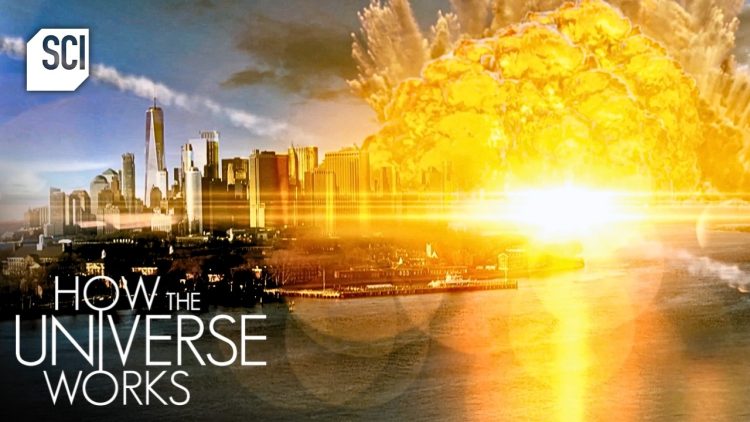
What If an Asteroid Hit New York City? | How the Universe Works
It is the question nobody wants to ask, and the one that has haunted humanity since we first understood what killed the dinosaurs: what if an asteroid hit a city? Not a desert, not an ocean, not a remote stretch of wilderness — a city, full of people, full of buildings, full of everything we have built. This episode of How the Universe Works takes the question literally, and it asks it about the most famous city on Earth. What if an asteroid hit New York City?
The film’s answer begins with the scale of the threat. The asteroids that matter are not the dust and pebbles that burn up in the atmosphere every night. They are the rocks tens of metres across and larger — big enough to survive the fall, big enough to reach the ground, and big enough to destroy a city. The film works through what such an impact would mean: the fireball, the blast wave, the heat, the shaking ground, and the aftermath in a city of eight million people, where the infrastructure of modern life would fail all at once.
The film does not invent its horrors. It grounds them in the events we have actually seen. In February 2013, a rock about twenty metres across exploded over Chelyabinsk, in Russia, fourteen miles above the ground. The blast released energy equivalent to around 440,000 tons of TNT, blew out windows across two hundred square miles, and injured more than sixteen hundred people — mostly from broken glass. A rock that small, over a city that large, would be a catastrophe. And Chelyabinsk was a warning, not an exception: a rock that size is expected to reach Earth roughly once a century, and most of the rocks that could do far worse have not yet been found.
Then the film turns to the deeper history, and it is the history that gives the question its weight. Sixty-six million years ago, an asteroid struck the Earth and ended the age of the dinosaurs. In 1908, a rock exploded over Tunguska, in Siberia, flattening forest across a vast area. The film’s argument is that impacts are not a matter of if, but of when — and that the question is not whether a rock will hit a city, but whether we will see it coming, and whether we will be able to do anything about it.
By the end, the film has become a story about defence. In 2016, NASA set up a Planetary Defense Coordination Office, tasked with finding and tracking the rocks that could threaten Earth. In 2022, its DART mission crashed a spacecraft into an asteroid, Dimorphos, and changed its trajectory — the first time humanity has ever deliberately moved a celestial body. The documentary closes on the question it opened with, but with the terms changed: the danger is real, the warning system is being built, and the difference between a catastrophe and a near miss may come down to how much time we have.
What the Film Explores
The film explores the impact first, and it is the documentary’s central sequence. What would happen, hour by hour and minute by minute, if a rock struck New York City? The fireball in the sky, the blast that flattens buildings, the heat that starts fires, the ground that shakes, the dust and debris that follow — the film works through the physics step by step, and its point is that a city is the worst possible place for an impact to happen, because a city concentrates everything that can be destroyed.
A second thread follows the evidence, and the film is at its most grounded here. Chelyabinsk, Tunguska, the crater that ended the dinosaurs — each is a data point, and together they describe a threat that is real, measurable, and badly understood. The film is interested in the gaps: the rocks we have found, and the far larger number we have not. Of the tens of thousands of near-Earth objects large enough to devastate a city, less than half have been catalogued.
A third thread follows the defence, and the film takes it seriously. Finding the rocks is the first step, and telescopes — including the infrared space telescope NASA is building to hunt them — are the tools. Moving a rock is the second, and DART proved that a spacecraft can change an asteroid’s course. The documentary’s argument is that planetary defence is no longer science fiction. It is an engineering problem, with a deadline we do not know, and the work has only just begun.
Running through the film is the scale of the stakes. A rock the size of a house injured sixteen hundred people in Chelyabinsk. A rock a kilometre across could devastate a country. The film’s closing question is not whether we should worry, but whether we are doing enough — and whether a city as famous as New York would be any safer than a city in Siberia, if the sky fell.
Key Themes & Topics Examined
- New York City, and the worst possible place for an impact
- The physics of an impact: fireball, blast wave, heat and shaking ground
- Chelyabinsk, 2013: a twenty-metre rock, and sixteen hundred injured
- Tunguska, 1908, and the crater that ended the dinosaurs
- The rocks we have found, and the far larger number we have not
- NASA’s Planetary Defense Coordination Office, set up in 2016
- DART, 2022: the first time humanity moved an asteroid
- A threat that is real, measurable, and badly understood
Production & Background
The film is a Science Channel production, an episode of How the Universe Works — the series that, with a cast of experts and eye-popping computer imagery, looks under the celestial hood to tell the story of where we and everything else came from. This episode applies that approach to a single question: what would happen if an asteroid hit New York City?
The documentary’s subject is the asteroid threat, and the hypothetical impact on a great city. Its grounding is the record of real impacts — Chelyabinsk in 2013, Tunguska in 1908, and the impact that ended the age of the dinosaurs — and the real work of planetary defence, from NASA’s tracking programmes to the DART mission of 2022.
Recommended Companion Viewing
Explore authoritative investigative documentaries on related historical events and investigative subjects.

Is Spider Web Really Stronger Than Steel?
Blackholes, Aliens, and the Sun! How the Universe Works
NASA's SpaceX Crew-12 Undocking
NASA's SpaceX Crew-13 Launch
Frequently Asked Questions
What is the film about?
What would happen if an asteroid struck New York City — the physics of the impact, the evidence from real strikes, and what humanity is doing to defend itself.
Has an asteroid ever hit a city?
In February 2013, a rock about twenty metres across exploded over Chelyabinsk, Russia, injuring more than sixteen hundred people and blowing out windows across two hundred square miles.
What killed the dinosaurs?
An asteroid impact, sixty-six million years ago, which ended the age of the dinosaurs — the event that gives the film’s question its weight.
Can we stop an asteroid?
In 2022, NASA’s DART mission crashed a spacecraft into the asteroid Dimorphos and changed its trajectory — the first time humanity has deliberately moved a celestial body.
Who made the film?
The Science Channel, as an episode of How the Universe Works.







