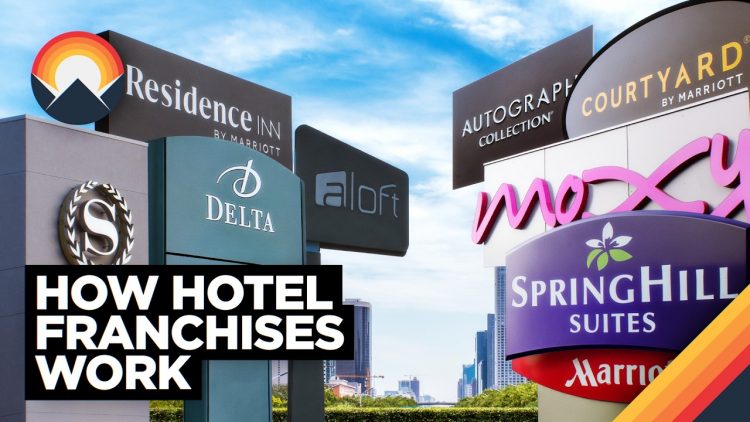
Why There Are So Many Different Hotel Brands
Stand in front of a hotel in a big American city and you will see a name you recognise. Stand in front of the next one and you will see another name you recognise. And the next. And the next. There are hundreds of hotel brands, and most of them belong to a handful of giant companies. Why? That is the question this film asks, and its answer is stranger than you might expect: the hotel industry does not really sell rooms to travellers. It sells brands to hotel owners.
The film opens with a puzzle, in Chicago, at the McCormick Place convention centre. In a single building there, three separate Hilton brands operate under one roof: a Hampton Inn and Suites, a Home2 Suites by Hilton, and a Hilton Garden Inn. Three hotels, three names, three lobbies, one building. It is not a mistake. In lucrative markets, the film shows, it is common — and it is the key to understanding the whole industry. The brands look like competitors. They are not. They are products, sold by the same company, to different customers.
The history explains how it happened. Marriott began with mid-range, full-service hotels, and then created separate brands — Courtyard, Residence Inn — to serve different kinds of guests without diluting its core name. Hilton did the same, building a portfolio of more than twenty brands. Then the big companies began buying each other: Marriott acquired Sheraton and Westin, gaining their loyalty programmes and market segments. By now, the largest groups each control dozens of brands — Hilton with more than twenty, Marriott with around thirty, Hyatt and Accor with more still.
The business model is the film’s central discovery. The great hotel companies, by and large, do not own the hotels that carry their names. They franchise them. An owner pays a fee to put a brand on a building, and in return must follow strict design standards — down to the requirements for pools, rooms and artwork, set out in brand design guides hundreds of pages long. The hotel company’s revenue comes from fees on the hotel’s revenue, and from its loyalty programme — which means its real customer is not the traveller in the room, but the owner of the building.
By the end, the film has turned a confusing landscape into a clear picture. The brands exist because they let one company serve every kind of traveller — the business guest, the family on holiday, the long-stay visitor, the luxury traveller — while sharing the infrastructure behind them: the kitchens, the meeting rooms, the reservation systems, the loyalty programmes. And every new brand is another chance to sign another property, and to collect another fee.
What the Film Explores
The film explores the puzzle first, and it is the documentary’s opening image: three Hilton brands in one building in Chicago. The Hampton Inn and Suites, the Home2 Suites, the Hilton Garden Inn — three names, one roof, one owner, one set of shared kitchens and meeting rooms. The film’s point is that the puzzle is the answer. If three brands can share a building, then the brands are not really about the buildings. They are about the customers — and about the owners who pay to use them.
A second thread follows the segmentation, and the film is at its most practical here. Travellers do not all want the same thing. A business traveller wants a desk and a quick breakfast. A family wants space and a pool. A long-stay guest wants a kitchen. A luxury traveller wants service and style. The brands are the industry’s way of serving each of them separately, with different prices and expectations — without asking any single brand to be everything to everyone. The differences between neighbouring brands can be small, but they are deliberate: each one is aimed at a different wallet and a different trip.
A third thread follows the money, and it is the film’s most important material. The franchise model, the asset-light strategy, the loyalty programmes that keep travellers inside one company’s ecosystem — the documentary lays out how the economics work, and why they push toward more brands rather than fewer. A company’s revenue comes from signing properties and collecting fees, so its incentive is to have a brand for every kind of building and owner. The traveller’s choice is real, the film argues — but it is a choice the industry designed.
Running through the film is the loyalty programme — the quiet engine of the whole system. Programmes like Marriott Bonvoy and Hilton Honors, with hundreds of millions of members between them, give travellers a reason to stay inside one company’s family of brands. The more brands a company has, the more reasons a member has to stay. The brands are not really competing with each other, the film argues. They are competing, together, to keep you.
Key Themes & Topics Examined
- Three Hilton brands, in a single building in Chicago
- Marriott, Hilton, Hyatt and Accor, and their dozens of brands
- Segmentation: a different brand for every kind of traveller
- The franchise model, and who really owns the hotel
- Strict brand standards, down to the artwork on the wall
- The asset-light strategy: selling names, not buildings
- Loyalty programmes, and the reason to stay inside one family
- The real customer: the hotel owner, not the guest
Production & Background
The film is a Wendover Productions production, written by Sam Denby, edited by Alexander Williard, with animation by Kate Rusher, Max Moser and Mikaila Blackburn. Wendover is the channel behind a long series of explainers on the hidden systems of the modern world, and this episode follows its pattern: a question that looks simple, and a business model underneath it that explains far more than the question asked.
The documentary’s subject is the proliferation of hotel brands, and the business logic behind it. Its framing is the one the film itself gives: why one building in Chicago holds three Hilton brands, and why the industry’s real customer is the person who owns the building, not the person sleeping in it.
Recommended Companion Viewing
Explore authoritative investigative documentaries on related historical events and investigative subjects.

Inside Hong Kong's Deepest Media Crackdown
Mystery Places: Siberian Mega Mine, Most Dangerous Hotel & Extreme Airport
Bill Gates' Daughter is in Trouble
Between Capitol Hill and Black Broadway - Washington, D.C.'s hidden worlds
Frequently Asked Questions
What is the film about?
Why there are hundreds of hotel brands, most of them owned by a handful of giant companies — and why the industry’s real customer is the hotel owner, not the traveller.
How can one building hold three Hilton brands?
In Chicago, at McCormick Place, a single building houses a Hampton Inn and Suites, a Home2 Suites by Hilton and a Hilton Garden Inn — three brands, one roof, sharing kitchens and meeting space.
Do hotel companies own their hotels?
Mostly not. The big groups franchise their brands: an owner pays a fee to use the name and must follow strict design standards, while the company collects fees and loyalty programme revenue.
Why do companies keep creating new brands?
Each new brand is another way to serve a different kind of traveller and another chance to sign another property. The largest groups each control dozens of brands, and the count keeps rising.
Who made the film?
Wendover Productions, written by Sam Denby, edited by Alexander Williard.