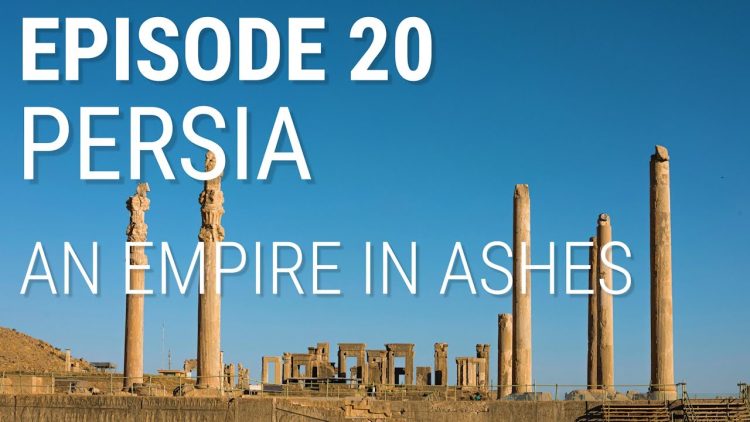
20. Persia – An Empire in Ashes
In the highlands of the Iranian Plateau, a collection of enormous pillars reaches up to the sky. They are all that remains of Persepolis, the ceremonial capital of the Achaemenid Persian Empire — the first empire in history to rule the known world.
The story begins in the ashes. In the centuries before Persia, the great powers of the Bronze Age had collapsed, and the Iranian Plateau was a patchwork of peoples: the Medes, the early Iranians, and the nomads of the steppe. From among them rose Cyrus, a prince of the small kingdom of Anshan, who in 550 BC conquered the Medes, in 546 BC defeated Croesus of Lydia — the richest king of his age, who had consulted the Oracle at Delphi before marching to war — and in 539 BC took Babylon, the greatest city on earth, almost without a fight.
Cyrus died in battle around 530 BC, and his son Cambyses conquered Egypt in 525 BC before dying on the road home. After a crisis of succession — an imposter king, a rebellion, and a year of civil war — Darius took the throne in 522 BC and built the empire into a machine. He divided it into satrapies, provinces run by royal governors; he built the Royal Road, a highway that carried messages from Sardis to Susa in days; he dug a canal from the Nile to the Red Sea; and he raised Persepolis, a city of columns and staircases carved with the peoples of the empire bringing tribute.
Then came the nemesis. In 490 BC the Persians landed at Marathon and were defeated by the Athenians; in 480 BC Xerxes returned with a vast army, won at Thermopylae, and lost at sea at Salamis; in 479 BC the Greeks won again at Plataea. The film follows the long aftermath — the war of the brothers, Xenophon and the Ten Thousand, the rise of Philip of Macedon — and then the end: Alexander the Great, who crossed into Asia in 334 BC, won at the Persian Gates, and in 330 BC burned Persepolis to the ground. The Achaemenid Empire was over, and its palaces stood in ashes for two thousand years, until a traveller named A. V. Williams Jackson walked among the pillars and began to read their story again.
What the Film Explores
The film explores how an empire is built from nothing. Persia did not inherit a great state: it built one, in a single generation, from a small kingdom on the edge of the known world.
It also explores the people behind the empire, through the sources that survive: Herodotus, the Greek historian who is both our best witness and our least reliable one; the legends of Cyrus’s upbringing and the feast of Astyages; the court records and the inscriptions in Old Persian that the film has read aloud in the original language.
Finally, the film explores why empires fall. Persia’s end was not a single battle but a slow unravelling: a century of revolt and civil war after the Greek victories, a court that grew distant from its provinces, and then Alexander, a conqueror who understood the empire well enough to destroy it. The film’s closing image is Persepolis in ruins, and its closing voice is Aeschylus, the Athenian playwright who wrote a tragedy about the Persian defeat — a reminder that the empire’s story was told, in the end, by the people it had tried to conquer.
Key Themes
- From the ashes: Persia rose from the ruins of the Bronze Age collapse to become the most powerful society on earth.
- Cyrus the Great: in a single generation he conquered Media, Lydia and Babylon, and built an empire on tolerance as well as force.
- Darius the organiser: the Royal Road, the satrapies and the palace at Persepolis turned conquest into a state.
- The Greek wars: Marathon in 490 BC, Thermopylae and Salamis in 480 BC, and Plataea in 479 BC checked the empire’s westward expansion.
- Life in the empire: its gods and gardens, its burial practices, and the Zoroastrian faith of its kings.
- Alexander: in 330 BC he burned Persepolis, and the Achaemenid Empire fell.
- What survives: the pillars of Persepolis, the Cyrus Cylinder, and the history written by its enemies.
Production and Background
The film is an episode of Fall of Civilizations, the documentary series by historian and author Paul Cooper, and at five and a half hours it is one of the longest episodes in the series.
The Achaemenid Empire ruled more people than any state before it — some forty million, nearly half the world’s population at the time — and its legacy runs through everything that followed: the roads and satrapies that Alexander copied, the tolerance that became a model for later empires, and the ruins of Persepolis, which still stand in the Iranian highlands as the most eloquent monument to an empire in ashes.
Recommended Companion Viewing
Explore authoritative investigative documentaries on related historical events and investigative subjects.

The First Crusade
U-Boat Wargamers: The Mastermind
Why Botswana Got So Wealthy
Brandenburg Gate: Enduring Symbol of Berlin
Frequently Asked Questions
When did the Persian Empire exist? The Achaemenid Empire was founded by Cyrus the Great around 550 BC, when he conquered the Medes, and it lasted until 330 BC, when Alexander the Great burned Persepolis. At its height it ruled from India to Greece.
Who was Cyrus the Great? Cyrus was the founder of the Achaemenid Empire. In a single generation he conquered Media (550 BC), Lydia (546 BC) and Babylon (539 BC), and he is remembered for a policy of tolerance towards conquered peoples, recorded on the Cyrus Cylinder.
What was Persepolis? Persepolis was the ceremonial capital of the Achaemenid Empire, built by Darius the Great and his successors in the highlands of the Iranian Plateau. Its great halls and staircases were carved with the peoples of the empire bringing tribute, and it was burned by Alexander in 330 BC.
What happened at Marathon, Thermopylae and Salamis? In 490 BC the Athenians defeated a Persian invasion at Marathon. In 480 BC Xerxes invaded Greece, won at Thermopylae, and lost his fleet at Salamis; in 479 BC the Greeks won again at Plataea. The defeats checked Persia’s expansion into Europe.
More to watch
- Facts About The Roman Empire
- The Complete History Of The Maya Empire: Secrets Of Mesoamerica’s Supercities
- The Complete History Of The Vikings: The Deadliest Warriors Of The Ancient World
- How Ancient Greece Shaped The Buddha’s First Image
- Archaeologists Investigate New Discoveries About The Roman Cavalry
Persia’s great rival and successor was Rome, and Facts About The Roman Empire shows how the next empire learned from the one Alexander destroyed.