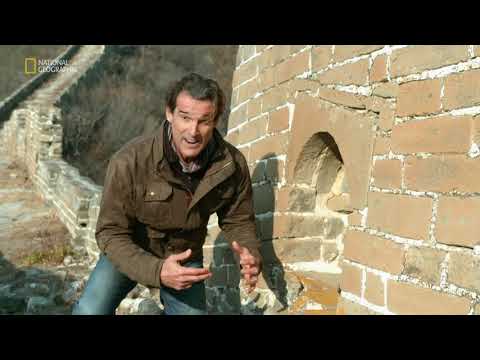
Secrets Of The Great Wall | Ancient China From Above | National Geographic
The Great Wall of China is the largest building project in human history: a system of walls, trenches and fortresses that stretches 21,196 kilometres across northern China, built over more than two thousand years. But the wall itself is only the beginning of the story.
The team’s method is the film’s first revelation. From orbit, the Great Wall is not a single line but a branching network, and satellite images reveal the things the eye cannot see from the ground: buried foundations, the outlines of lost cities, and the routes of the roads and canals that supplied the wall’s garrisons. On the ground, the archaeologists follow those images to palaces and tombs, to incredible megastructures, and to entire long-lost cities that have been hidden for centuries.
The journey takes in the myths of Xanadu, the summer capital built by Kublai Khan, the Mongol ruler who founded the Yuan dynasty, in the thirteenth century. Xanadu — Shangdu, in Chinese — was a city of palaces and hunting parks on the edge of the steppe, a place where the Mongol court lived in tents beside Chinese halls, and its ruins still hold the evidence of how two civilisations met and mixed.
What emerges is a different picture of the Great Wall itself. The popular image is of a single wall built to keep out invaders, but the archaeology shows something more complicated: a system that was as much about controlling trade and movement as about defence, built and rebuilt by many dynasties, and above all by the Ming, who ruled from 1368 to 1644 and constructed most of the brick-and-stone wall that visitors see today. The wall was a statement of power as much as a fortification, and the cities and tombs behind it tell the story of the empire it protected.
What the Film Explores
The film explores how archaeology has changed. A generation ago, finding a lost city meant luck and a shovel; now it starts with a satellite. Maca’s team uses orbital images to read the landscape the way a detective reads a crime scene, spotting the faint lines of buried walls and the shadows of vanished buildings, then confirming them on the ground.
It also explores the meeting of worlds along the wall. The Great Wall was never simply a border between China and the steppe: it was a zone where Chinese farmers, Mongol herders, traders and soldiers lived side by side, and where empires were made and unmade.
Finally, the film explores why these discoveries matter now. Chinese archaeologists are excavating at a pace never seen before, and their finds are rewriting the textbooks: the wall is longer than anyone thought, the cities behind it are older, and the story of ancient China is more connected to the rest of the world than the old histories allowed. The film’s closing argument is that the Great Wall is not a monument to isolation but to ambition, and that the secrets it still holds are worth the climb.
Key Themes
- 21,196 kilometres: the Great Wall system is the largest building project in human history, built over more than two thousand years.
- Archaeology from space: satellite images guide the team to buried foundations, lost cities and forgotten tombs.
- Allan Maca’s team: archaeologists follow the orbital evidence on the ground, from survey to excavation.
- Xanadu: Kublai Khan’s thirteenth-century summer capital, where Mongol and Chinese worlds met.
- The Ming wall: the Ming dynasty (1368-1644) built most of the brick-and-stone wall visitors see today.
- Rewriting history: new excavations are changing what historians thought they knew about ancient China.
Production and Background
The film is a National Geographic production, part of the broadcaster’s Ancient China From Above series, which uses aerial and satellite imagery to re-examine China’s ancient sites.
The Great Wall was inscribed on UNESCO’s World Heritage List in 1987, and the official survey completed in 2012 measured the full system — all its branches, trenches and natural barriers — at 21,196 kilometres.
Recommended Companion Viewing
Explore authoritative investigative documentaries on related historical events and investigative subjects.

Retold - History's Forgotten Stories: The Deadly Force of Nature
Was Operation Barbarossa Doomed to Fail?
Why Chernobyl still isn't over: 40 years after the worst nuclear disaster ever
Boeing Wonderland: How Engineers & SFX People Built Fake Towns During WWII
Frequently Asked Questions
How long is the Great Wall of China? The full system of walls, trenches and natural barriers measures 21,196 kilometres, according to the official Chinese survey completed in 2012. It was built and rebuilt over more than two thousand years by successive dynasties.
Who built most of the wall we see today? The Ming dynasty, which ruled China from 1368 to 1644, built most of the brick-and-stone wall that visitors walk on today. Earlier walls were largely built of rammed earth.
What was Xanadu? Xanadu, or Shangdu, was the summer capital built by Kublai Khan, the Mongol ruler who founded China’s Yuan dynasty, in the thirteenth century. It was a city of palaces and hunting parks where Mongol and Chinese cultures met.
How do archaeologists find lost cities? Increasingly, they start from space: satellite images reveal buried foundations, the outlines of walls and the routes of ancient roads, which archaeologists then confirm by excavation on the ground.
More to watch
- Rise of China
- Mao’s China: Against the World
- China’s plan to never run out of food
- The Imperial History Behind Beijing’s 600-Year-Old Central Axis
- The Complete History Of The Maya Empire: Secrets Of Mesoamerica’s Supercities
The wall protected an empire whose capital still carries its history in stone: The Imperial History Behind Beijing’s 600-Year-Old Central Axis traces the heart of that empire.