
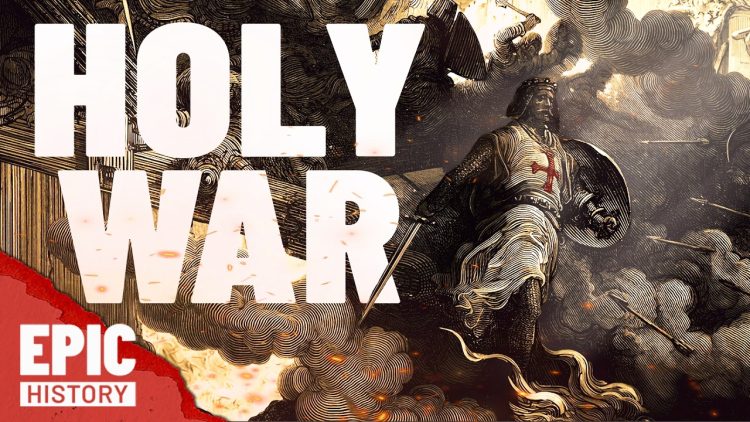
The First Crusade
The First Crusade was one of the most extraordinary, bloody and significant episodes in medieval history. It began with an appeal for aid from the Christian Byzantine Empire, threatened by the rising power of the Muslim Seljuk Turks. But when Pope Urban II preached his sermon at the Council of Clermont on 27 November 1095, the result was unlike anything the world had ever seen. Hundreds of thousands answered the call — lords, knights, peasants and priests — driven by religious fervour, the promise of salvation, and the dream of liberating the most sacred city on earth: Jerusalem.
The appeal came from the Byzantine emperor Alexios I Komnenos, who had sent ambassadors to the Council of Piacenza in March 1095 asking for military help against the Seljuk Turks, who had defeated the Byzantines at Manzikert in 1071 and taken Antioch in 1085 and Nicaea in 1092. Urban’s sermon turned a request for mercenaries into an armed pilgrimage, and the response was immediate and overwhelming. The first to move were the poor: in the spring of 1096 some 30,000 people set off in what became known as the People’s Crusade, led by the preacher Peter the Hermit, and on the way through Germany they carried out the Rhineland massacres of Jewish communities.
The main army, the Princes’ Crusade, set out from the agreed departure date of 15 August 1096: four contingents of 30,000 to 100,000 people, led by Raymond IV of Toulouse with the papal legate Adhemar of Le Puy, Godfrey of Bouillon of Lower Lorraine with his brother Baldwin of Boulogne, Bohemond of Taranto with his nephew Tancred, and the northern French and Flemish forces under Robert Curthose of Normandy and Robert II of Flanders. They gathered at Constantinople between November 1096 and April 1097, crossed into Anatolia, and took Nicaea in June 1097, then beat Kilij Arslan at Dorylaeum on 1 July. In March 1098 Baldwin seized Edessa and founded the first Crusader state.
Jerusalem was the goal, and the end was as brutal as the journey. The crusaders arrived on 7 June 1099 and besieged the city, then held by a Fatimid governor, until Genoese craftsmen arrived with supplies and siege towers. On 15 July 1099 they breached the walls and, over the next two days, massacred many of the city’s Muslim and Jewish inhabitants. Godfrey of Bouillon became its ruler in all but name, and on 12 August 1099 the crusaders beat a Fatimid army at Ascalon. Four Crusader states were created in the Middle East — Edessa, Antioch, Tripoli and the Kingdom of Jerusalem — and their defence would draw further expeditions from Europe for another two centuries. The film’s closing point is that the army that achieved the impossible did so more than once on the brink of annihilation, and that the victory was bought with a massacre that still shapes how the Crusades are remembered.
What the Film Explores
The film explores how a speech became an army. Urban II’s sermon at Clermont promised spiritual reward — the remission of sins — to those who took up the cross, and it spoke to a Europe in which pilgrimage, penance and warfare were already tangled together.
It also explores the geography of the campaign, which is what made it so hard.
Finally, the film explores the aftermath. The First Crusade succeeded where later crusades failed, and the film asks why: the Muslim world was divided between Seljuk Turks, Danishmendids and the Fatimid Caliphate of Egypt, the crusaders were desperate enough to keep going when a sane army would have turned back, and at Antioch and Jerusalem they were lucky as well as brave. But the success created a problem that would last two centuries: four Christian states in the middle of the Muslim world, surrounded, outnumbered and dependent on reinforcements from Europe that came only in waves.
Key Themes
- The call at Clermont: on 27 November 1095 Pope Urban II turned a Byzantine request for soldiers into an armed pilgrimage to Jerusalem, promising remission of sins.
- The People’s Crusade: some 30,000 poor pilgrims set out in spring 1096, carried out the Rhineland massacres, and were destroyed at Civetot in October 1096.
- The princes: Godfrey of Bouillon, Raymond of Toulouse, Bohemond of Taranto and Robert Curthose led the main army, 60,000 to 100,000 strong, from August 1096.
- Nicaea and Dorylaeum: the first victories of 1097, taking the Seljuk capital in Anatolia and beating Kilij Arslan in the open field.
- Antioch: an eight-month siege, a betrayal that opened the gates on 3 June 1098, and a desperate breakout that defeated Kerbogha on 28 June.
- Jerusalem: besieged from 7 June 1099 and stormed on 15 July, the city fell amid a massacre of its Muslim and Jewish inhabitants.
Production and Background
The film is by Epic History TV, the channel known for its animated military histories, and this version is fully remastered with all-new animation. Epic History’s style is its strength here: the campaign’s geography — the march across Anatolia, the sieges, the distances — is hard to follow in words alone, and the animation makes the army’s route and the shape of each battle visible.
The First Crusade was the first of the Crusades, the series of religious wars launched by the papacy between 1095 and 1291 for the recovery and defence of the Holy Land. Its success was never repeated: the Second Crusade failed, the Third retook little, and the Fourth ended by sacking Constantinople, the very city the First had set out to help. Godfrey of Bouillon died in 1100, a year after taking Jerusalem, and was succeeded by his brother Baldwin as the first King of Jerusalem. The states the crusaders founded lasted, in the case of Jerusalem, until 1187, and in the case of the last of them, Acre, until 1291.
Recommended Companion Viewing
Explore authoritative investigative documentaries on related historical events and investigative subjects.

The Real Story Of Henry VIII: Inside The Mind Of A Tudor Tyrant
Archaeologists Re-examine Artifacts From Post-Roman Britain
King Canute: The Ruthless Viking Conqueror Who Became King Of England
The Vikings: The Truth Behind the Legend
Frequently Asked Questions
What started the First Crusade? The Byzantine emperor Alexios I Komnenos asked Pope Urban II for military help against the Seljuk Turks in 1095.
How long did the First Crusade last? From the departure of the main armies in August 1096 to the Battle of Ascalon on 12 August 1099 — three years of marching, sieging and fighting across Anatolia and the Levant.
When was Jerusalem captured? The crusaders arrived on 7 June 1099 and stormed the city on 15 July 1099, after Genoese craftsmen arrived with supplies and siege towers.
What were the Crusader states? The four Christian-ruled territories created by the First Crusade: the County of Edessa (1098), the Principality of Antioch (1098), the County of Tripoli, and the Kingdom of Jerusalem (1099).
More to watch
- What Historians Get Wrong About The Knights Templar In America
- Dan Snow Tests 1,000 Years Of Deadly Medieval Weapons
- How Did Viking Raiders Turn Into Europe’s Greatest Medieval Rulers?
- Inside A Perfectly-Preserved 15th-Century Medieval Manor House
- Facts About The Roman Empire
The crusading orders outlived the Crusades themselves, and What Historians Get Wrong About The Knights Templar In America separates the Templars’ real history from the myths.







