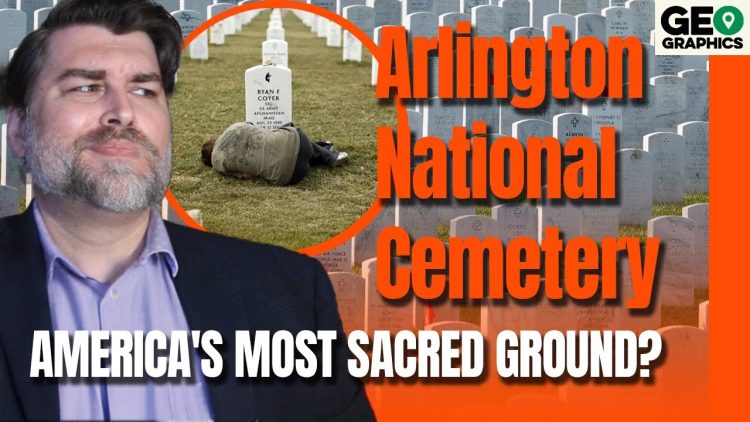
Arlington National Cemetery: America’s Hallowed Ground
There is a hill across the Potomac River from Washington, D.C., and on it sits the most hallowed ground in America. Arlington National Cemetery is the final resting place of more than 400,000 veterans and their eligible family members, spread across 639 acres of rolling ground. This film is the story of how that ground became what it is — and of the house, the family and the war that made it.
The story begins before the cemetery, with a house. Arlington Estate was established by George Washington Parke Custis, the step-grandson of George Washington, as a living memorial to the first president. Custis built a mansion on the ridge — Arlington House — and filled it with gardens and memorabilia honouring the nation’s founding. His daughter Mary married a young army officer named Robert E. Lee, and the family lived at Arlington House together. It was a home, and a memorial, and one of the most beautiful properties in the country.
Then came the Civil War, and the house became a fortress. When Virginia seceded in 1861, Lee resigned his commission to fight for the Confederacy, and his family fled south. On the morning of 24 May 1861, the United States Army seized the estate, because its high ground offered protection for Washington, D.C. — not, as is sometimes claimed, to punish the Custis-Lee family. Three forts were built on the property, and part of the estate became a settlement for freed and escaped enslaved people. The house that had been a memorial to George Washington was now a military position.
The cemetery itself was born of the war’s carnage. As wartime fatalities mounted and the military cemeteries around Washington ran out of space, the army’s Quartermaster General, Montgomery Meigs, ordered part of the property to be used as a cemetery. On 13 May 1864, the first military burial was conducted, for Private William Christman. On 15 June 1864, Arlington officially became a national cemetery, on 200 acres of the estate. The ground that had been a family’s home was now a burial ground for the soldiers of the war that had taken it.
By the end, the film has followed the cemetery from its beginning to its present scale: from 200 acres to 639, from a single burial to more than 400,000. The Tomb of the Unknown Soldier, dedicated on 11 November 1921, holds the unidentified dead of the First World War, with Unknowns from the Second World War and the Korean War added in 1958. Two presidents are buried here — William Howard Taft, in 1930, and John F. Kennedy, whose eternal flame burns on the hillside. Arlington, the film’s title says, is America’s hallowed ground. Its history is the story of how a house became a fortress, and a fortress became a cemetery, and a cemetery became the place where the nation buries its dead.
What the Film Explores
The film explores the estate first, and it is the documentary’s foundation. Arlington House, built by George Washington Parke Custis as a memorial to his step-grandfather, was a home before it was anything else — a mansion on a ridge, filled with the memory of the nation’s founding, and the home of the Custis-Lee family. The film treats the house as the key to the cemetery: everything that happened at Arlington happened because of where the house stood, and whose it was.
A second thread follows the seizure, and the film is at its most careful here. The army took the estate on 24 May 1861 because its high ground protected Washington, not to punish the family — a distinction the cemetery’s own history makes plain. The documentary follows what the army did with the property: the forts, the settlement for freed people, and then the decision, as the dead mounted, to use the ground for burials. The first burial, of Private William Christman on 13 May 1864, is presented as the moment the estate became a cemetery in fact, a month before it became one in law.
A third thread follows the growth, and the film takes it in stages. The original 200 acres grew to 639. The Tomb of the Unknown Soldier was dedicated in 1921, and the Unknowns of later wars were added to it. The cemetery became the resting place of presidents and generals, and of hundreds of thousands of ordinary soldiers.
Running through the film is the legal aftermath — the story the history books remember almost as well as the cemetery itself. After the war, the Lees’ eldest son sued, and in 1882 the Supreme Court ruled that the government had taken the land illegally. Rather than disturb the graves, he accepted payment, and the cemetery stayed. The film’s point is that Arlington’s history is not a simple one: it is a story of a house, a war, a seizure, a lawsuit and a burial ground, all on the same hill.
Key Themes & Topics Examined
- Arlington House, and the Custis estate on the ridge
- George Washington Parke Custis, and his memorial to the first president
- Robert E. Lee, and the family that lived at Arlington House
- The seizure of 24 May 1861, and the high ground over Washington
- The first military burial, Private William Christman, 13 May 1864
- The cemetery’s founding, 15 June 1864, on 200 acres
- The Tomb of the Unknown Soldier, dedicated 11 November 1921
- Two presidents, Taft and Kennedy, and more than 400,000 veterans
Production & Background
The film is a Geographics production, from the channel’s series of place-based history documentaries. Geographics publishes new videos twice a week, and its films follow a single place or story through its history — in this case, a hill across the Potomac, and the cemetery on it.
The documentary’s further reading points to On Hallowed Ground: The Story of Arlington National Cemetery by Robert M. Poole, published by Bloomsbury in 2009. Its history follows the account of the cemetery itself: the Custis estate, the seizure of 1861, the first burial of 1864, and the Tomb of the Unknown Soldier of 1921.
Recommended Companion Viewing
Explore authoritative investigative documentaries on related historical events and investigative subjects.

Homo Sapiens: How Humans Conquered the Planet
What Historians Get Wrong About The Knights Templar In America
9/11 The First Hours Minute By Minute
Death Marches: The Third Reich's Final Crime
Frequently Asked Questions
What is the film about?
Arlington National Cemetery, across the Potomac from Washington, D.C. — how a family’s estate became America’s most hallowed ground, and the final resting place of more than 400,000 veterans.
How did Arlington become a cemetery?
During the Civil War, the army seized the Custis estate for its high ground. As military cemeteries ran out of space, Quartermaster General Montgomery Meigs ordered part of the property used for burials; the first was Private William Christman, on 13 May 1864.
What is the Tomb of the Unknown Soldier?
A large white sarcophagus on the Memorial Amphitheater’s east plaza, dedicated on 11 November 1921 with the burial of the Unknown from the First World War. Unknowns from the Second World War and the Korean War were added in 1958.
Which presidents are buried at Arlington?
Two: William Howard Taft, buried in 1930, and John F. Kennedy, whose eternal flame burns on the hillside.
Who made the film?
Geographics, the history channel behind a series of place-based documentaries, published twice a week.