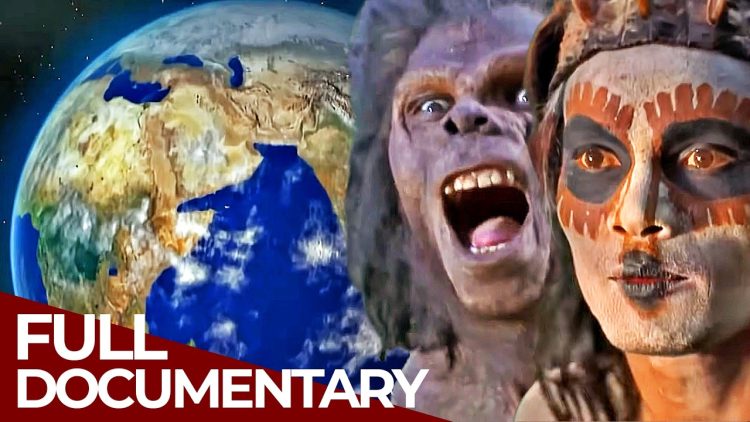
Homo Sapiens: How Humans Conquered the Planet
Homo Sapiens relates the extraordinary development of our species during the last one hundred and fifty thousand years before our time, and this film from Free Documentary – History tells that story on the grandest possible scale. It begins with a world shared by several kinds of humans, and it ends with a world in which only one kind remains: us. Little by little, Homo sapiens replaced all the other hominids, from Homo erectus to the Neanderthals, tamed animals, explored the earth, and moved into every territory of the planet.
The film’s opening chapters take place in Africa, where our species first appeared. Fossil evidence now places the earliest known Homo sapiens in Africa roughly 300,000 years ago, and for most of our history we lived there as one population among others, hunting, gathering and making stone tools. The film follows the slow spread of our ancestors out of Africa, a movement that took tens of thousands of years and many false starts, until humans reached every continent except Antarctica.
Along the way, our ancestors met other human species. The Neanderthals lived in Europe and western Asia, stocky and strong, adapted to the cold, making tools and burying their dead. The Denisovans lived in Asia. Homo erectus had spread across Africa and Asia long before us. The film shows how Homo sapiens gradually replaced them all, a process that took tens of thousands of years and whose details are still debated. We now know from ancient DNA that our ancestors interbred with Neanderthals and Denisovans, so that most people alive today carry a small percentage of Neanderthal ancestry, a legacy of those encounters written into our genes.
What made the difference, the film argues, was the human brain. Homo sapiens became a remarkable thinker, and that thinking changed everything. Humans established and delimited their space, invented property, the family, territorial defence, conjugal life, work and agriculture. The taming of animals and the domestication of plants, which began roughly ten thousand years ago, allowed populations to grow far beyond what hunting and gathering could support, and settled farming villages grew into towns, cities and eventually civilisations.
By the end, the film presents this as the story of a dazzling ascension: our history. From small bands of hunter-gatherers in Africa to a species that has settled every habitable environment on Earth, from deserts to the Arctic, from mountain valleys to island chains reached by boat, the conquest of the planet by Homo sapiens is presented as the central story of our species, and the film tells it as an epic, with the full sweep of deep time behind it.
What the Film Explores
The film explores the long competition between human species. For most of human history, the world held several kinds of humans at once, and the film asks what allowed one of them to prevail. Part of the answer it offers is adaptability: Homo sapiens could live in more environments, eat a wider range of foods, and cooperate in larger groups than its rivals. Part of it is technology, from better stone tools to the spear-thrower and the bow, and later to boats that could cross open sea. And part of it, the film suggests, is social: the ability to share knowledge, to tell stories, and to organise in groups larger than a family.
It also explores the inventions that remade human life. Agriculture is the great turning point in the film’s account, because it allowed humans to produce more food than they needed to survive, and that surplus supported specialists, craftsmen, priests and rulers. The domestication of animals provided meat, milk, wool and transport, and later horses and oxen transformed warfare and trade. The film treats these as the foundations of everything that followed, from the first cities to the modern world.
A third thread is the question of what was lost. The other human species are gone, and the film does not pretend their disappearance was gentle. Whether they were outcompeted, absorbed through interbreeding, or in some cases killed, the result was the same: a world with one human species in it. The film presents that as both a triumph and a narrowing of the human story, and it leaves the viewer with the sense that our dominance of the planet is a recent and extraordinary thing, not an inevitability.
Key Themes
- The emergence of Homo sapiens in Africa
- The other human species: Neanderthals, Denisovans and Homo erectus
- The slow spread of humans out of Africa and across the planet
- Interbreeding and the Neanderthal legacy in modern DNA
- The human brain and the power of cooperation and shared knowledge
- The domestication of animals and the invention of agriculture
- Property, family, territory and the first settled societies
- How one species came to inhabit every corner of the Earth
Production and Background
Homo Sapiens: How Humans Conquered the Planet is presented by Free Documentary – History, a channel that publishes full-length history documentaries on YouTube. The film runs for one hour and thirty-two minutes and is built from reconstructions, animations, location footage and expert commentary, following the story from the deep past to the first farming societies.
The science behind the film has moved quickly in recent years. The discovery of early Homo sapiens fossils at Jebel Irhoud in Morocco, dated to around 300,000 years ago, pushed back the origin of our species far earlier than the 200,000 years once assumed. Ancient DNA has revealed interbreeding with Neanderthals and Denisovans that was unsuspected a generation ago. The film’s account reflects the broad outline of that science, and where dates and details remain debated among researchers, it keeps to the general story rather than the contested specifics.
Recommended Companion Viewing
Explore authoritative investigative documentaries on related historical events and investigative subjects.

American Revolution 1776: Battles of Brooklyn Heights, Trenton & Princeton
How Did Viking Raiders Turn Into Europe’s Greatest Medieval Rulers?
How Mandela Changed South Africa | From Prison To President
American Revolution: Road to Independence
Frequently Asked Questions
How old is our species? The earliest known fossils of Homo sapiens, from Jebel Irhoud in Morocco, are roughly 300,000 years old. The film concentrates on the last 150,000 years, when our species spread out of Africa.
What happened to the Neanderthals? They lived in Europe and western Asia and disappeared around 40,000 years ago, as Homo sapiens spread into their territory. Our ancestors interbred with them, and most people outside Africa carry a small amount of Neanderthal DNA.
When did farming begin? Agriculture began independently in several parts of the world, starting roughly ten thousand years ago in the Near East, and later in China, the Americas and elsewhere.
Did humans reach Australia and the Americas? Yes. Humans reached Australia by sea tens of thousands of years ago, and the Americas were settled from Asia, most likely overland and along the coast, before the end of the last Ice Age.
Why are we the only human species left? That is one of the great questions of human history. The film’s answer is that Homo sapiens combined adaptability, technology and large-scale cooperation in a way no other human species matched, and gradually replaced them all.