Ben Johnson Breaks 38 Years of Silence About the Olympic Scandal
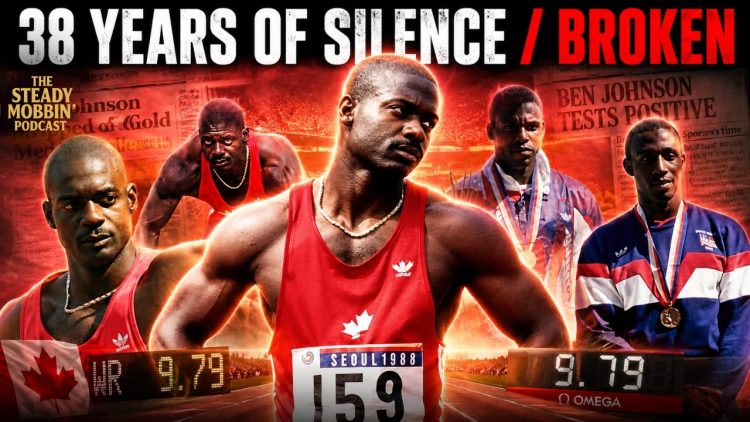
Ben Johnson finally breaks his silence about the 1988 Olympic scandal that changed sports history forever. That is the promise of this episode of The Steady Mobbin Podcast, and it is a promise that needs care: this is not a produced documentary but a long-form podcast interview, in which Johnson speaks openly about betrayal, race, the media, Carl Lewis, Canada, and the truth behind the biggest scandal in Olympic history — as he sees it. For 38 years, the film’s description says, the world heard everyone else’s version of the story. Now Ben Johnson tells his.
The record is this. Benjamin Sinclair Johnson was born on 30 December 1961 in Falmouth, Jamaica, and emigrated to Canada in 1976, where he joined the Scarborough Optimists track club under coach Charlie Francis. He won two bronze medals at the 1984 Los Angeles Olympics, then gold at the 1985 World Indoor Championships and the 1986 Commonwealth Games, and in Rome in 1987 he beat Carl Lewis to win the World Championships in a world record of 9.83 seconds. On 24 September 1988, in Seoul, he won the Olympic 100 metres final in a world record of 9.79 seconds, raising one finger in the air as he crossed the line, ahead of Lewis. Three days later, on 27 September, the International Olympic Committee announced that his urine sample contained stanozolol, an anabolic steroid.
What followed was the Dubin Inquiry, the Canadian commission of inquiry into drug use in sport, chaired by Justice Charles Dubin, which reported in 1990. Before it, Johnson and Francis testified about years of steroid use; Johnson later admitted having used steroids when he ran his 1987 world record, which the IAAF rescinded, and Francis argued that Johnson was only one of many cheaters who happened to get caught. The inquiry’s evidence showed that of the eight finalists in Seoul, six were implicated in doping at some point in their careers — only Calvin Smith and Robson da Silva remained clean throughout. Johnson returned to competition after a ban, but in 1993, after a further positive test for testosterone, he received a lifetime ban from the IAAF.
The interview is Johnson’s attempt to reclaim that story. He speaks about the $2 million offer from the Dallas Cowboys that he says he turned down, about his mother keeping him mentally strong through the darkest years, about what Canada did to him that most Canadians still do not know, and about the property investments he says were taken from him. He addresses Carl Lewis directly, in a message the description says he is delivering publicly for the first time, and he returns to the claim he has made since 1988: that he was made a scapegoat, and that the stanozolol in his sample was the work of a saboteur. That claim was investigated at the time and rejected: the IOC stated that the steroid profile was not consistent with after-the-race tampering, and Johnson himself later admitted to steroid use.
What the Film Explores
The film explores what it means to be the fastest man alive for three days.
It also explores the question at the heart of the scandal: was Johnson a cheat, or a scapegoat? The interview’s answer is the second, and Johnson’s argument is that the sport was full of doping, that six of the eight men in that final were implicated, and that he was the one who was caught and made an example of. The verified record supports part of that: the doping was indeed widespread, and Francis testified to it.
Finally, the film explores race, immigration and belonging. Johnson was a Jamaican immigrant who became Canada’s darling and then, in 72 hours, a Jamaican immigrant again — the interview’s own framing, and a pointed one. He speaks about what it meant to carry a country’s hopes as a Black immigrant athlete, and about the media’s role in building him up and tearing him down. The episode is a podcast, not a documentary, and it is one-sided by design: there is no response from Lewis, no response from the Canadian authorities, and no independent verification of Johnson’s claims about the Cowboys offer or the property.
Key Themes
- 9.79 seconds: on 24 September 1988 Johnson won the Olympic 100 metres in a world record, raising one finger as he crossed the line.
- The fall: three days later he was disqualified after his sample tested positive for stanozolol, and Carl Lewis was awarded the gold.
- The Dubin Inquiry: the 1989-90 Canadian inquiry in which Johnson and his coach Charlie Francis testified about years of steroid use.
- The dirtiest race: six of the eight finalists in Seoul were implicated in doping at some point; only Calvin Smith and Robson da Silva stayed clean.
- The lifetime ban: after a further positive test in 1993, Johnson was banned for life by the IAAF, ending his career.
- The scapegoat claim: Johnson argues he was made an example of in a sport full of doping — a claim the interview presents, and the record partly supports, but which does not include his sabotage theory, rejected by the IOC.
Production and Background
The episode is from The Steady Mobbin Podcast, a podcast about Black Canadian culture, and it features Ben Johnson with Anthony Farrell, the creator and showrunner of a mockumentary series about Johnson’s life, streaming on Paramount Plus Canada, Game TV and Amazon Prime Video. It is a podcast interview, not a produced documentary: there is no narration, no archive footage and no independent investigation, and the claims Johnson makes — about the Cowboys offer, the property, the sabotage — are his own, presented without verification.
The Seoul final remains one of the most famous races in history, and its reputation has only grown: it is known as the dirtiest race in history, and the 9.79 seconds that Johnson ran stood, briefly, as the fastest time ever recorded. The record was expunged within 48 hours, and the gold went to Lewis, who ran 9.92. Johnson’s 1987 world record of 9.83 was also rescinded.
Recommended Companion Viewing
Explore authoritative investigative documentaries on related historical events and investigative subjects.

Frequently Asked Questions
What happened to Ben Johnson at the 1988 Olympics? He won the 100 metres final in Seoul on 24 September 1988 in a world record of 9.79 seconds, then was disqualified three days later after his sample tested positive for the steroid stanozolol.
Did Ben Johnson admit to taking steroids? Yes.
Why is the 1988 final called the dirtiest race in history? Because six of the eight finalists were implicated in doping at some point in their careers.
What happened to Johnson after 1988? He was banned, returned to competition, and in 1993 received a lifetime ban from the IAAF after a further positive test for testosterone.
More to watch
- Against All Odds – Lewis Hamilton Documentary
- India’s Little-Known Minority – The Siddi and the Olympic Dream
- Nature and risk for likes – How social media is changing extreme sports
- The Surfers Who Changed the Sport Forever | Bustin’ Down the Door | FULL DOCUMENTARY
- The Mafia Football Murders
Johnson’s story is about what sport does to its heroes; Against All Odds – Lewis Hamilton Documentary shows a champion who survived the same pressures and came out the other side.