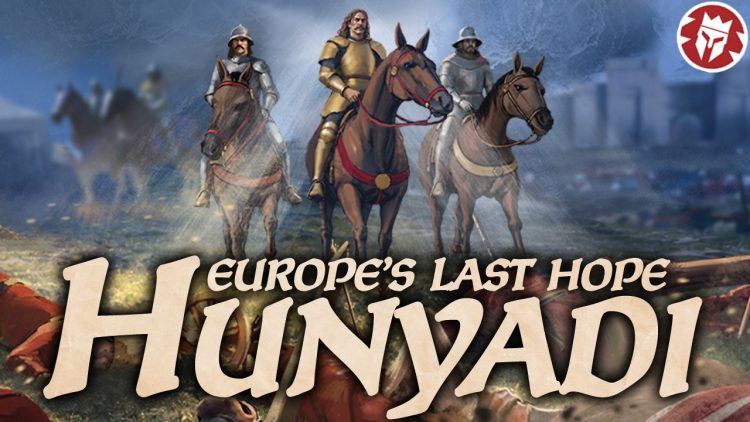
Hunyadi vs the Ottomans: The Full Story Behind the Legend
For most of the fifteenth century, the Ottoman Empire pushed steadily into south-eastern Europe, and the kingdom of Hungary stood directly in its path. The man who held that frontier for two decades was John Hunyadi, a commander of Wallachian roots who rose from a minor noble family to become regent of Hungary and the most feared opponent the sultans faced in Europe.
Hunyadi was born around 1406, the son of a minor nobleman of Romanian ancestry, and he learned his trade on Hungary’s southern borderlands, where Ottoman raiding was a fact of daily life. Service in Italy exposed him to the new infantry tactics of the Hussite wars, above all the use of fortified wagon forts, and he built an army around cavalry, wagons, artillery and aggressive battlefield manoeuvre.
The film moves through his early victories in Transylvania in 1442, when he beat Ottoman armies at the Iron Gate and the Ialomita river, and then the Long Campaign of 1443-1444, a winter offensive deep into the Balkans that took Nish and Sofia and won the battles of Zlatitsa and Kunovica. It was the first time a European army had carried a sustained offensive against the Ottomans, and it made Hunyadi famous across Christendom.
Defeat did not end Hunyadi. Elected regent of Hungary in 1446, he rebuilt his forces, marched south again in 1448 and was beaten a second time at the Second Battle of Kosovo by Sultan Murad II, escaping captivity only with difficulty. Then Constantinople fell in 1453, and the balance of power shifted decisively: Mehmed II, the conqueror of the Byzantine capital, turned on Serbia and then on Belgrade, the key fortress guarding the road into Hungary. The film’s climax is the siege of Belgrade in the summer of 1456, where Hunyadi broke the Ottoman river blockade, held the walls through weeks of bombardment and finally drove Mehmed’s army away. He died of plague three weeks later, on 11 August 1456, but the victory bought Hungary and central Europe some seventy years of breathing room.
What makes the story stick is not only the battles. Hunyadi’s son Matthias Corvinus became king of Hungary in 1458, and the noon ringing of church bells across Europe is traditionally linked to the Belgrade victory, a reminder that was ordered by the pope while the siege was still being fought.
What the film explores
The first part of the film sets out the world Hunyadi inherited. Hungary in the 1430s was a kingdom in political chaos after the death of King Sigismund without a male heir, with rival claimants fighting a civil war while the Ottomans raided across the southern border at will. Hunyadi’s early career is shown as a product of that chaos: a capable soldier from the borderlands who won the trust of the new king, Wladyslaw III, and was given the offices that mattered, Voivode of Transylvania and captain of Belgrade, because nobody else was willing to hold the frontier.
The middle of the film is a study in how a smaller army fights a larger one. Hunyadi’s forces were usually outnumbered, and the film explains the tools he used to close the gap: the wagon fort, a ring of armoured wagons chained together that gave infantry a defensible position in open country; light cavalry used for raids and pursuit; and artillery deployed in the field rather than only in sieges.
The film also follows the politics that kept undoing Hunyadi’s work. The truce of Szeged was broken because the papal legate argued that a promise made to an infidel need not be kept, and the crusade that followed was launched against Hunyadi’s advice. After Varna, rival Hungarian nobles fought over the regency while the Ottomans recovered, and Hunyadi spent as much energy holding his own kingdom together as he did fighting the enemy.
The final section is the siege of Belgrade, told in detail. Mehmed II brought an army of tens of thousands and a fleet up the Danube to blockade the fortress from the river. Hunyadi broke the blockade with a flotilla of his own, got reinforcements and supplies into the city, and then held the walls as Ottoman guns battered them for weeks. When the sultan’s troops finally stormed the breach, they were thrown back in desperate hand-to-hand fighting, and Mehmed withdrew wounded. The film is clear about the cost: the city was wrecked, plague was already spreading through both armies, and Hunyadi himself was dead within weeks.
Key Themes
- Frontier warfare: how a border kingdom defends itself against a much larger empire.
- The wagon fort and Hussite tactics, adapted by Hunyadi for open battle.
- The Long Campaign of 1443-1444, Europe’s first sustained offensive against the Ottomans.
- The disaster at Varna in 1444 and the death of King Wladyslaw III.
- The Second Battle of Kosovo in 1448 and the limits of crusading warfare.
Production and Background
The film is a Kings and Generals animated documentary, made by Arif Azaman with a script by Ege Gunes and narration by Officially Devin, and it is part of the channel’s long-running remake of its Ottoman history series.
The episode is built around a detailed campaign narrative, with animated maps tracing each march and battle, and its sources are listed in a public document linked from the description. At eighty minutes it is one of the channel’s longer single-subject films, and it covers roughly twenty years of warfare, from Hunyadi’s first commands in the early 1440s to his death in 1456.
Recommended Companion Viewing
Explore authoritative investigative documentaries on related historical events and investigative subjects.

Falling from the Sky: Air Disasters FULL EPISODE
Archeologists Unearth A Crashed WW2 Bomber
Why Berlin is still the Spy Capital
World War 2: 1939
Frequently Asked Questions
Who was John Hunyadi? A Hungarian military commander and statesman of Wallachian origin, born around 1406, who served as Voivode of Transylvania from 1441 and as regent of Hungary from 1446 to 1453.
What happened at the Battle of Varna in 1444? A crusading army led by King Wladyslaw III of Hungary and Poland marched against the Ottomans after breaking the truce of Szeged. At Varna on 10 November 1444, Sultan Murad II’s army defeated the crusaders and the king was killed in a charge.
Why is the siege of Belgrade in 1456 so famous? Mehmed II, fresh from conquering Constantinople, besieged Belgrade with a large army and a river fleet.
How did Hunyadi die? He died of plague on 11 August 1456, about three weeks after the victory at Belgrade, in Zemun, near the city he had just saved.
What happened to his family after his death? His younger son Matthias Corvinus was elected king of Hungary in 1458, at the age of fourteen, and ruled for more than thirty years, becoming one of Hungary’s most celebrated kings.
More to watch
- Dan Snow Tests 1,000 Years Of Deadly Medieval Weapons
- How Did Viking Raiders Turn Into Europe’s Greatest Medieval Rulers?
- King Canute: The Ruthless Viking Conqueror Who Became King Of England
- The Complete History Of The Maya Empire: Secrets Of Mesoamerica’s Supercities
- Inside A Perfectly-Preserved 15th-Century Medieval Manor House
For more on the medieval world Hunyadi fought in, Dan Snow Tests 1,000 Years Of Deadly Medieval Weapons shows the arms and armour of the age in action.