
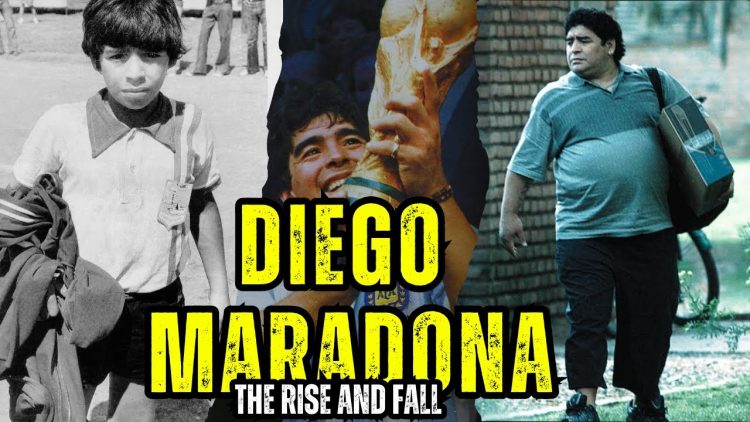
Diego Maradona: The Rise, The Fall & The Immortal Legacy | Full Documentary
Diego Maradona — a name that transcends football. From the dusty streets of Villa Fiorito to the pinnacle of world football, Maradona’s journey is one of brilliance, controversy and immortality.
He was born on October 30, 1960, in Villa Fiorito, a shantytown on the edge of Buenos Aires, the fifth of eight children in a poor family. His talent was obvious almost immediately: as a boy he could keep a ball in the air longer than anyone, and at fifteen he made his professional debut for Argentinos Juniors. In 1981 he moved to Boca Juniors, the club he loved, and a year later, after the 1982 World Cup in Spain, Barcelona paid a world-record fee for him.
Naples changed everything. In 1984 Maradona joined Napoli, a club from Italy’s poor south that had never won the league, and he made it the best team in the country. Napoli won Serie A in 1987 and again in 1990, the Coppa Italia in 1987 and the UEFA Cup in 1989, and Maradona became a god in a city that saw itself in him: southern, poor, looked down on by the rich north. Then came Mexico 1986. In the quarter-final against England on June 22, 1986, Maradona scored two goals in four minutes that defined his legend: the first with his hand, which he called the Hand of God, and the second a dribble from his own half past five England players that was later voted the Goal of the Century.
The fall was as spectacular as the rise. In 1991 he failed a drug test and received a fifteen-month ban for cocaine, and he left Napoli in disgrace. At the 1994 World Cup in the United States he was expelled from the tournament after testing positive for ephedrine. His playing career wound down through Sevilla, Newell’s Old Boys and a return to Boca, and his health — his weight, his heart, his addictions — became a public spectacle. As a coach he led Argentina at the 2010 World Cup in South Africa, where his team lost 4-0 to Germany in the quarter-final. He died on November 25, 2020, aged sixty, and Argentina declared three days of national mourning. In Naples, the stadium was renamed after him. In Buenos Aires, they still say that he was not a footballer but a religion.
What the Film Explores
The film explores the distance Maradona travelled, from a shantytown to the summit of the world’s most popular sport, and what that distance cost him.
It also explores the Napoli years as a story about more than football. Napoli’s triumphs were the triumphs of the Italian south over the rich north, and Maradona understood that perfectly: he played for a city that felt insulted, and he insulted its enemies back.
Finally, the film explores the fall without flinching. The drugs, the bans, the weight, the chaotic later years are all here, and the film does not try to excuse them. Its argument is that Maradona’s immortality does not depend on his being a good man: it depends on what he did with a ball, and on what he meant to the people who loved him. The legend, the film suggests, was never really about football at all.
Key Themes
- Villa Fiorito: Maradona was born in 1960 in a Buenos Aires shantytown and debuted professionally at fifteen.
- Barcelona: a world-record move in 1982 ended in injury and disappointment.
- Napoli: from 1984 he turned Italy’s poor southern club into champions, winning Serie A in 1987 and 1990 and the UEFA Cup in 1989.
- Mexico 1986: the Hand of God and the Goal of the Century against England, then the World Cup final win over West Germany.
- The fall: a fifteen-month cocaine ban in 1991 and expulsion from the 1994 World Cup after a positive test for ephedrine.
- The coach: he managed Argentina at the 2010 World Cup, losing 4-0 to Germany in the quarter-final.
- The immortal legacy: he died in 2020 aged sixty; Naples renamed its stadium for him, and Argentina mourned for three days.
Production and Background
The film is a fan-made documentary from the channel Pitch Side TV, built around match footage, photographs and narration rather than original interviews.
Maradona remains one of the most argued-over figures in sport: the greatest player ever to some, a flawed genius to others, and a folk hero in Argentina and Naples whatever the argument.
Recommended Companion Viewing
Explore authoritative investigative documentaries on related historical events and investigative subjects.

Frequently Asked Questions
When was Diego Maradona born? On October 30, 1960, in Villa Fiorito, a shantytown on the edge of Buenos Aires, Argentina. He made his professional debut for Argentinos Juniors at fifteen.
What happened in the 1986 World Cup quarter-final against England? On June 22, 1986, Maradona scored two goals in four minutes: the Hand of God, scored with his hand, and the Goal of the Century, a dribble from his own half past five England players. Argentina won the tournament, beating West Germany 3-2 in the final.
Why did Maradona leave Napoli? In 1991 he failed a drug test and received a fifteen-month ban for cocaine. He left Napoli in disgrace, and his career never recovered its peak.
When did Maradona die? He died on November 25, 2020, aged sixty. Argentina declared three days of national mourning, and Napoli renamed its stadium the Stadio Diego Armando Maradona.
More to watch
- The Mafia Football Murders
- The Surfers Who Changed the Sport Forever | Bustin’ Down the Door | FULL DOCUMENTARY
- Nature and risk for likes – How social media is changing extreme sports
- India’s Little-Known Minority – The Siddi and the Olympic Dream
- Against All Odds – Lewis Hamilton Documentary
Maradona’s story is inseparable from football’s darker side, and The Mafia Football Murders shows how deeply organised crime has reached into the game.







