
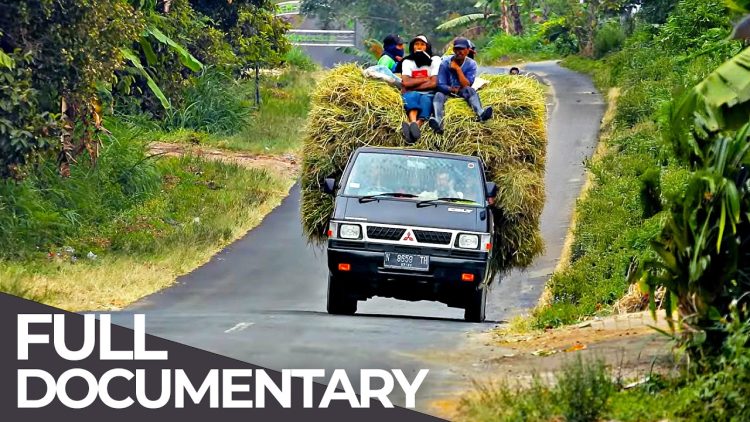
Earth Untold: Java | Hidden Tales from the World’s Most Crowded Island
Java is the most crowded island in the world. With around 140 million inhabitants at the time this film was made, it holds more people than any other island on Earth, and more than half of Indonesia’s population lives on land that makes up only a small fraction of the country’s area. Yet life there hangs on the whims of its volcanoes, and its people, the film shows, are full of joy and always welcoming.
The film is an episode of Earth Untold, a series that looks for the hidden stories of the world’s great islands, and it treats Java as a place of contrasts. It is at once the political and economic heart of Indonesia, home to the capital, Jakarta, and a landscape shaped by fire, where a chain of volcanic mountains runs like a spine down the length of the island. The people who live there have learned to live with that danger, farming the rich volcanic soil and building their lives in the shadow of peaks that can erupt without much warning.
What the film returns to again and again is diversity. Java is a symbol of Indonesian diversity, with more than a dozen dialects and traditions that are both vibrant and complex. The island is home to the Javanese, the Sundanese and other peoples, each with their own language, music, food and customs, and the film moves between them to show how much variety can fit on a single island.
The film was made in 2019, and it carries the unhurried pace of a travel documentary from that period, letting landscapes and faces do much of the work. There is little narration in the conventional sense; instead the film builds its portrait from the places it visits, from crowded city streets to quiet volcanic slopes, and from the people it meets along the way.
By the end, the portrait that emerges is of an island that should not work, and does. Too many people, too many volcanoes, too many languages, and yet a place where daily life carries on with warmth and humour. That is the hidden tale the film sets out to tell.
What the Film Explores
The film explores Java’s volcanoes first, because they explain so much of the island. Java is almost entirely volcanic in origin, formed by the subduction of one tectonic plate beneath another, and it contains more than a hundred volcanoes, of which around forty have been active. The highest is Mount Semeru, at 3,676 metres, and the most active is Mount Merapi, near the city of Yogyakarta. The film shows how these mountains dominate the landscape and the imagination of the island, and how their ash makes the soil among the most fertile on Earth.
It then turns to the people, and to the sheer scale of life on the island. Jakarta, on the north-western coast, is the capital of Indonesia and its largest city, a metropolis of more than ten million people. Beyond it lie other great cities, including Surabaya in the east and Bandung in the highlands, and between them a countryside that is among the most densely settled rural landscapes anywhere in the world.
The film also explores Java’s cultural depth. The island holds four of Indonesia’s UNESCO World Heritage Sites, including Borobudur, the great ninth-century Buddhist temple, and Prambanan, the Hindu temple complex, both in Central Java. These monuments speak to a history in which Buddhist and Hindu kingdoms rose and fell long before the arrival of Islam, which is now the faith of most Javanese, and the film treats them as evidence of how many layers of history a single island can hold.
Finally, the film looks at the everyday traditions that make Java distinct: the languages and dialects, the music and dance, the food and the markets. With more than a dozen dialects spoken across the island, and distinct cultures among the Javanese, Sundanese and others, Java is less a single place than a collection of worlds pressed together, and the film’s pleasure comes from moving between them.
Key Themes
- Java as the world’s most populous island, home to more than half of Indonesia’s people.
- Life in the shadow of volcanoes, from Semeru to the restless Merapi.
- Volcanic soil and farming, and how danger and fertility go together.
- Jakarta, the capital, and the scale of Java’s cities.
- Borobudur and Prambanan, monuments of Java’s Buddhist and Hindu past.
- More than a dozen dialects and the island’s cultural diversity.
- The warmth and openness of Javanese daily life.
- An island of contrasts, where crowding and calm exist side by side.
Production and Background
Earth Untold: Java is an episode of the Earth Untold series from Free Documentary, and it runs for 50 minutes. The documentary itself dates from 2019, which is why its population figure of 140 million is lower than the island’s population today, now estimated at well over 150 million. The series looks at islands around the world, and its Java episode is one of several that explore Indonesia, a country of more than 17,000 islands of which Java is by far the most populous.
Recommended Companion Viewing
Explore authoritative investigative documentaries on related historical events and investigative subjects.

Former Adviser on Trump’s Economic Worldview
Immigration Under President Trump’s First Term: Kids Caught in the Crackdown
Behind the Polarization
Secret Mission: Former Child Soldier's Risks His Life To Save His Son
Frequently Asked Questions
How many people live on Java?
The film gives a figure of around 140 million. Java is the world’s most populous island, home to more than half of Indonesia’s population.
How many volcanoes does Java have?
Java has more than a hundred volcanoes, of which around forty have been active. The highest is Mount Semeru, and the most active is Mount Merapi.
What is Borobudur?
Borobudur is a great ninth-century Buddhist temple in Central Java, one of Indonesia’s UNESCO World Heritage Sites and one of the largest Buddhist monuments in the world.
Where is Jakarta?
Jakarta, the capital of Indonesia, sits on Java’s north-western coast. It is the island’s largest city, with more than ten million residents.
When was this documentary made?
The film dates from 2019, so some of its figures, including the population, have moved on since it was filmed.







