
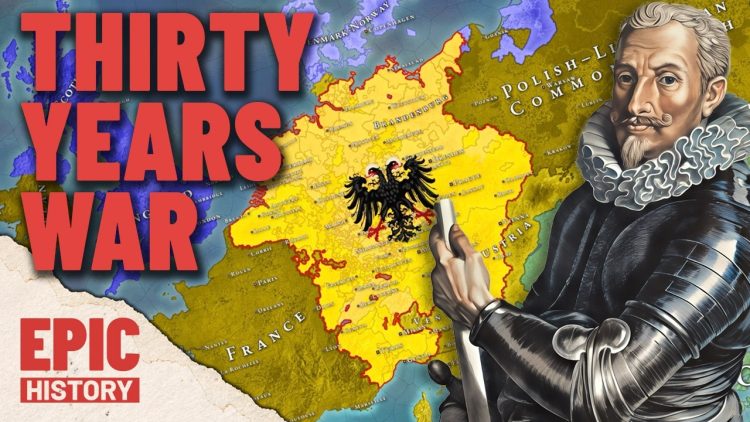
Europe’s Cataclysm: Thirty Years’ War
In 1618, Europe stands on the cusp of the most destructive war in its history. That is where this film from Epic History TV begins, with a continent that does not yet know what is coming: a thirty-year-long cataclysm that will engulf it, in which war, starvation and plague will decimate whole populations, and in which slaughter and rumours of cannibalism will haunt the land. What started as a regional religious dispute spirals into a widespread, total war, and no one, the film says, will be spared.
The spark came in Bohemia. In May 1618, Protestant nobles in Prague, led by Count Thurn, objected to decisions by the Catholic Habsburg emperor Ferdinand II that favoured Catholics, and they threw two of his representatives, along with their secretary, out of a window of Prague Castle. The event, the Defenestration of Prague, has become one of the most famous moments in European history, not least because all three men survived the fall. But the revolt it began did not stop at Bohemia. The Protestant estates chose their own king, Frederick V of the Palatinate, and the Habsburgs moved to crush them, and a local dispute became a continental war.
The film follows the war through its four phases, and that structure is the key to understanding it. First came the Bohemian revolt of 1618 to 1620, then the intervention of Denmark from 1625, then the intervention of Sweden from 1630, under its king Gustavus Adolphus, one of the great commanders of the age, and finally the intervention of France from 1635. With each phase the war grew wider, and with each phase its character changed, from a religious conflict within the Holy Roman Empire into a struggle for dominance in Europe between the Habsburgs and their rivals.
The human cost is the film’s centre of gravity. Modern estimates put the total dead at between four and a half and eight million soldiers and civilians, killed by battle, famine and disease, and in parts of Germany the population fell by more than half. Armies lived off the land, stripping villages bare, and plague followed the soldiers wherever they went. The sack of Magdeburg in 1631, in which some 20,000 of the city’s 25,000 people were killed, became the war’s most notorious atrocity, and the film does not flinch from what that meant for the people caught in it.
By the end, the film arrives at the Peace of Westphalia in 1648, which ended the fighting without declaring a winner. The settlement gave greater autonomy to the German states, confirmed the independence of the Netherlands, and redrew the map of Europe, and it is still remembered as the moment when the modern system of sovereign states began to take shape. The war’s shadow, the film argues, still lies across European history.
What the Film Explores
The film explores the origins of the war first, and the religious settlement that failed to hold it. The Peace of Augsburg of 1555 had allowed the rulers of the German states to choose their own religion, Catholic or Lutheran, but it had left Calvinism unrecognised and it had said nothing about what happened when a ruler changed his faith. By the early seventeenth century those gaps had become dangerous, and when Ferdinand II, a determined Catholic, became king of Bohemia in 1617, his largely Protestant subjects saw their religious freedoms under threat, and the revolt followed.
It then follows the war’s escalation, and the way outside powers were drawn in one by one. Denmark intervened to support the Protestants and was defeated; Sweden intervened under Gustavus Adolphus, whose modernised army won a string of victories before his death at the Battle of Lutzen in 1632; and France, though Catholic, intervened against the Habsburgs from 1635, because its chief minister, Cardinal Richelieu, saw the Habsburgs as the greater threat. The film shows how a war that began over religion became a war over power.
The film also explores what the war did to the people who lived through it. The armies of the time were largely mercenary, and they were paid by being allowed to plunder. Villages were stripped of food, and the people who survived the soldiers often died of the hunger and disease that followed them. The Peace of Westphalia of 1648 ended the fighting, recognised the autonomy of the German princes and the independence of the Dutch Republic, and gave Sweden territory in northern Germany. It did not solve the religious question so much as freeze it, but it ended the age when a single emperor could claim to rule Christendom, and it left a Europe of competing states that would shape the centuries that followed.
Key Themes
- The Defenestration of Prague in May 1618, and how a local revolt became a continental war.
- The four phases of the war: Bohemia, Denmark, Sweden and France.
- Ferdinand II and Frederick V, and the religious settlement that broke down.
- Gustavus Adolphus of Sweden, and his death at Lutzen in 1632.
- The sack of Magdeburg in 1631, the war’s most notorious atrocity.
- Famine and plague, and how they killed more people than battle did.
- A death toll of between four and a half and eight million, and population losses of more than half in parts of Germany.
- The Peace of Westphalia in 1648, and the birth of the modern system of states.
Production and Background
Europe’s Cataclysm: Thirty Years’ War was released by Epic History TV and runs for 32 minutes and 43 seconds. It was published in October 2025. The film is part of the channel’s series of animated military histories, which use detailed maps and narration to follow campaigns step by step, and it is supported by the channel’s historical consultants and its bookshop of recommended reading on the period. The war it covers ran from 1618 to 1648, and its settlement, the Peace of Westphalia, remains one of the most important dates in European history.
Recommended Companion Viewing
Explore authoritative investigative documentaries on related historical events and investigative subjects.

What Historians Get Wrong About The Knights Templar In America
Women of the Third Reich: The Other Face of Nazi Germany
Scapa Flow: Diving Mecca of Scotland
King Ranch: America’s Largest Working Ranch
Frequently Asked Questions
What started the Thirty Years’ War?
The revolt began in Bohemia in May 1618, when Protestant nobles threw two of Emperor Ferdinand II’s representatives out of a window of Prague Castle, an event known as the Defenestration of Prague.
How many people died?
Modern estimates put the total at between four and a half and eight million soldiers and civilians, killed by battle, famine and disease, with parts of Germany losing more than half their population.
Who was Gustavus Adolphus?
He was the king of Sweden, who intervened in the war in 1630 with a modernised army and won a string of victories before being killed at the Battle of Lutzen in 1632.
What was the sack of Magdeburg?
In 1631, Imperial troops sacked the Protestant city of Magdeburg, killing some 20,000 of its 25,000 inhabitants. It became the war’s most notorious atrocity.
How did the war end?
It ended with the Peace of Westphalia in 1648, which gave greater autonomy to the German states, confirmed Dutch independence and redrew the map of Europe, without declaring a winner.







