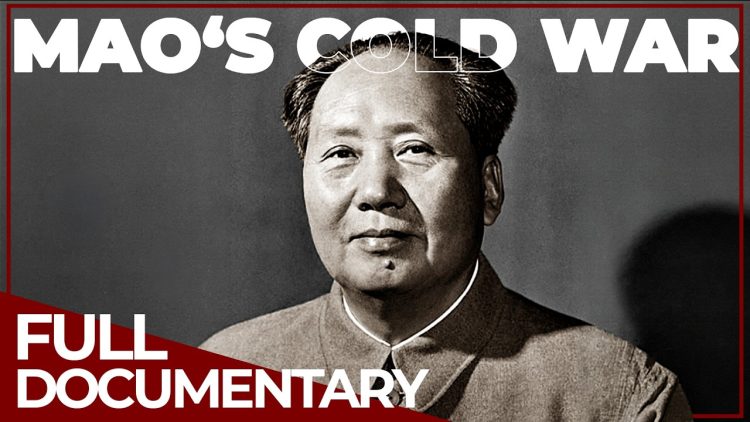
Mao’s China: Against the World
In the tense decades after the Second World War, a new kind of conflict divided the world’s greatest powers: the Cold War. For many, it was seen as a struggle between capitalism and communism, between the United States and the Soviet Union. But behind that familiar story, this film argues, lay a hidden third force: China. Under the leadership of Mao Zedong, China significantly reshaped the global balance of power, and left a lasting mark on Cold War history.
For years, China’s role in the Cold War remained largely obscured. The film draws on newly released archives to tell it, through the men and women who lived, fought and endured it on the front lines, and it asks three questions that structure the whole film. Why did Chinese forces fight with such ferocity in the Korean War? What drove Mao to launch a war against India? And how did the bitter split between China and the Soviet Union fracture the communist world into rival camps?
The film is a full series in a single sitting, running for more than two hours and divided into three parts. The first covers China against the United States in Korea, the second China against India, and the third China against the Soviet Union, and together they trace a single arc: a China that began the Cold War as the junior partner of the Soviet Union and ended it as a power that answered to no one, having fought all three of the other great powers of its age.
What the film shows, above all, is that Mao’s China was not a bystander in the Cold War but one of its makers. Its decisions in Korea, in the Himalayas and on its northern border changed the course of the conflict, and the soldiers who fought those wars, whose experiences the film draws on, paid the price for them. The result is a portrait of a country that reshaped the world by being willing to fight anyone, including its own allies.
By the end, the film has told the story of how the communist world split apart, and how that split changed everything. The rivalry between China and the Soviet Union, which began as a dispute over ideology, ended with armed clashes on their shared border, and it opened the way for the opening between China and the United States in the 1970s, which remade the politics of the late Cold War.
What the Film Explores
The film explores the Korean War first, and China’s entry into it. When North Korea invaded the South in June 1950, the United States intervened under the flag of the United Nations, and its forces drove north towards the Chinese border. In October 1950, China sent its People’s Volunteer Army across the Yalu River, in vast numbers, and threw the United Nations forces back. The film asks why Chinese forces fought with such ferocity, and its answer lies in Mao’s conviction that a hostile power on China’s border was an existential threat, and in the memory of a century of foreign invasion. The war ended in stalemate in 1953, but it had shown that China could fight the United States to a standstill.
It then turns to the war with India, in 1962. The dispute was over the Himalayan border, a line drawn by the British that China had never accepted, and it flared into a short, sharp war in October and November 1962. Chinese forces advanced into territory claimed by India and then withdrew, having made their point. The film explores Mao’s motives, and the way the war humiliated India and reshaped its politics, while leaving a border dispute that remains unresolved to this day.
The third part covers the split with the Soviet Union, and the way it fractured the communist world. China and the Soviet Union had been allies, bound by treaty and ideology, but by the late 1950s Mao and the Soviet leader Nikita Khrushchev were openly at odds, over ideology, over nuclear weapons and over who led the communist movement. The split became public in the early 1960s, and by the end of the decade the two countries were fighting each other on their border, in clashes on the Ussuri River in 1969 that brought them close to full-scale war.
Finally, the film looks at the consequences. The Sino-Soviet split ended the idea of a single communist bloc, and it changed the Cold War from a two-sided contest into a triangular one, in which China could play the two superpowers against each other.
Key Themes
- China as the hidden third force of the Cold War, behind the familiar American-Soviet story.
- The Korean War, and why China intervened in October 1950 to fight the United States.
- The Sino-Indian War of 1962, and the Himalayan border dispute that caused it.
- The Sino-Soviet split, and how an ideological dispute became an armed one.
- The border clashes of 1969, and how close China and the Soviet Union came to war.
- Mao Zedong’s strategy, and his willingness to fight any power, including his allies.
- Newly released archives, and the soldiers’ experiences the film draws on.
- The end of the single communist bloc, and the triangular Cold War that followed.
Production and Background
Mao’s China: Against the World was released by Free Documentary History and runs for two hours, eleven minutes and 44 seconds. It was published in November 2026, and it presents a full series, Mao’s Cold War, in a single film, in three parts: China against the United States, China against India, and China against the Soviet Union. The film uses original footage, re-enactments and animation, with explanations from historians, and it draws on archives that have only recently been released to tell a story that was long obscured.
Recommended Companion Viewing
Explore authoritative investigative documentaries on related historical events and investigative subjects.

The Final Hours Of Anne Boleyn: The Most Shocking Execution In English History
U-Boat Wargamers: The Mastermind
Archeologists Investigate Mesoamerica's Epic Ancient Megacities
Frequently Asked Questions
When did China enter the Korean War?
China sent its People’s Volunteer Army across the Yalu River in October 1950, after United Nations forces advanced towards the Chinese border, and fought the United States to a stalemate that lasted until 1953.
What was the Sino-Indian War?
It was a short war in October and November 1962, fought over the disputed Himalayan border between China and India. Chinese forces advanced and then withdrew, leaving the border dispute unresolved.
What caused the Sino-Soviet split?
Ideological disputes between Mao Zedong and the Soviet leader Nikita Khrushchev, over nuclear weapons and over who led the communist movement, turned into an open break in the early 1960s.
Did China and the Soviet Union fight each other?
Yes. Their forces clashed on their shared border in 1969, on the Ussuri River, in fighting that brought the two countries close to full-scale war.
Why is China’s Cold War role described as hidden?
Because the familiar story of the Cold War is told as a contest between the United States and the Soviet Union, while China’s wars and decisions, which reshaped the conflict, received far less attention until archives were opened.