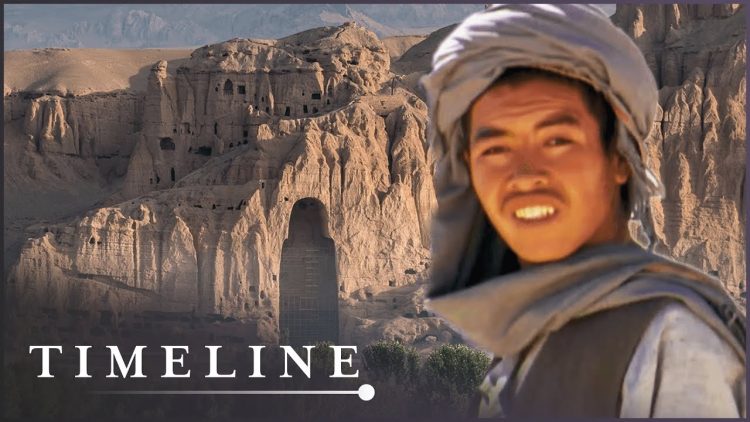
The Mysterious Lost Buddhas Of Afghanistan | Inside Afghanistan
Afghanistan is not so much a country as a series of shifting borders, the film begins, a place with no easily definable physical or civil boundaries, where war has been an everyday fact of life for a generation. The film’s own figures are stark: about a million and a half people killed during twenty years of war, and perhaps another four million driven from their homes. But the film’s subject is not the war itself. It is what the war destroyed, and the most famous of its losses stands in the Bamiyan Valley, north of Kabul, where two of the largest statues of the Buddha on the planet were carved into a cliff face some fifteen centuries ago.
The Buddhas of Bamiyan were monumental works, the larger standing 55 metres tall and the smaller 38 metres, carved directly into the sandstone cliff in the sixth century, when the valley was a flourishing centre of Buddhism on the Silk Road. Carbon dating of the statues’ remains has placed the smaller figure in the sixth century and the larger around the turn of the seventh. They were the largest standing Buddha carvings in the world, their robes once painted in vivid colours, and for more than a thousand years they watched over a valley of monasteries, painted caves and pilgrims travelling between China, India and Persia.
The film’s central fact is that they are gone. In March 2001, the Taliban government of Afghanistan, on the orders of its leader Mullah Muhammad Omar, destroyed both statues, first with artillery and anti-aircraft guns and then with dynamite placed in holes drilled into the rock. The destruction took weeks, and it was carried out in the face of protests from around the world. By the middle of March 2001, after some fifteen centuries, the niches were empty.
What makes the film unusual is its footage. The documentary draws on film shot by David Adams, described in the film as the last Westerner to film the Buddhas exhaustively before they were blown up, and it preserves a record of the statues as they stood, and of the valley and its people around them. The film is, in part, an act of salvage: the images it contains are now among the fullest records of what was lost.
By the end, the film has widened from the statues to the country around them. Afghanistan, it argues, was once a peace-loving and Buddhist land, a crossroads of civilisations, and the destruction of the Buddhas was the destruction of a piece of that history. The empty niches in the cliff remain, and in 2003 UNESCO inscribed the Bamiyan Valley as a World Heritage Site, in part as an act of remembrance.
What the Film Explores
The film explores the Bamiyan Valley first, and what it was. The valley sits about 130 kilometres north-west of Kabul, at an altitude of some 2,500 metres, in the Hindu Kush. For centuries it was a centre of Buddhist monastic life, with more than a thousand cave dwellings, monastic cells and painted chambers cut into the cliff alongside the two great statues. Pilgrims and traders on the Silk Road passed through it, and its art mixed Indian, Persian and Greek influences into the style known as Gandharan Buddhism.
It then turns to the statues themselves, and to their scale. The two figures were carved in the sixth century, during the rule of the Hephthalites in the region, and they were the largest standing Buddha carvings in the world. The film shows them as they were in the years before their destruction, towering over the valley floor, and it gives a sense of what it meant for a community to live for centuries in the shadow of figures that had stood there since before Islam arrived in the region.
The film also explores the war that surrounded them. Afghanistan had been at war, in one form or another, for decades before 2001, and the film does not shy away from the human cost it describes: the dead, the displaced, the roads torn apart by tank treads and the buildings left standing with holes blown through them. The Buddhas stood through much of that war, and their destruction came not in battle but by deliberate decision, after the Taliban declared the statues un-Islamic idols.
Finally, the film looks at what remains. The niches are still there, hollowed out of the cliff, and the painted caves and the fragments of the statues are still being studied and conserved. UNESCO’s decision in 2003 to inscribe the valley as a World Heritage Site, and to list it as in danger, was a recognition that the place still mattered, even with its centrepieces gone, and the film closes on the question of what a country keeps when its monuments are taken from it.
Key Themes
- The Bamiyan Valley, a Buddhist centre on the Silk Road, and its thousand painted caves.
- The two Buddhas, 55 and 38 metres tall, the largest standing Buddha carvings in the world.
- The sixth-century carving of the statues, and the Gandharan art they represent.
- David Adams, and the last exhaustive filming of the statues before their destruction.
- The Taliban’s order of February 2001, and the weeks of destruction that followed in March.
- Afghanistan’s long wars, and the human cost the film describes.
- UNESCO’s inscription of the valley in 2003, as remembrance and protection.
- What remains: empty niches, fragments and the question of rebuilding.
Production and Background
The Mysterious Lost Buddhas Of Afghanistan was released by Timeline, the history channel of Little Dot Studios, and it runs for 50 minutes. It was first aired in 2019. The film draws on the footage of David Adams, presented as the last Westerner to film the statues exhaustively before their destruction, and it is built around the record that footage preserves. The Buddhas were carved in the sixth century, destroyed in March 2001, and the valley was inscribed as a UNESCO World Heritage Site in 2003.
Recommended Companion Viewing
Explore authoritative investigative documentaries on related historical events and investigative subjects.

Archeologists Investigate Mesoamerica's Epic Ancient Megacities
What Historians Get Wrong About The Knights Templar In America
Road to WW2: 1931 - 34
Frequently Asked Questions
How big were the Buddhas of Bamiyan?
The larger stood 55 metres tall and the smaller 38 metres, making them the largest standing Buddha carvings in the world.
When were they carved?
They were carved in the sixth century, when the Bamiyan Valley was a flourishing centre of Buddhism on the Silk Road. Carbon dating places the smaller in the sixth century and the larger around the turn of the seventh.
Who destroyed them, and when?
The Taliban destroyed both statues in March 2001, on the orders of their leader Mullah Muhammad Omar, using artillery and then dynamite.
Where is the Bamiyan Valley?
It lies about 130 kilometres north-west of Kabul, at an altitude of around 2,500 metres in the Hindu Kush mountains of central Afghanistan.
Is the site protected now?
Yes. UNESCO inscribed the Cultural Landscape and Archaeological Remains of the Bamiyan Valley as a World Heritage Site in 2003, and it remains listed as World Heritage in Danger.