
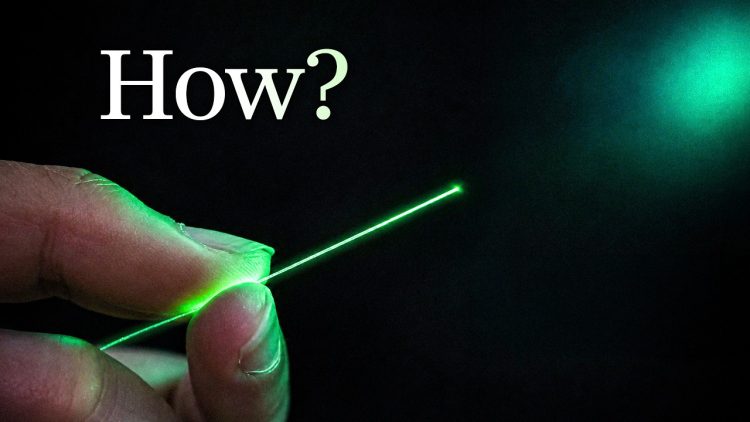
Fiber Optics are so much cooler than I thought
Why making glass fibres to send signals was almost impossible. That is the starting point of this film, and it is a stranger story than it sounds. The glass in your windows is transparent, and the light in your home travels through the air. So why was it so hard to make a glass fibre that could carry a signal — a pulse of light — over kilometres, without losing it? The answer, this film shows, is that glass is not as transparent as it looks, and that making it transparent enough took one of the great engineering feats of the twentieth century.
The film begins with the problem that came before. For a century, the world’s communications ran on copper: telephone wires, strung across continents, carrying voices as electrical signals. But copper has limits. The film explains them with a clarity that is its hallmark: the skin effect, in which a signal travelling through a copper wire crowds toward the surface, and the resistance that eats the signal as it goes. Copper could carry a call. It could not carry the internet. Something else was needed, and the something else was light, travelling through glass.
Then the film turns to the glass itself, and to why it was so lossy. Glass absorbs light, and it scatters it, and every impurity in the material — every speck of metal, every trace of water — steals a little more of the signal. The early fibres lost so much light that a signal could travel only metres before it faded. The film follows the scientists who set out to fix that, and the long work of removing the impurities: purer raw materials, new ways of making glass, and the vapour deposition techniques that built the fibre up, layer by layer, from gas rather than from sand.
The breakthrough, the film shows, came in 1970, when a team at Corning — including Donald Keck, one of the film’s expert guides — made a fibre with losses low enough to carry a signal over useful distances. It was the moment the idea stopped being a laboratory curiosity and became a technology. From there, the film follows the manufacturing: how fibre optic glass is made today, in plants where glass is drawn into hair-thin strands, and how those strands are bundled into the cables that now carry the world’s data.
By the end, the film has become a story about the invisible infrastructure of the modern world. Every video you watch, every message you send, every page you load — it travels, for most of its journey, as light through glass. The documentary closes on the thought that the internet, the defining technology of our age, rests on a thread of glass thinner than a hair — and on the people who spent years learning how to make it.
What the Film Explores
The film explores the copper limit first, and it is the documentary’s foundation. A century of telephone wires, and the physics that limited them: the skin effect, the resistance, the fading signal. The film explains these ideas without dumbing them down, and its point is that the limit was not a matter of effort. It was a matter of physics. Copper, however well you built it, could not carry what the world was about to ask for.
A second thread follows the glass, and the film is at its most detailed here. Why glass is lossy, how scattering and absorption steal the light, and what the impurities do — the documentary takes the viewer inside the material, and it shows the work of making it pure. The vapour deposition process, in which the fibre is built up from gas, layer by layer, is the key insight: you do not make pure glass by cleaning sand, but by building it from scratch.
A third thread follows the people, and the film gives them their due. Donald Keck, of the Corning team that made the breakthrough; Vincent Chan, David Payne, Nikola Alic, Jim Hayes, and the other experts on screen; Jeff Hecht, whose book City of Light tells the story in full. The internet was not built by a single invention, the film argues, but by a generation of people who solved a problem that had looked impossible.
Running through the film is the scale of what followed. The fibre that could barely carry a signal across a room now carries the world’s data across oceans — a thread of glass, thinner than a hair, carrying more information than all the copper wires ever strung. The film’s closing question is about the infrastructure we never see, and the science it rests on.
Key Themes & Topics Examined
- Copper phone lines, and the limits that stopped them carrying the internet
- The skin effect, and the signal that crowds to the surface of a wire
- Why glass is so lossy: scattering, absorption, and impurities
- Removing the impurities, and building glass from gas
- Corning, 1970, and the fibre that changed everything
- How fibre optic glass is made today, drawn into hair-thin strands
- The experts: Donald Keck, Vincent Chan, David Payne, and more
- The technology that made the internet possible
Production & Background
The film is a Veritasium production, written by Sulli Yost and Henry van Dyck, produced and directed by Sulli Yost, and presented by Henry van Dyck. Veritasium is the science channel of Derek Muller, and this episode follows its pattern: a question that looks simple, a deep dive into the physics, and the people who solved the problem. Its experts include Dr. Donald Keck, Prof. Vincent Chan, Sir David Payne, Dr. Nikola Alic and Jim Hayes, and it draws on Jeff Hecht’s book City of Light: The Story of Fiber Optics.
The documentary’s subject is fibre optics, and the story of how glass came to carry the world’s communications. Its framing is the one the description gives: why making glass fibres to send signals was almost impossible, how the impurities were removed, how the glass is made, and how the result became the technology that made the internet possible.
Recommended Companion Viewing
Explore authoritative investigative documentaries on related historical events and investigative subjects.

Drones, Robots, and Super Sperm – The Future of Farming
Digital Solutions for Decent Lives - Founders Valley
Google Maps is Unreasonably Fast. Let Me Explain
Throwing the Best Party
Frequently Asked Questions
What is the film about?
The story of fibre optics: why making glass to carry light was almost impossible, how scientists solved it, and how the result made the internet possible.
Why could copper not carry the internet?
Copper wires have physical limits — including the skin effect, in which a signal crowds toward the surface of the wire — and the resistance that eats the signal as it travels.
What made glass fibres so hard to make?
Glass absorbs and scatters light, and every impurity in it steals more of the signal. Early fibres lost so much light that a signal faded within metres.
When was the breakthrough?
In 1970, a team at Corning — including Donald Keck — made a fibre with losses low enough to carry a signal over useful distances, turning fibre optics from a laboratory curiosity into a technology.
Who made the film?
Veritasium, written by Sulli Yost and Henry van Dyck, produced and directed by Sulli Yost, and presented by Henry van Dyck.







