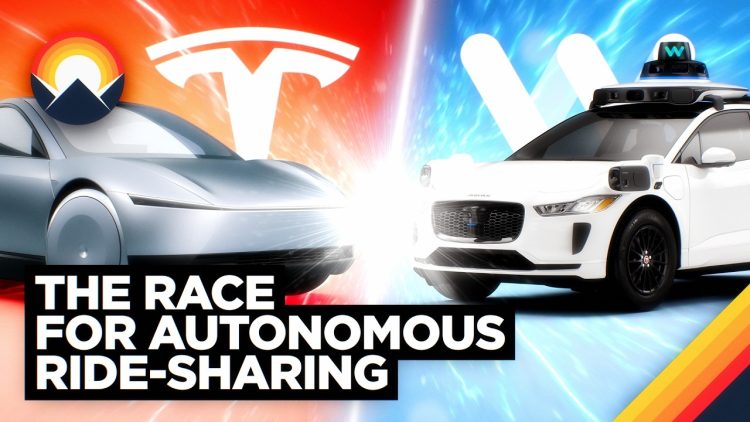
Waymo vs Tesla
For most of the last decade, the robotaxi was always a year away. In 2026, it stopped being a promise. Depending on which American city you live in, you can now open an app and summon a car with no one in the driver’s seat, and two companies that barely resemble one another are carrying paying passengers today. This film is the story of that race, and of the two completely different bets behind it.
On one side is Waymo, owned by Google’s parent company Alphabet, and the scale leader by a wide margin. As of September 2026 it runs paid public rides in 15 US cities and completes more than 500,000 paid trips a week across a fleet of over 4,000 vehicles. Waymo’s approach is the cautious one, and it shows in the hardware: its cars wear a tall rooftop dome and bulging pods packed with cameras, radar and spinning laser sensors called lidar, and they drive on detailed pre-built maps of each service area.
On the other side is Tesla, chasing the same goal from the opposite direction, and its approach is the most debated in the industry. Rather than lidar and mapped zones, Tesla relies on cameras and artificial intelligence alone, the same vision-led approach as the Full Self-Driving system in its consumer cars. Its first robotaxi is a version of the regular Model Y SUV, operating as an autonomous Robotaxi service in limited parts of Austin, Dallas, Houston, Miami, Orlando and Tampa as of September 2026, launched with human safety monitors in the car and beginning to remove them on some routes.
The second Tesla vehicle is the Cybercab, a purpose-built two-seat robotaxi with no steering wheel and no pedals, which began carrying paying riders in a limited area of Austin. The bet is that huge manufacturing volume makes autonomy cheap: the Cybercab has a target price under 30,000 dollars, and a production line rated at more than 125,000 units a year.
The film’s argument is that this is not really a race between two cars, but between two philosophies of how to solve driving itself. Waymo builds a complete driver first, with several kinds of sensors and a detailed map, and then scales it one city at a time, selling rides rather than cars. Tesla bets that cheap cameras on millions of customer cars will collect enough driving data for one software system to learn from all of it, and that the same system can grow from supervised driving into a driverless service. One side is winning on proof, the other on potential, and the film lays out exactly where each stands.
What the Film Explores
The film explores Waymo’s approach first, and it is the one with the clearest record to examine. Waymo discloses rides, miles, cities and safety comparisons, and its latest safety analysis covers more than 220 million fully autonomous miles, reporting far fewer serious crashes than human drivers in the same areas over the same period. The film treats that transparency as part of the story.
A second thread follows Tesla’s opposite bet, and the film is interested in why it is so contested. Tesla’s fleet is far larger in one sense: its customers had driven about 12 billion miles on FSD (Supervised) by mid 2026, with about 1.48 million active FSD subscriptions. But those are not driverless robotaxi miles, because Tesla itself says FSD (Supervised) requires active driver supervision, which places it at SAE Level 2. On driverless scale, Tesla is far behind: it reported nearly 2 million cumulative unsupervised miles at the end of September 2026, against Waymo’s more than 270 million rider-only miles through June 2026.
A third thread follows the safety debate, and the film gives both sides their hearing. Tesla’s camera-only architecture is criticised on the grounds that cameras alone may not be enough in glare, fog or low light, and the US regulator NHTSA is looking into FSD crashes in sun glare, fog and dust. Waymo is at fault in only 12 to 15 percent of its reported incidents, and is frequently struck while stopped.
Running through the film is the question of what winning actually looks like. The cleanest measure, the film argues, is paid driverless rides per week by city, supported by fleet productivity, paid driverless miles, safety events and remote-assistance rates. On that measure Waymo is the leader at more than 500,000 paid rides a week, its last disclosed figure, while Tesla still gives no ride count. But Tesla has moved faster in 2026 than many expected, and its strongest advantage remains cost and scaling potential. The documentary closes on the open question: whether the company with the better robotaxi business today, or the company with the better scaling machine, ends up owning the road.
Key Themes & Topics Examined
- Waymo, the scale leader: 15 US cities and more than 500,000 paid rides a week
- Tesla’s opposite bet: cameras and artificial intelligence alone, no lidar
- The Cybercab: a purpose-built two-seat robotaxi with no steering wheel
- Lidar, radar and detailed maps against vision-led software and fleet data
- Safety in the numbers: crash rates, at-fault rates and NHTSA scrutiny
- Selling rides against selling cars: two different business models
- The scale gap: 270 million rider-only miles against under 2 million unsupervised
- What winning means: paid driverless rides per week, city by city
Production & Background
The film is a Wendover Productions production, written by Tristan Purdy, edited by Alexander Williard, animated by Kate Rusher and Mikaila Blackburn, designed by Jasmine Wei, with sound by Manni Simon and Dony Bullen and thumbnail by Simon Buckmaster. Wendover Productions is the channel of Sam Denby, known for explainers that take a single logistical or technological question and follow it through the systems underneath.
The documentary’s subject is the contest between Waymo and Tesla for the driverless car, as it stood in late 2026. Its framing is the one the film itself sets out: two companies that barely resemble one another, carrying paying passengers today, and getting there in three completely different ways. The figures cited in the film come from company disclosures and reporting by Bloomberg and Automotive World, as of September 2026.
Recommended Companion Viewing
Explore authoritative investigative documentaries on related historical events and investigative subjects.

The Rise and Reckoning of Jensen Huang | The Circuit with Emily Chang
Dropbox Was Worth $10 Billion. Then Everyone Left
One electric truck's road trip to Norway
Frequently Asked Questions
What is the film about?
The race between Waymo and Tesla to build the driverless car, and the two completely opposite approaches they are taking to get there.
How big is Waymo’s robotaxi service?
As of September 2026, Waymo runs paid public rides in 15 US cities, completing more than 500,000 paid trips a week across a fleet of over 4,000 vehicles.
How does Tesla’s approach differ?
Tesla relies on cameras and artificial intelligence alone, with no lidar and no detailed pre-built maps, betting that scale and data from millions of customer cars will let it drive anywhere.
What is the Cybercab?
Tesla’s purpose-built two-seat robotaxi, with no steering wheel and no pedals, which began carrying paying riders in a limited area of Austin, with a target price under 30,000 dollars.
Who is winning?
Waymo leads on proven driverless scale and paid rides per week; Tesla leads on supervised miles and manufacturing potential, but is far behind on driverless miles.