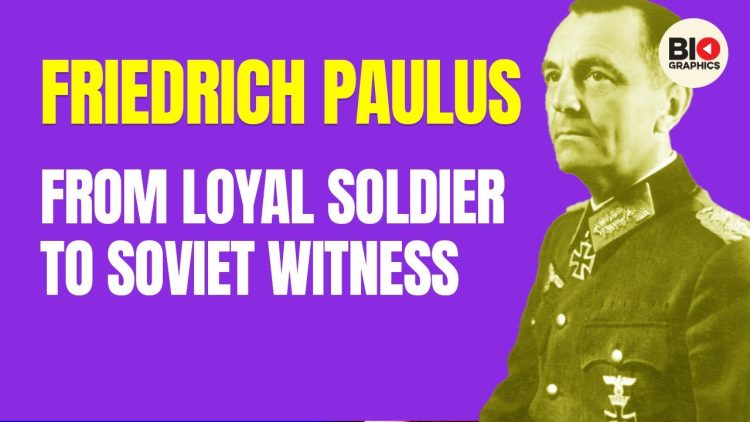
Friedrich Paulus: Surrender at Stalingrad
Friedrich Paulus is remembered for one moment: his surrender at Stalingrad. It is the moment this film is built around, and it is one of the turning points of the Second World War. Paulus commanded the German Sixth Army, the force sent to take Stalingrad, and he was the man who, when the battle was lost, gave up the fight. The film tells the story of how a general reached that moment — and what it cost him, his army, and the war his country was fighting.
The story begins with the invasion. Paulus was part of the German war machine that invaded the Soviet Union in Operation Barbarossa, the vast offensive that opened the eastern front. The film’s further reading points to that campaign, and to the scale of it: an invasion that stretched across a continent, and a war that would be decided, in the end, on the ground of the Soviet Union. Paulus rose within that machine, and the command of the Sixth Army — one of the largest formations in the German army — was the summit of his career.
Stalingrad was the city where that career ended. The battle for the city was one of the most terrible of the war: months of fighting, street by street, house by house, in a ruined city on the Volga. The Sixth Army went in to take it, and found itself in a battle it could not win. The film follows the battle as a story of encirclement and attrition — an army that advanced into a city and discovered, too late, that it could not get out. The hinge of the history, as one account of the battle calls it, was the moment the Sixth Army was cut off, and the war turned.
The surrender is the film’s centre. Paulus, the commander, faced a choice that no general wants to face: to keep fighting a battle that was lost, or to surrender and save what was left of his men. The film presents the surrender as the end of the Sixth Army, and as a turning point for the war itself. Stalingrad was where the German advance stopped, and where the Soviet advance began. The battle is remembered as a hinge of history — and Paulus, the man who surrendered, is remembered as the man who was there when it turned.
By the end, the film has followed Paulus past the surrender, to the part of his story that is less well known. He survived the war, and he was cross-examined at Nuremberg — the trials where the leaders of the defeated regime were called to account. The film’s further reading points to that cross-examination, and to the strange afterlife of a defeated general: a man who had commanded an army, and who ended the war as a witness to its crimes. The story of Friedrich Paulus, the film suggests, is the story of a career that rose with an army and fell with it — and of a surrender that changed the war.
What the Film Explores
The film explores the rise first: Paulus’s career within the German army, and the command of the Sixth Army. The documentary treats the command as the summit of a career built in the war machine that invaded the Soviet Union — an army, and a general, at the height of their power. The film’s interest is in how that height was reached, and how quickly it fell.
A second thread follows the invasion itself — Operation Barbarossa, and the war on the eastern front. The film sets Paulus’s story in that context: a vast offensive, a continent at war, and an army advancing into the Soviet Union. The documentary’s further reading points to the history of the campaign, and to the scale of the war that Paulus was part of. Stalingrad was not the beginning of that war. It was the place where it turned.
A third thread follows the battle: Stalingrad, and the encirclement of the Sixth Army. The film presents the battle as one of the most terrible of the war — months of fighting in a ruined city, an army cut off, and a commander facing a choice no general wants to make. The documentary follows the battle’s logic: the advance, the encirclement, the attrition, and the moment when the army that had come to take a city found itself trapped in one.
Running through the film is the surrender, and what followed it. The film treats the surrender as the hinge of the history: the moment the Sixth Army ceased to exist as a fighting force, and the moment the war on the eastern front turned. And it follows Paulus past that moment — to his survival, and to his cross-examination at Nuremberg, where the defeated general became a witness. The surrender, the film argues, was not the end of Paulus’s story. It was the middle of it.
Key Themes & Topics Examined
- Friedrich Paulus, and the command of the Sixth Army
- Operation Barbarossa, and the invasion of the Soviet Union
- Stalingrad, and the battle for the ruined city
- The encirclement of the Sixth Army
- The surrender, and the end of an army
- Stalingrad as the hinge of history
- A defeated general, and the cross-examination at Nuremberg
- A career that rose with an army and fell with it
Production & Background
The film is a Biographics production, from the channel’s series of biographical portraits. Biographics publishes new videos at least twice a week, and its portraits are built around the arc of a life — the rise, the turning points, and the questions that remain. This film follows that pattern: a general, a battle, and a surrender.
The documentary’s further reading points to the histories of the battle: the accounts of Stalingrad, the history of Operation Barbarossa, the record of the siege of Leningrad, and the transcript of Paulus’s cross-examination at Nuremberg. The film’s subject is a single moment — a surrender — and its argument is that the moment changed the war.
Recommended Companion Viewing
Explore authoritative investigative documentaries on related historical events and investigative subjects.

Norm MacDonald: The Comedian On The Outside
Frequently Asked Questions
Who was Friedrich Paulus?
The German general who commanded the Sixth Army at Stalingrad, and who surrendered there — the moment this film is built around.
What happened at Stalingrad?
The Sixth Army went in to take the city and found itself in a battle it could not win — encircled, worn down, and finally surrendered. The battle is remembered as a hinge of history, the point where the war on the eastern front turned.
What was Operation Barbarossa?
The German invasion of the Soviet Union, the vast offensive that opened the eastern front — the war Paulus and the Sixth Army were part of.
What happened to Paulus after the surrender?
He survived the war, and he was cross-examined at Nuremberg — the trials where the leaders of the defeated regime were called to account.
Who made the film?
Biographics, the channel behind a long series of biographical portraits, published at least twice a week.