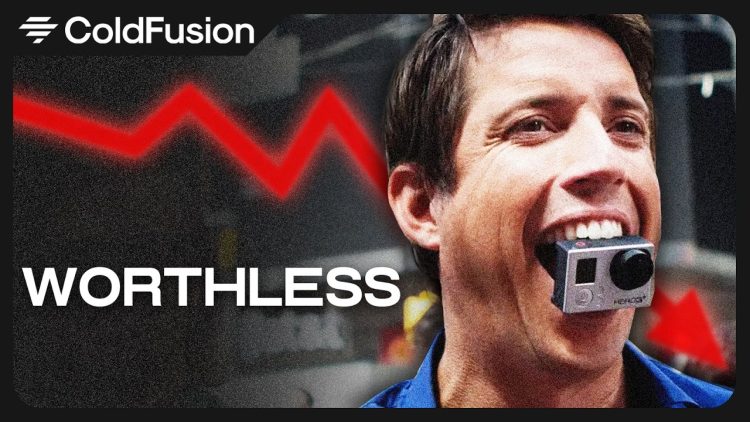
Why Everyone Stopped Buying GoPro
There was a time when GoPro was not just a camera company but a cultural phenomenon. The little rugged camera that could be strapped to a helmet, a surfboard or a handlebar turned ordinary people into filmmakers, and it turned its founder into one of the most famous chief executives in America. At one stage, GoPro’s chief executive Nick Woodman was the highest paid chief executive in the United States. Today, the company is no longer what it once was. This film is the story of that rise and fall — and of the strange final twist, in which a YouTuber named Markiplier became part of the story.
The rise began with a simple problem. Woodman, a surfer, wanted a way to film himself riding waves, and the cameras of the early 2000s could not do it. He built one: a small, tough, wearable camera that went where its owner went. The action camera became a new category of consumer electronics, and GoPro owned it. The company went public in June 2014, its shares rocketing from an opening price of 24 dollars to nearly 100 dollars within months.
The fall, the film argues, was not a single event but a slow unravelling. Smartphones got better cameras, and for most people a phone in a pocket did the job a dedicated action camera once did. GoPro tried to become more than a camera company: it built an entertainment division, and it built a drone, the Karma, which was recalled soon after launch. Neither bet paid off. The company that had once been valued in the billions saw its share price collapse by almost everything it had gained, and the question of what GoPro was for — beyond the camera — was never convincingly answered.
What makes the film more than a business obituary is the twist it ends on. Markiplier, one of YouTube’s biggest creators, quietly built a significant stake in the company, and when the holding became public the share price jumped sharply in a single day. It is a strange coda to the story: the creator economy that had helped make GoPro famous, coming back to move the company’s fate. The film’s argument is that GoPro’s story is really a story about YouTube — about a product that lived on the platform, and a platform that ended up owning the product’s destiny.
By the end, the film has become a cautionary tale about success. GoPro invented a category, dominated it, and then discovered that inventing a category is not the same as building a lasting business. The film closes on the question it opened with: why did everyone stop buying GoPro? Its answer is that they never really stopped buying cameras. They stopped needing a separate one, and GoPro never found a second act.
What the Film Explores
The film explores the rise first, and it is a classic founder story. A surfer with a problem, a homemade solution, a product that found an audience far larger than its inventor imagined. The documentary follows the arc from garage project to public company, and it is interested in the moment when the product stopped being a niche tool for surfers and became a mass-market object — the point at which GoPro stopped selling cameras to athletes and started selling them to everyone.
A second thread follows the peak, and the film is at its most vivid here. The 2014 public listing, the shares climbing toward 100 dollars, Woodman becoming the highest paid chief executive in America on the back of a huge stock award — the documentary presents the peak as the moment the story turned. Success on that scale changes a company, and the film’s argument is that GoPro’s success changed it for the worse: it encouraged expansion, hiring and ambition on a scale the underlying business could not support.
A third thread follows the decline, and the film takes it step by step. The improving smartphone camera, which quietly removed the reason most people bought a second camera. The entertainment division, an attempt to turn user footage into a media business, which was shut down. The Karma drone, recalled after launch, which cost the company money and credibility. Each failure is presented not as bad luck but as a symptom: a company trying to be something other than what it was good at.
Running through the film is the Markiplier twist — the question the description poses directly, of what the YouTuber has to do with GoPro’s story. The documentary treats it as the final chapter: a creator from the platform that made GoPro famous taking a stake in the company, and the market reacting. It is, the film suggests, a fitting end to a story that was always about the relationship between a product and the people who filmed with it.
Key Themes & Topics Examined
- Nick Woodman, the surfer who invented the action camera
- The 2014 public listing, and the highest paid chief executive in America
- How the smartphone quietly killed the second camera
- The entertainment division, and the attempt to become a media company
- The Karma drone, and a recall that cost money and credibility
- A one-product company, and the problem of the second act
- Markiplier, and what a YouTuber has to do with GoPro’s fate
- A cautionary tale about success, and what it does to a company
Production & Background
The film is a ColdFusion production, created by Dagogo Altraide and produced by Tawsif Akkas and Dagogo Altraide. ColdFusion is the channel behind a long series of technology and business documentaries, and this episode follows its pattern: a company, a rise, a fall, and the question of what went wrong.
The documentary’s subject is GoPro, the action camera company founded by Nick Woodman. Its framing is the one the description gives: the rise and fall of GoPro, and what the YouTuber Markiplier has to do with it — a story that runs from a surfer’s wrist-strapped camera to a public company, and back to the creator economy that made it famous.
Recommended Companion Viewing
Explore authoritative investigative documentaries on related historical events and investigative subjects.

How 3 Million People Got Locked Out of their Bank
Something is jamming GPS over Europe. Here's what we found
AI Keeps Pissing Off Mathematicians
How Flappy Bird Ruined The Life of its Creator
Frequently Asked Questions
What is the film about?
The rise and fall of GoPro, the action camera company — from its founding by surfer Nick Woodman to its peak as a public company, and its long decline afterwards.
Why was Nick Woodman the highest paid CEO in America?
At the time of GoPro’s 2014 public listing, Woodman received a large stock award that made his compensation for the year the highest of any chief executive in the United States.
What went wrong for GoPro?
The film points to several causes: smartphone cameras improving until most people no longer needed a second camera, a failed entertainment division, and the Karma drone, which was recalled soon after launch.
What does Markiplier have to do with it?
The YouTuber quietly built a significant stake in GoPro, and when the holding became public the share price jumped sharply — a final twist in which the creator economy that made GoPro famous came back to move its fate.
Who made the film?
ColdFusion, created by Dagogo Altraide, the channel behind a series of technology and business documentaries.