
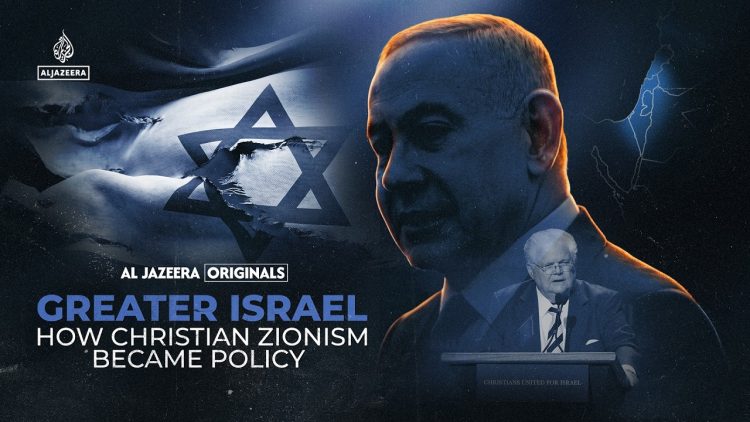
Greater Israel: How Christian Zionism became policy
A sermon becomes a map. A map becomes policy. And policy becomes land taken, homes emptied and borders redrawn. That is the opening of this film, and it is the whole of its argument in three sentences. ‘Greater Israel: How Christian Zionism Became Policy’ is a 24-minute Al Jazeera Originals documentary, directed by Awad Joumaa, and it traces how a centuries-old biblical idea travelled from English fringe pulpits to the heart of American politics — and from prophecy into the machinery of modern power.
The idea at the centre of the film is Christian Zionism: a religious vision of territory, rooted in a reading of the Bible, in which the land of Israel is understood as promised, and its extent as a matter of prophecy. The film follows that idea through the centuries, from the pulpits where it was first preached to the politics where it now operates. It is a story about how a theological claim becomes a political one — and about what happens when a vision of territory, held as a matter of faith, is taken up by people with power.
The journey the film traces is a long one. The idea began on the fringes — English pulpits, far from the centres of power, preaching a vision of a greater Israel that existed, at first, only in sermons. From there it travelled: across the Atlantic, into American religion, and from American religion into American politics. The documentary follows that movement step by step, showing how a fringe idea became a mainstream one, and how a mainstream idea became a policy — backed by votes, by money, by military infrastructure and by state policy.
What makes the film distinctive is the way it tells that story. It blends archival footage and AI-assisted visuals, using the archive for the history and the generated imagery for the ideas — the visions, the maps, the prophecies that exist, for the most part, in words rather than in pictures. The combination is deliberate: the film is about a vision of territory, and a vision needs to be shown as well as told. The archival footage grounds it in the real; the AI-assisted visuals show what the vision looks like from the inside.
By the end, the film has asked the question it says no longer belongs only to theologians or historians: what happens when a religious vision of territory is backed by votes, money, military infrastructure and state policy? The answer, as the documentary presents it, is in its opening lines: a sermon becomes a map, a map becomes policy, and policy becomes land taken, homes emptied and borders redrawn. The film’s subject is an idea, and its argument is that ideas, given power, become facts on the ground.
What the Film Explores
The film explores the idea first: Christian Zionism, and the biblical vision of territory at its heart. The documentary treats the idea as a real historical force — a centuries-old reading of the Bible in which the land is promised and its extent is a matter of prophecy. The film’s interest is in how such an idea works: how a theological claim about land becomes, over time, a political claim about borders.
A second thread follows the journey: from English fringe pulpits to the heart of American politics. The film traces the idea’s movement across centuries and across an ocean — from the margins of English religion to the centre of American power. The documentary presents that journey as the story of an idea finding its audience: preached in pulpits, taken up in churches, and carried, step by step, into the rooms where policy is made.
A third thread follows the transformation: from prophecy into the machinery of modern power. The film shows what happens when the vision is backed by the instruments of the state — by votes, by money, by military infrastructure, by state policy. The prophecy does not stay a prophecy. It becomes a map, and the map becomes a policy, and the policy becomes land taken, homes emptied and borders redrawn. The documentary’s argument is that this transformation is the story, and that it is still happening.
Running through the film is the question it poses directly: what happens when a religious vision of territory is backed by votes, money, military infrastructure and state policy? The film suggests that the question no longer belongs only to theologians or historians — it belongs to everyone who lives with the consequences. The archival footage and the AI-assisted visuals are the film’s way of asking it: the footage shows what happened, and the visuals show what was imagined, and the gap between the two is the film’s subject.
Key Themes & Topics Examined
- Christian Zionism, and a centuries-old biblical idea
- A sermon becomes a map, a map becomes policy
- From English fringe pulpits to the heart of American politics
- From prophecy into the machinery of modern power
- Votes, money, military infrastructure and state policy
- Land taken, homes emptied and borders redrawn
- Archival footage and AI-assisted visuals
- A question for theologians, historians — and everyone else
Production & Background
The film is an Al Jazeera Originals documentary, directed by Awad Joumaa, running 24 minutes. Al Jazeera Originals is the channel’s strand for feature documentaries, and this film follows its pattern: a single subject, traced through its history, and presented as a question about the present.
The documentary blends archival footage and AI-assisted visuals, using the archive for the historical record and the generated imagery for the visions and maps that are the film’s subject. Its structure follows the journey it describes: from the pulpit, to the politics, to the policy — and to the land itself.
Recommended Companion Viewing
Explore authoritative investigative documentaries on related historical events and investigative subjects.

Iran: Diary from a warzone
How a Mexican Migrant Farmer’s Journey to the U.S. Turned Fatal
Venezuela in the midst of the US military intervention - Notes from Caracas
Congo's blood minerals - The high price of high-tech
Frequently Asked Questions
What is the film about?
How Christian Zionism became policy: a centuries-old biblical idea that travelled from English fringe pulpits to the heart of American politics, and from prophecy into the machinery of modern power.
Who directed it?
Awad Joumaa, as a 24-minute Al Jazeera Originals documentary.
What does ‘a sermon becomes a map’ mean?
It is the film’s opening argument: a religious vision of territory becomes a map, the map becomes policy, and policy becomes land taken, homes emptied and borders redrawn.
How is the film made?
It blends archival footage and AI-assisted visuals — the archive for the history, the generated imagery for the visions and maps at the heart of the idea.
What question does the film ask?
What happens when a religious vision of territory is backed by votes, money, military infrastructure and state policy? The film argues that question no longer belongs only to theologians or historians.







