
How Indian Fashion Inspires the World
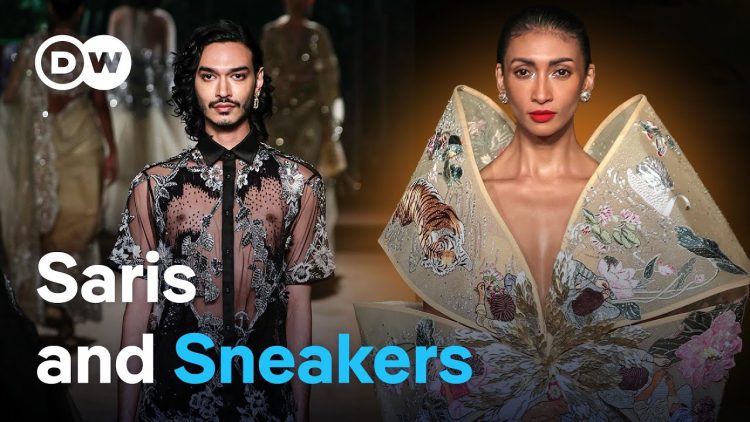
Indian fashion is inspiring the world. From Mumbai to Delhi, and Chennai to Paris, young Indian designers are using innovative ideas to enrich the country’s fashion culture — from saris to sneakers to luxurious fabrics, all with gorgeous craftsmanship. This film meets the designers who are making sure Indian fashion goes global, and it follows them from their workshops to the world’s runways.
The film’s first stop is the top of the mountain. Rahul Mishra has made it to the Mt. Olympus of Parisian haute couture, and his fashion designs are worn by stars like Zendaya and Gigi Hadid. The documentary goes behind the scenes as he prepares for a Paris show, and visits his workshop on the outskirts of Delhi, where the work that ends up on the world’s most famous bodies is actually made — slowly, by hand, and with a level of craft that the camera lingers on.
From Delhi, the film travels to Varanasi, an ancient Indian city with a rich heritage, to meet Hemang Agrawal — an innovative designer with a deep respect for tradition. His fine woven fabrics sell around the world, and the film shows how a designer can be both innovative and traditional at once, using the weaving heritage of one of India’s oldest cities to make cloth that the rest of the world wants to buy.
In Mumbai, the film meets the people dressing the stars and reinventing the classics. Pyu Mishra styles Bollywood stars and takes the viewer to the hottest young designers in the city. SUTA is a rapidly expanding young fashion label in Mumbai that designs saris and sometimes pairs them with sneakers — the work of two young women who are putting a fresh twist on India’s traditional dress with new shapes, cheeky modern patterns and super-soft fabrics. It is the film’s clearest image of what the new Indian fashion looks like: traditional dress, worn in a new way, without apology.
The journey continues to Chennai, formerly Madras, where RMKV is one of the largest and best-known suppliers of high-quality wedding saris — a traditional company founded in 1924. Then to NorBlack NorWhite, founded by Amrit and Mriga, who were raised in Toronto and whose designs have captured the spirit of a young Indian generation that combines the traditional with the contemporary and does not see that as a contradiction. There is Vino Supraja, a designer from South India who wants to inspire the world with the colours and styles of her homeland, and who is also a pioneer of sustainable design. And last but not least, the film gets an exclusive audience with Ritu Beri — the fashion queen of India, who has even had a stamp dedicated to her.
What the Film Explores
The film explores the idea in its title first: that Indian fashion is inspiring the world, and that the inspiration runs in both directions. The designers it follows are not copying Paris or New York. They are taking Indian craft — weaving, embroidery, the sari itself — and putting it in front of the world on their own terms, and the world is responding. From Mumbai to Delhi, and Chennai to Paris, the film maps a fashion culture that is no longer regional but global.
A second thread follows the craft, and the film spends real time in the workshops. Mishra’s workshop on the outskirts of Delhi, Agrawal’s weaving in Varanasi, the saris of RMKV in Chennai — in each place, the documentary shows the handwork behind the glamour. The gorgeous craftsmanship the film keeps returning to is not a backdrop; it is the argument. Indian fashion is going global, the film suggests, because the making of it is extraordinary, and because the designers refuse to separate the making from the design.
A third thread follows the new generation, and the film is at its liveliest here. SUTA’s saris with sneakers, NorBlack NorWhite’s blend of the traditional and the contemporary, Vino Supraja’s sustainable design from South India — these are designers who do not see tradition and modernity as opposites. They combine them, and the film presents that combination as the spirit of a young Indian generation: rooted, confident, and uninterested in choosing between the past and the present.
Running through the film is the figure of the star designer, and the two poles of the story. At one end is Rahul Mishra, in Parisian haute couture, dressing Zendaya and Gigi Hadid. At the other is Ritu Beri, the fashion queen of India, honoured with a stamp of her own. Between them is a whole ecosystem — the stylists, the weavers, the young labels — and the film’s achievement is to show that ecosystem as a whole, rather than as a single success story.
Key Themes & Topics Examined
- Rahul Mishra — Parisian haute couture, worn by Zendaya and Gigi Hadid
- The workshop on the outskirts of Delhi, and the Paris show
- Hemang Agrawal — fine woven fabrics from Varanasi
- Pyu Mishra — styling Bollywood stars in Mumbai
- SUTA — saris with sneakers, and a fresh twist on traditional dress
- RMKV, Chennai — wedding saris since 1924
- NorBlack NorWhite — the traditional and the contemporary, combined
- Vino Supraja and Ritu Beri — sustainable design, and the fashion queen of India
Production & Background
The documentary is a DW production that travels across India and to Paris, following designers from Mumbai, Delhi, Varanasi and Chennai. Its structure follows the journey itself — from the workshops where the clothes are made, to the shows where they are seen, to the designers who are carrying Indian fashion onto the world stage.
The film’s cast spans the generations of Indian fashion: the established names like Rahul Mishra and Ritu Beri, the heritage companies like RMKV, founded in 1924, and the young labels like SUTA and NorBlack NorWhite, who are rewriting what Indian dress can look like. The documentary presents them not as rivals but as parts of a single, fast-moving story.
Recommended Companion Viewing
Explore authoritative investigative documentaries on related historical events and investigative subjects.

The missing Van Gogh
The magic of colors
Frequently Asked Questions
Who is Rahul Mishra?
A designer who has made it to the Mt. Olympus of Parisian haute couture. His fashion designs are worn by stars like Zendaya and Gigi Hadid, and the film follows him as he prepares for a Paris show and visits his workshop outside Delhi.
What is SUTA?
A rapidly expanding young fashion label in Mumbai that designs saris and sometimes pairs them with sneakers. Two young women run it, putting a fresh twist on India’s traditional dress with new shapes, cheeky modern patterns and super-soft fabrics.
Who is Hemang Agrawal?
An innovative designer with a deep respect for tradition, living and working in Varanasi. His fine woven fabrics sell around the world.
What is RMKV?
One of the largest and best-known suppliers of high-quality wedding saris, based in Chennai. It is a traditional company founded in 1924.
Who is Ritu Beri?
Described in the film as the fashion queen of India — she has even had a stamp dedicated to her.







