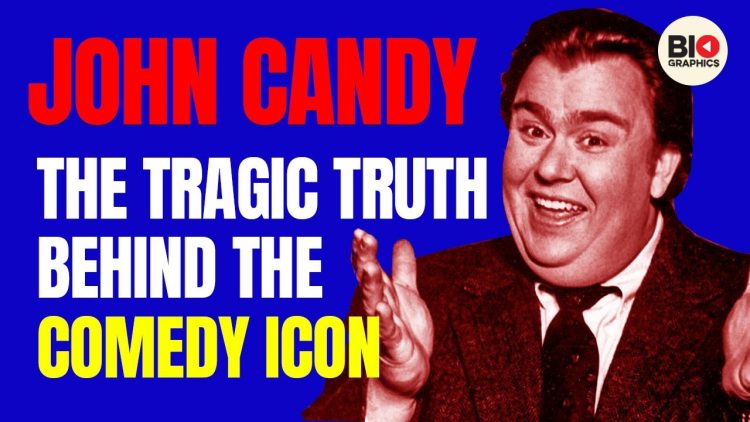
John Candy: The Larger-Than-Life King of Canadian Comedy
John Franklin Candy was born on October 31, 1950, in Newmarket, Ontario, and grew up in Toronto. He was a big man with an even bigger presence, and for two decades he was one of the most recognisable faces in comedy.
Candy found his calling in improvisation. He joined the Toronto branch of The Second City in 1972, and when the troupe’s sketch show, Second City Television, reached a North American audience, he became one of its best-loved performers. His characters were a gallery of loveable rogues and blowhards: the unscrupulous street-beat television personality Johnny LaRue, the 3-D horror auteur Doctor Tongue, the sycophantic talk-show sidekick William B. Williams, and Melonville’s corrupt Mayor Tommy Shanks.
Hollywood came calling in the 1980s, and Candy’s film career reads like a list of the decade’s best-loved comedies. He played the dopey recruit Ox in Stripes (1981), the womanising brother in Splash (1984), and the best friend in Brewster’s Millions (1985). In 1987 he had two of his defining roles in the same year: Barf the half-man, half-dog in Mel Brooks’s Spaceballs, and Del Griffith, the shower-curtain-ring salesman who will not leave Steve Martin alone, in John Hughes’s Planes, Trains and Automobiles. The Great Outdoors followed in 1988, and in 1989 he played the title role in Uncle Buck, the slovenly uncle who turns out to be exactly what a family in crisis needs.
What made Candy special was that his characters were never cruel. He played men who were large, loud and often in over their heads, but they were generous, kind and fundamentally decent, and audiences loved him for it. Off screen he had the same reputation: colleagues described him as one of the most amiable and easygoing people in Hollywood. He was also a proud Canadian who co-owned the Toronto Argonauts of the Canadian Football League; the team won the Grey Cup in 1991 under his ownership. On March 4, 1994, while filming Wagons East in Durango, Mexico, Candy died of a heart attack. He was 43. His final films, Wagons East and the already completed Canadian Bacon, were released posthumously and dedicated to his memory.
What the Film Explores
The film explores how a Canadian stage comic became a Hollywood star without ever losing his Canadian identity. Candy’s comedy was rooted in the improvisational tradition of The Second City, where a performer had to invent characters on the spot and keep them alive in front of a live audience. That training gave him something film actors often lack: the ability to make a scripted scene feel spontaneous, as if the joke had just occurred to him.
It also explores the particular kind of stardom Candy achieved. He was rarely the romantic lead or the action hero. He was the best friend, the uncle, the salesman, the coach — the character who made the film work by being the most human person in it. The film argues that this was not a limitation but a gift: Candy played ordinary people under extraordinary pressure, and his gift was making their decency funny. In Uncle Buck and Planes, Trains and Automobiles, the joke is never that the character is a fool.
Finally, the film explores the cost of the life Candy lived. He struggled with his weight, with overeating and heavy smoking, and his father had died of a heart attack at 35. The film does not moralise about this, but it does not hide it either. Candy’s death at 43, in the middle of a film shoot, shocked Hollywood because he seemed to have so much more to give. A documentary about his life, John Candy: I Like Me, directed by Colin Hanks, premiered as the opening film of the 2025 Toronto International Film Festival, a sign that his reputation has only grown since his death.
Key Themes
- From stage to screen: Candy’s career began in Toronto improvisation, and the spontaneity he learned at The Second City shaped everything he did in film.
- The SCTV years: characters like Johnny LaRue and Doctor Tongue made him a star in Canada and won the show Emmy Awards for its writing in 1981 and 1982.
- The 1980s comedy run: Stripes, Splash, Spaceballs, Planes, Trains and Automobiles, Uncle Buck and Cool Runnings made him one of the decade’s defining comic actors.
- Decency as comedy: his characters were loud and chaotic, but they were kind, and audiences loved him because the joke was never cruel.
- A proud Canadian: he stayed rooted in Toronto, co-owned the Argonauts, and celebrated a Grey Cup win in 1991.
- A life cut short: his death from a heart attack at 43, while filming in Mexico, ended a career that still seemed to be rising.
Production and Background
The film is a Biographics production, from the channel’s long-running series of biographical documentaries about notable lives. It draws on Martin Knelman’s biography Laughing on the Outside: The Life of John Candy, as well as the Canadian Encyclopedia and the Second City’s own archives, and it follows the channel’s usual approach: a clear, chronological telling of the life, built around the work rather than the gossip.
Candy’s legacy is visible in the comedians who followed him. The big-hearted comic who steals a film by being the most human person in it is a role that still exists in Hollywood comedy, and it still traces back to him. His films remain staples of the genre, and Planes, Trains and Automobiles is still watched every Thanksgiving in the United States.
Recommended Companion Viewing
Explore authoritative investigative documentaries on related historical events and investigative subjects.

Mikhail Gorbachev: The Last Soviet Leader
Norm MacDonald: The Comedian On The Outside
Frequently Asked Questions
When was John Candy born, and where? John Franklin Candy was born on October 31, 1950, in Newmarket, Ontario, Canada, and grew up in Toronto.
How did John Candy become famous? He joined Toronto’s Second City in 1972 and became a star on its sketch show Second City Television (SCTV), which won Emmy Awards for its writing in 1981 and 1982. His film career took off in the 1980s with Stripes, Splash, Spaceballs, Planes, Trains and Automobiles and Uncle Buck.
What are John Candy’s most famous films? Stripes (1981), Splash (1984), Brewster’s Millions (1985), Spaceballs (1987), Planes, Trains and Automobiles (1987), The Great Outdoors (1988), Uncle Buck (1989) and Cool Runnings (1993).
How did John Candy die? He died of a heart attack on March 4, 1994, aged 43, while filming Wagons East in Durango, Mexico. His final films, Wagons East and Canadian Bacon, were released after his death and dedicated to his memory.
More to watch
- John Belushi: From Second City and Saturday Night Live to Tragedy
- Norm MacDonald: The Comedian On The Outside
- Bob Saget: America’s Greatest and Most Controversial TV Dad and Stand Up Comedian
- Alan Rickman: Cinema’s Greatest Silver Tongued Devil
- Humphrey Bogart: The Greatest Icon of Classic Hollywood
Candy’s path through Second City and into film closely mirrors that of his friend and fellow troupe member, as John Belushi: From Second City and Saturday Night Live to Tragedy shows.