
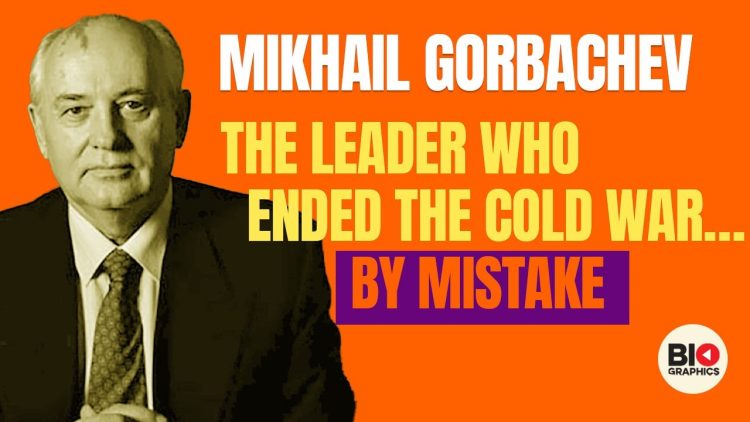
Mikhail Gorbachev: The Last Soviet Leader
Mikhail Gorbachev was born on March 2, 1931, in the village of Privolnoye in the Stavropol region of southern Russia, the son of peasants, and he grew up in the shadow of Stalin’s terror and the Second World War. He studied law at Moscow State University, where he joined the Communist Party and married a fellow student, Raisa Titorenko, in 1953. He rose through the party ranks in Stavropol, became a member of the Central Committee in 1971, and in 1980, at forty-nine, became the youngest full member of the Politburo, the party’s supreme policy-making body. On March 11, 1985, the day after Konstantin Chernenko died, the Politburo elected him general secretary of the Communist Party of the Soviet Union. He was, in effect, the leader of the Soviet Union, and he set out to save it.
Gorbachev’s programme had two words at its heart: glasnost, meaning openness, and perestroika, meaning restructuring. Glasnost was a cultural thaw: freedom of expression and information expanded, the press was allowed unprecedented candour, and the legacy of Stalinist rule was eventually repudiated by the government itself. Perestroika was the attempt to fix the economy: modest democratic reforms, multicandidate elections with a secret ballot, and the first limited free-market mechanisms in a system that had been centrally planned for seventy years. The reforms ran into fierce resistance from party and government bureaucrats who would not give up their control, and the economy, stagnant after the years of drift under Leonid Brezhnev, did not improve fast enough.
Abroad, Gorbachev changed the world faster than anyone expected. He cultivated warmer relations with the West, above all with the United States, and in a series of summit meetings with President Ronald Reagan he signed the Intermediate-Range Nuclear Forces Treaty in December 1987, the first agreement to eliminate an entire class of nuclear weapons. He withdrew Soviet troops from Afghanistan, completing the pullout in February 1989, and he refused to use force to hold the Soviet bloc together: when the communist regimes of Eastern Europe fell in 1989, and the Berlin Wall came down on November 9, 1989, he let them fall.
At home, the opening he had created ran ahead of him. The Baltic republics demanded independence, ethnic tensions flared in Armenia, Georgia, Ukraine and Moldova, and the economy slid towards collapse. In August 1991 communist hardliners staged a three-day coup attempt while Gorbachev was on holiday in Crimea; it failed, but it destroyed what was left of his authority, and power shifted to Boris Yeltsin, the president of the Russian Republic. On December 8, 1991, the leaders of Russia, Ukraine and Belarus formed the Commonwealth of Independent States, and on December 25, 1991, Gorbachev resigned the presidency. The Soviet Union ceased to exist the same day. He lived on for thirty more years, founding the Gorbachev Foundation in 1992 and Green Cross International, an environmental organisation, in 1993, and running for president of Russia in 1996, when he won about one percent of the vote. He died in Moscow on August 30, 2022, aged ninety-one, the last leader of a country that no longer exists.
What the Film Explores
The film explores the paradox at the centre of Gorbachev’s life: a man who set out to reform communism and ended it instead. It shows how glasnost and perestroika were meant to save the system by making it more honest and more efficient, and how the honesty destroyed the system faster than the efficiency could save it.
It also explores the relationship with Reagan, the Cold War’s odd couple: the American president who had called the Soviet Union an evil empire, and the Soviet leader who wanted to end the arms race.
Finally, the film explores Gorbachev’s reputation, which is split in two. In the West he is remembered as the man who ended the Cold War and won the Nobel Peace Prize. In Russia he is remembered very differently, as the leader who lost an empire and presided over economic collapse, and who was never forgiven for it. The film does not try to reconcile the two verdicts.
Key Themes
- The peasant’s son: born in 1931 in Privolnoye, Gorbachev rose through the party to become the youngest full member of the Politburo in 1980.
- Glasnost: his policy of openness expanded freedom of expression and repudiated the legacy of Stalinist rule.
- Perestroika: restructuring brought multicandidate elections and the first market mechanisms, but the economy did not improve fast enough.
- The Reagan summits: four meetings between 1985 and 1988 led to the INF Treaty of December 1987, eliminating an entire class of nuclear weapons.
- 1989: the withdrawal from Afghanistan, the fall of the Berlin Wall on November 9, and the end of Soviet domination of Eastern Europe.
- The August Coup: the failed hardliner coup of August 1991 destroyed Gorbachev’s authority and shifted power to Boris Yeltsin.
Production and Background
The film is a Biographics production, from the channel’s long-running series of biographical documentaries, and it follows the channel’s usual approach: a clear, chronological telling of the life, built around the work rather than the gossip, and drawing on the standard sources, including William Taubman’s biography Gorbachev: His Life and Times and the Nobel Prize’s own biographical account.
Gorbachev’s legacy is still argued over in Russia, where he is blamed for the chaos of the nineties, and celebrated in the West, where he is credited with ending the Cold War without a shot being fired. He was the only Soviet leader who was never a Stalinist, the only one who tried to give his people a voice, and the last one there was.
Recommended Companion Viewing
Explore authoritative investigative documentaries on related historical events and investigative subjects.

Boris Yeltsin: The First Russian President
Frequently Asked Questions
Who was Mikhail Gorbachev? Mikhail Gorbachev (1931-2022) was the last general secretary of the Communist Party of the Soviet Union (1985-91) and the last president of the Soviet Union (1990-91).
What do glasnost and perestroika mean? Glasnost means “openness”: freedom of expression and information, and an end to the censorship and secrecy of the Stalinist system.
What was the INF Treaty? The Intermediate-Range Nuclear Forces Treaty, signed by Gorbachev and President Ronald Reagan in December 1987, was the first agreement to eliminate an entire class of nuclear weapons, removing all ground-launched ballistic and cruise missiles with ranges between 500 and 5,500 kilometres.
When did the Soviet Union end? On December 25, 1991, when Gorbachev resigned the presidency.
More to watch
- The Untold Story of the Reagan Presidency
- 1945 – 1961: The Complete Story Of The Early Cold War
- Mao’s China: Against the World
- King George V: Founder of the Modern British Monarchy
- Jimmy Hoffa: What Happened to America’s Most Infamous Union Boss?
Gorbachev’s story cannot be told without Reagan, and The Untold Story of the Reagan Presidency tells the other side of the summits that ended the Cold War.







