
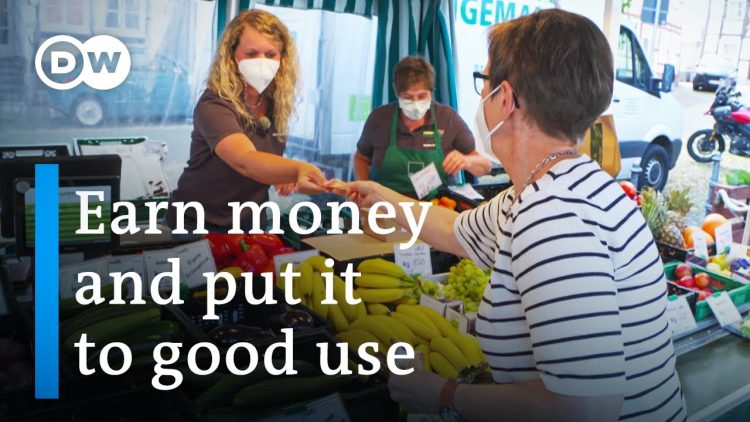
Money isn’t everything – A new definition of wealth | DW Documentary
Most investing is aimed at generating as much profit as possible. But that is slowly changing. Some people are now working on a new definition of wealth, and the idea at its heart is simple: earn money and put it to good use.
The first stop is Kenya, where the company BURN is developing a resource-friendly oven for the country’s rural population. In large areas of Kenya, forest is cut down to meet the huge demand for firewood, and the smoke from open fires damages the health of the people who cook over them. BURN’s stove, the Jikokoa, burns far less fuel than an open fire — its design cuts fuel consumption by more than half — and it is made in Kenya, in a factory founded in 2011 by Peter Scott. The company needs capital if it is to expand, and that capital is organised by Olga Dickmann, through what is known as crowdinvesting. Instead of putting their money into anonymous funds, investors choose this model to support a specific sustainable, environmentally friendly project.
The same idea — investing money while doing good at the same time — is being pursued in the German city of Münster. For decades, Münster has been a pioneer in local climate protection, and it invests in what are known as climate trainers: local people who are trained to become CO2 experts, then go on to advise households and companies on how to cut their emissions. The programme has been an outright success. Since its launch, the annual carbon dioxide emissions of Münster households have been a total of 2.5 tons less per household than those of the average German household.
The third portrait is the Engemann family from the region of Höxter, who grow organic fruit, vegetables and cereals. They are well connected and support other organic smallholdings in the area. In 2020, they compiled what is known as a balance sheet for the common good. This does not only show the financial profits from their business, but also its social and ecological value: what it gives back to the soil, to the community and to the people who work there. It is a model that has gained a foothold internationally too. Nations like Scotland, New Zealand and Iceland no longer want to measure their wealth by GDP alone, but also by new indicators of success such as social justice and eco-friendliness. The film’s argument is that these are not three separate stories. They are the same story, told in three places: wealth, redefined.
What the Film Explores
The film explores crowdinvesting as an alternative to anonymous finance. In the conventional system, a saver puts money into a fund and has little idea where it goes. Crowdinvesting reverses that: the investor chooses a specific project, knows what it does, and accepts a return that is modest but real. The film shows how that works in practice for BURN, where many small investments together provide the capital a growing company needs.
It also explores the idea that a city can invest in people rather than in infrastructure. Münster’s climate trainers are not a power station or a tram line. They are neighbours, trained to advise other neighbours on insulation, heating and energy use. The film shows why that works: advice from someone you trust, in your own language, about your own house, is far more effective than a leaflet.
Finally, the film explores what happens when a country stops measuring itself by GDP alone. Scotland, New Zealand and Iceland have all moved towards measuring wellbeing — social justice, health, education and the environment — alongside economic output. The film presents this not as an abstract policy debate but as the logical conclusion of the other two stories: if a stove in Kenya and a trainer in Münster can create wealth that GDP does not count, then GDP is not counting wealth properly. The new definition of wealth, the film suggests, is one that counts what matters.
Key Themes
- Crowdinvesting: small sums from many backers fund a specific sustainable project, and investors are repaid with interest — finance with a face.
- A stove that saves forests: BURN’s Jikokoa cuts fuel use by more than half, reducing the pressure on Kenya’s forests and the smoke in its kitchens.
- Climate trainers: Münster trains local people as CO2 experts, and its households now emit 2.5 tons less CO2 a year than the German average.
- The balance sheet for the common good: the Engemann farm measures its social and ecological value alongside its financial profit.
- Beyond GDP: Scotland, New Zealand and Iceland are measuring national success by wellbeing, justice and the environment as well as output.
- Wealth, redefined: the film’s three stories point to the same conclusion — that money is a means, not the measure.
Production and Background
The film is a DW Documentary production, in the broadcaster’s characteristic style of following a single idea through several locations and letting the people involved explain it in their own words.
The idea it presents has grown since the film was made. Crowdinvesting has become a recognised way of funding sustainable projects, and the wellbeing-economy movement has spread beyond the three countries the film names. The film remains a useful introduction to both, because it does not argue in the abstract.
Recommended Companion Viewing
Explore authoritative investigative documentaries on related historical events and investigative subjects.

Afghanistan's raw materials - The race is on
Earth Untold: Java | Hidden Tales from the World's Most Crowded Island
Global Junk Food: How the West is Poisoning the Developed World | ENDEVR Documentary
Backbreaking Work: Deep-Sea Fishing in the Arctic Ocean
Frequently Asked Questions
What is crowdinvesting? It is a form of investment in which many small investors together fund a specific project, rather than putting their money into an anonymous fund. In the film, Olga Dickmann organises crowdinvesting for BURN’s cookstoves in Kenya, and investors are repaid later with interest.
What does BURN’s stove do? BURN, a Kenyan company founded in 2011, makes the Jikokoa, a resource-friendly stove that cuts fuel consumption by more than half compared with an open fire, reducing both deforestation and indoor smoke.
What are Münster’s climate trainers? They are local people trained as CO2 experts who advise households and companies on cutting emissions. Since the programme began, Münster households have emitted 2.5 tons less CO2 a year than the average German household.
Which countries measure wealth beyond GDP? Scotland, New Zealand and Iceland are among the nations that now measure national success by indicators such as social justice, health and eco-friendliness as well as gross domestic product.
More to watch
- Why Botswana Got So Wealthy
- The Poor, The Banks & Digital Money
- Luxury Living and the Ultra-Rich – When Money is No Object
- How much influence do the super rich have?
- Overworked Underpaid: The Strange Economics of Essential Jobs
The question of what wealth is for runs through Why Botswana Got So Wealthy too, which asks how one African country turned natural resources into lasting prosperity.







