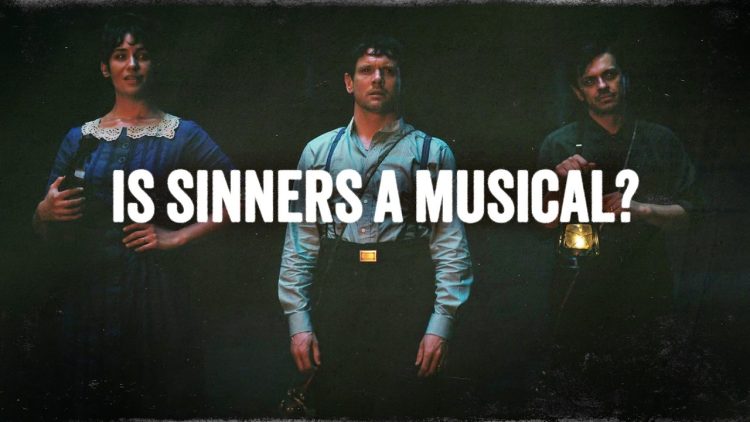
How Music Works in “Sinners”
In Ryan Coogler’s Sinners, a 2025 film set in 1932 in the Mississippi Delta, music is not background. It is the engine of the story. The film follows twin brothers Smoke and Stack, and their young cousin Sammie, a gifted guitarist whose playing can summon spirits from the past and the future. When Sammie plays, the room changes: musicians from other centuries appear beside him, the present blends with the past and the future, and the vampires are drawn to the sound.
The film’s musical world is built by composer Ludwig Goransson, Coogler’s long-time collaborator, who worked on the soundtrack from his own experience with American blues. The score was built around a 1932 Dobro Cyclops resonator guitar, the same kind of guitar Sammie carries through the film, and much of it was written on set, with the cast performing live alongside blues musicians. Goransson and Coogler worked together on the music from the beginning: Coogler played guitar during the scriptwriting sessions, and Goransson trained him on the instruments, so that the music was part of the story before a single scene was shot. The result is a film in which the songs are not placed on top of the action.
The blues is the film’s backbone. Sammie’s music is the Delta blues of the 1930s, played on a resonator guitar with a slide, and the film treats it as a living tradition rather than a museum piece: the soundtrack features living blues musicians including Bobby Rush, Cedric Burnside and Buddy Guy, who plays the older Sammie in the film’s later scenes. The blues in Sinners is the devil’s music, in the old sense: Sammie’s pastor father warns him against it, and the film takes that warning seriously. The music is powerful because it is dangerous, and it is dangerous because it opens a door.
Then there is the Irish music, and it is the film’s great surprise. The vampire Remmick, played by Jack O’Connell, is Irish, and when he arrives, he brings Irish folk with him: fiddle tunes, folk songs and a wild, joyful energy that is the mirror image of Sammie’s blues. The two traditions meet in the film’s most famous scene, when Remmick’s folk music erupts into a dance that is both a celebration and a threat. The essay draws on Leah Schnelbach’s writing on the Irish music in Sinners, which the video’s description links, to explain what Coogler is doing: the Irish songs are not decoration, they are the film’s other half, a second musical tradition with its own history of migration, loss and survival, and the collision between the two traditions is the film’s real subject.
A film about the power of music needs music with real power, and Sinners has it, as The healing power of music – How does music impact us? explores from the listener’s side of the same mystery.
What the Film Explores
The essay explores how Coogler and Goransson built the film’s sound from the ground up. There are no great recordings of the 1930s to copy: the surviving records are distorted, hissing and scratched, and the film footage of the period is largely lost. So Goransson built the sound from the instruments themselves, playing the 1932 Dobro himself, recording live on set with the cast and with blues musicians, and writing the score in the rooms where it would be heard.
It also explores the juke joint scene, the film’s centrepiece, in which Sammie’s playing causes the present to blend with the past and the future. The essay breaks down what is happening musically in that scene: the blues guitar, the voices, the layers of sound that build as musicians from other eras join in.
A third strand is the Irish music, and the essay gives it the attention it deserves. Remmick’s folk songs are not a joke or a gimmick. They are a fully realised musical world, with its own instruments, its own rhythms and its own history, and the essay traces how Coogler uses them to make Remmick both charming and terrifying.
Key Themes
- Music as a force: in Sinners, music summons spirits, crosses centuries and draws the vampires in — it is the engine of the story, not its background.
- The Delta blues: Sammie’s music is the blues of 1930s Mississippi, played on a 1932 Dobro resonator guitar, and performed live on set.
- Irish folk as the mirror: Remmick brings Irish folk songs and fiddle tunes, a second displaced tradition that collides with the blues.
- Built from the instruments: Goransson wrote the score on set, on period instruments, because no good recordings of the 1930s survive.
- The juke joint scene: Sammie’s playing blends past, present and future in the film’s centrepiece, and the music makes the supernatural visible.
- Two traditions, one history: the blues and Irish folk are both music of displaced peoples, and their meeting in 1932 Mississippi is the film’s real subject.
Production and Background
Sinners is a 2025 film written and directed by Ryan Coogler, his fifth collaboration with composer Ludwig Goransson, and his first non-franchise project since his debut Fruitvale Station in 2013. It stars Michael B. Jordan as the twins Smoke and Stack, and Miles Caton as Sammie, and it was filmed in Louisiana, in New Orleans, Bogalusa, Labadieville and Donaldsonville, with the story set over a single day in 1932 in Clarksdale, Mississippi.
The Polyphonic essay is part of the channel’s long-running project of explaining how popular music works, song by song and scene by scene, and it draws on the writing about the film’s Irish music, including Leah Schnelbach’s piece for Reactor, which the video’s description links.
Recommended Companion Viewing
Explore authoritative investigative documentaries on related historical events and investigative subjects.

Frequently Asked Questions
What is Sinners? Sinners is a 2025 film by Ryan Coogler, set in 1932 in Clarksdale, Mississippi, about twin brothers Smoke and Stack and their cousin Sammie, a gifted young guitarist whose music can summon spirits from the past and the future.
Who composed the music? Ludwig Goransson, Coogler’s long-time collaborator, composed the score and produced the soundtrack. He built the sound around a 1932 Dobro Cyclops resonator guitar and wrote much of it on set, with live performances by the cast and blues musicians.
Why is there Irish music in a film about the Mississippi Delta? The vampire Remmick, played by Jack O’Connell, is Irish, and he brings Irish folk songs and fiddle tunes with him. The film uses the Irish tradition as a mirror to the blues: both are music of displaced peoples, and their collision is the film’s central musical idea.
What happens in the juke joint scene? When Sammie plays in the juke joint, the music causes the present to blend with the past and the future, as musicians from other centuries appear beside him — the film’s most famous scene, and the moment its premise becomes visible.
More to watch
- Music in Nazi Germany – The maestro and the cellist of Auschwitz
- The healing power of music – How does music impact us?
- The Untold History of Disco
- How these Oscar Winners Changed Movie History