Mystery Places: Siberian Mega Mine, Most Dangerous Hotel & Extreme Airport
Some places on Earth are hard to believe until you see them. This episode of Mystery Places travels to a handful of them: a diamond mine in Siberia so vast it can be seen from space, a hotel in one of the most dangerous locations on the planet, an airport where landing is an extreme sport in itself, and a housing development in China built as a copy of an Austrian village. It is a tour of the strange, the extreme and the improbable, held together by one question: how did these places come to exist?
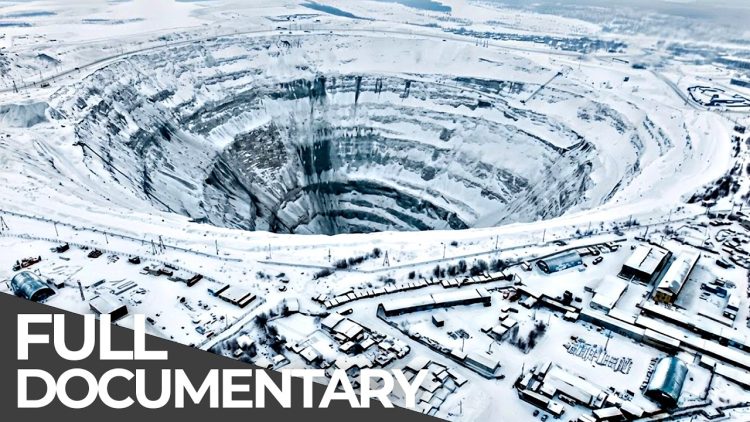
The journey begins in Siberia, at the Mirny diamond mine, the giant open pit in the Sakha Republic that the film calls the Siberian mega mine. Discovered in 1955 by Soviet geologists on the Amakinsky expedition, the Mir mine was the Soviet Union’s first developed diamond mine and became its largest. The pit is more than 525 metres deep and 1,200 metres across, one of the largest excavated holes in the world, and at its peak in the 1960s it produced around 10 million carats of diamonds a year. Open-pit mining ended in 2001, and the mine later continued underground.
From Siberia the film moves to the hotel it calls the most dangerous in the world, a place where staying the night is itself an adventure, and then to an airport so extreme that every arrival and departure is a test of nerve. The film does not treat these as curiosities alone: each one exists because of a human decision, a place where somebody looked at an impossible location and decided to build there anyway, whether for mining, for tourism, or for the sheer challenge of reaching somewhere remote.
The episode also visits a housing development in Luoyang, China, modelled after the Austrian village of Hallstatt, a UNESCO World Heritage site. Built by China Minmetals and opened in 2012, the development reproduces the Alpine village’s town centre, including a replica of its parish church and its fountain, street by street, thousands of kilometres from the original. It is a place that raises its own questions about authenticity, imitation and what makes a place real, and the film treats it as one of the strangest destinations on its route.
The tour rounds out with two more stops that show how differently people live in different corners of the world: a used car market in Benin, where vehicles from around the world change hands in a vast open-air trade, and some of the world’s most fascinating beaches, where the shoreline itself becomes the attraction. Together, the stops add up to a portrait of a planet full of places that should not exist, and do.
What the Film Explores
The film explores the Mirny mine first, and it is the episode’s most staggering stop. The mine was discovered on 13 June 1955, when geologists Yuri Khabardin, Ekaterina Elagina and Viktor Avdeenko found a kimberlite pipe in the Siberian wilderness. Development began in 1957 in brutal conditions, with seven months of winter a year freezing the ground solid. The film shows the pit’s scale from the air.
A second thread follows the copy of Hallstatt in China, and the film is interested in why it exists at all. The original Hallstatt is a small lakeside village in Austria, listed by UNESCO in 1997, whose salt mines date back to the Bronze Age. The replica in Luoyang, in Boluo County near Huizhou in Guangdong province, was built in secret, with the Austrian village reportedly measured and photographed by visitors before the project was discovered. The mayor of the real Hallstatt first heard about the plans in 2011, and attended the opening in 2012. The film uses the replica to ask what a place is when its buildings are copied but its history is not.
A third thread follows the extremes of travel itself: the hotel in a dangerous location and the airport where flying in is an adventure. The film treats these as part of the same story as the mine and the replica, places where human ambition meets geography and refuses to back down. Whether the danger comes from altitude, weather, remoteness or politics, the people who built and run these places made a deliberate choice to live and work at the edge of what is possible.
Running through the film is the question of what makes a place mysterious. Some stops are mysterious because they are hidden, like the mine in Siberia. Some because they are copies, like the Austrian village in China. And some simply because they exist at all. The film’s answer is that mystery is not about the supernatural: it is about the gap between what a place looks like and how it got there.
Key Themes & Topics Examined
- The Mirny diamond mine: a 525-metre pit in the Siberian permafrost
- The Soviet Union’s first and largest diamond mine, discovered in 1955
- The most dangerous hotel in the world, and the people who stay there
- An extreme airport where every landing is a test of nerve
- Hallstatt in China: an Austrian UNESCO village rebuilt in Guangdong
- A used car market in Benin, and the global trade in second-hand vehicles
- The world’s most fascinating beaches
- What makes a place mysterious: hidden, copied, or simply improbable
Production & Background
The film is a Free Documentary production, part of the Mystery Places series, which visits unusual and extreme locations around the world. Free Documentary is the channel of the Free Documentary network, which aims to provide high-quality documentaries on YouTube for free, working with filmmakers from around the world and using the latest camera technology.
The documentary’s subject is a tour of extraordinary places, and its framing is the one the description gives: in this episode, the series explores the most dangerous hotel in the world, visits a housing development in Luoyang, China, modelled after an Austrian UNESCO village, checks out the world’s most fascinating beaches, visits a used car market in Benin, and looks at a diamond mine in Mirny. The Mirny mine’s facts, from its discovery in 1955 to its 525-metre depth and 1,200-metre diameter, and the Hallstatt replica’s history, from its construction by China Minmetals to its opening in 2012, are drawn from the historical record of both places.
Recommended Companion Viewing
Explore authoritative investigative documentaries on related historical events and investigative subjects.

What Does the IAEA Know About Iran’s Stockpile of Highly Enriched Uranium?
How a Scam and Chinese Spy Scandal Rocked the Philippines
Fmr. Trump Envoy on Negotiating the Abraham Accords | Jason Greenblatt (Interview)
How to Lose $35 Billion Dollars Betting on AI
Frequently Asked Questions
What is the film about?
An episode of Mystery Places touring extraordinary locations: a Siberian diamond mine, the world’s most dangerous hotel, an extreme airport, a copied Austrian village in China, a used car market in Benin and remarkable beaches.
Where is the Siberian mega mine?
At Mirny in the Sakha Republic of Siberia, Russia. The Mir mine is more than 525 metres deep and 1,200 metres across, one of the largest excavated holes in the world.
When was the Mirny mine discovered?
On 13 June 1955, by Soviet geologists on the Amakinsky expedition. Open-pit mining began in 1957 and ended in 2001.
What is the Hallstatt replica in China?
A housing development in Luoyang, Guangdong, built by China Minmetals and opened in 2012, modelled on the Austrian UNESCO-listed village of Hallstatt, including a replica of its parish church.
Who made the film?
Free Documentary, as part of its Mystery Places series.