
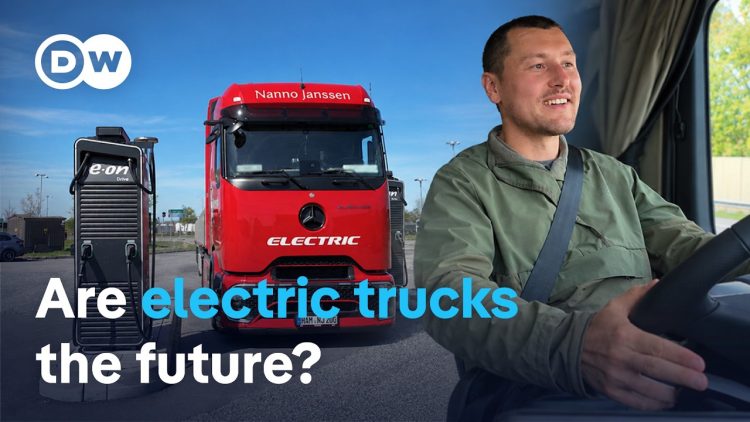
One electric truck’s road trip to Norway
Trucker Tobias Wagner has a mission: to get from Germany’s East Frisia to Norway in an electric truck. The assignment is an unusual one. A navigation buoy from the Juister Riff in the North Sea went missing and has turned up in Scandinavia — and now it is Wagner’s job to bring it back. What follows is a 900-kilometre journey through three countries and a ferry crossing, all in an electric truck.
To make the trip work, Wagner has had to plan his route carefully. Weight, distance and road incline all affect the truck’s range, and every one of those factors has to be worked into the plan before he sets off. Finding suitable overnight stops is also crucial, since not all truck parking areas have charging stations — and an electric truck that cannot charge overnight cannot finish the journey.
Many in Wagner’s industry are still skeptical about electric trucks, and the film does not hide that skepticism. But freight hauler Nanno Janssen has no doubt: e-trucks are the future. Sixty percent of his fleet already runs on electricity, and he plans to transition the remaining trucks in the coming years. Wagner is a believer, too — he regularly shares his experiences as “Elektrotrucker” on YouTube, and the film follows him as someone who has already made the switch in his own working life.
The film follows Wagner on this unusual assignment from East Frisia to Norway, and it shows how today’s electric mobility is already working for long-haul trucking — and looks at the challenges that remain. It is a road movie with a practical question at its heart: not whether electric trucks are a nice idea, but whether one can actually do the job, over 900 kilometres, with a buoy in the back and a ferry in the middle.
What makes the film work is that it never argues in the abstract. Every claim about electric trucking is tested against the road itself — against the weight of the load, the incline of the hills, the distance between chargers and the reality of finding somewhere to stop for the night. The trip is the argument, and the film lets the journey speak for itself.
What the Film Explores
The film explores the assignment itself first: a missing navigation buoy from the Juister Riff, found again in Scandinavia, and a trucker given the job of bringing it home. The buoy gives the journey a purpose beyond the test drive — Wagner is not driving to Norway to prove a point, he is doing a job, and the film’s interest is in whether an electric truck can do that job like any other truck would.
A second thread follows the planning, and the film is at its most practical here. Weight, distance and road incline all affect how far the truck can go, and the route has to be worked out around them. Overnight stops have to be chosen not just for rest but for charging, because not all truck parking areas have charging stations. The film shows that long-haul electric driving is, for now, as much a matter of logistics as of technology.
A third thread follows the argument about the future of trucking. Many in the industry are still skeptical about electric trucks, and the film gives that skepticism a fair hearing. Against it, it sets Nanno Janssen, a freight hauler who has already moved sixty percent of his fleet to electricity and plans to transition the rest, and Wagner himself, who shares his experiences as “Elektrotrucker” online. The contrast is the film’s real subject: an industry in the middle of changing its mind.
Running through the film is the question of what electric mobility can already do. The documentary shows how today’s electric trucks are already working for long-haul journeys — and it is equally clear about the challenges that remain, from charging infrastructure to the sheer planning a long electric journey still demands. The trip to Norway is the test case, and the film reports the result honestly.
Key Themes & Topics Examined
- Tobias Wagner’s mission: East Frisia to Norway in an electric truck
- The missing navigation buoy from the Juister Riff in the North Sea
- 900 kilometres, three countries and a ferry crossing
- Weight, distance and road incline — and what they do to an e-truck’s range
- Overnight stops and the search for charging stations
- Skepticism in the trucking industry about electric trucks
- Nanno Janssen: sixty percent of his fleet already electric
- Wagner as “Elektrotrucker” — sharing the electric trucking life on YouTube
Production & Background
The documentary is a DW Documentary production that follows trucker Tobias Wagner on a single assignment, from Germany’s East Frisia to Norway. Its subject is practical rather than theoretical: a working trucker, a real load, and a route that has to be driven rather than imagined.
The film’s structure follows the journey itself — the planning, the driving, the ferry crossing and the arrival — with the people Wagner meets along the way, above all freight hauler Nanno Janssen, providing the wider picture of an industry deciding whether electric trucks are ready for long-haul work.
Recommended Companion Viewing
Explore authoritative investigative documentaries on related historical events and investigative subjects.

SpaceX Went Public - A Disaster Waiting to Happen
How It's Made
We Made A Giant Zipper To Explain How It Works
World’s Biggest Car Wash: Secrets of the Giant Cleaning Machine
Frequently Asked Questions
What is Tobias Wagner transporting, and why?
A navigation buoy from the Juister Riff in the North Sea went missing and has turned up in Scandinavia. Wagner’s job is to bring it back to Germany — a 900-kilometre trip in an electric truck.
How far is the trip?
900 kilometres, through three countries, with a ferry crossing — from Germany’s East Frisia to Norway, all in an electric truck.
What affects an electric truck’s range?
Weight, distance and road incline all affect the truck’s range, which is why Wagner has to plan his route carefully. Finding suitable overnight stops matters too, since not all truck parking areas have charging stations.
Why are many hauliers skeptical about electric trucks?
The film shows the skepticism in the industry directly — long distances, heavy loads and charging infrastructure are the worries. Against that, it sets hauliers who have already made the switch.
Who is Nanno Janssen?
A freight hauler who believes e-trucks are the future. Sixty percent of his fleet already runs on electricity, and he plans to transition the remaining trucks in the coming years.







