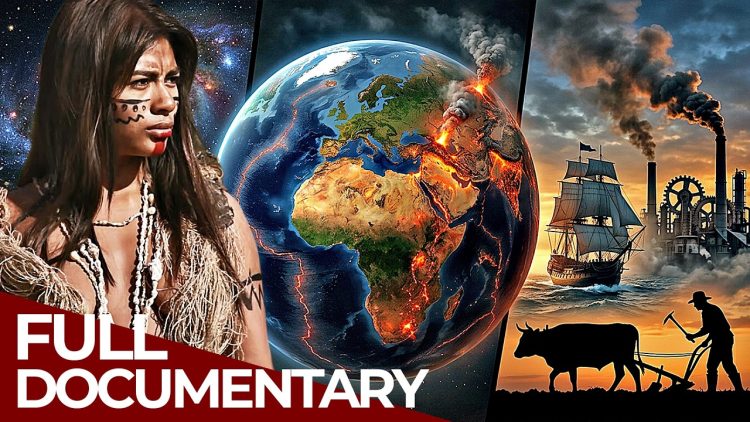
The History of Humanity: From Deep Time Until Today
Our civilisation and our innovations, our voyages and our battles, are driven not only by the decisions we make, but by physics, geology, biology and chemistry. Often the forces that shaped us are too small to see, or so far back in time that the only way to understand their influence is to think in a whole new way. That is the idea behind this film, a two-and-a-half-hour compilation of the series Deep Time History, which tears down the walls between science and history to show how the story of mankind is driven by events from the deep past.
The film is built in three parts. The first, The Rise of Civilization, asks how human beings went from small bands of hunter-gatherers to cities, states and empires, and it answers by looking far beyond human choices. The crops that made farming possible, the animals that could be domesticated, the metals that could be worked and the rivers that could be farmed were all products of geology and biology, laid down long before any human being existed. The film shows how the shape of the continents, the climate of the planet and the chemistry of the soil decided where civilisations could rise, and where they could not.
The second part, The Age of Discovery, follows the voyages that connected the world, and it shows how those voyages were themselves driven by deep forces. The winds and currents that carried ships across the oceans were products of the planet’s rotation and its climate. The gold and silver that drew Europeans across the Atlantic were laid down by geological processes hundreds of millions of years old. And the diseases that travelled with the explorers, which killed far more people than any battle, were products of biology, of the long separation of the world’s peoples and the animals they lived with.
The third part, The Industrial Revolution, asks how a small island off the north-west coast of Europe came to remake the world, and it answers with coal. The coal that powered the steam engines, the factories and the railways was the compressed remains of ancient forests, laid down hundreds of millions of years ago in swamps that no longer exist. The film shows how the geology of Britain, which put coal and iron close together and close to the surface, gave the Industrial Revolution its fuel, and how the physics of steam turned that fuel into power.
Running through all three parts is a single argument: that history is not only the story of kings and battles, but the story of a planet, and that to understand the human past we need to understand the deep past as well. Ancient exploding stars, the clash of continents and the formation of molecules all secretly shaped the history we thought we knew, and the film’s pleasure comes from watching those hidden connections emerge.
What the Film Explores
The film explores the deep past first, and the scale of it. The Earth is more than four and a half billion years old, and human beings have existed for only a tiny fraction of that time. The film shows how the planet was built, from the formation of the solar system to the collisions that made the continents, and how the long history of the Earth set the conditions for everything that followed.
It then turns to the rise of farming, and to the question of why agriculture began where it did. The film shows how the end of the last ice age changed the climate, how the wild grasses of the Fertile Crescent could be turned into wheat and barley, and how the animals of the region, sheep, goats, pigs and cattle, could be domesticated. It also shows why farming did not begin everywhere: the crops and animals that could be domesticated were not evenly spread, and the places that had them had a head start that lasted for thousands of years.
The film also explores the age of discovery, and the biology of it. When Europeans reached the Americas, they brought with them diseases to which the peoples of the Americas had no immunity, and the epidemics that followed killed a large part of the population. The film explains why: the peoples of Eurasia had lived for thousands of years alongside domesticated animals, and the diseases that jumped from those animals to people had become endemic. In the Americas, with fewer domesticated animals, that long exposure had not happened, and the result was catastrophe.
Finally, the film looks at the Industrial Revolution, and at the chemistry and physics behind it. It shows how coal, iron and steam came together in Britain, how the steam engine turned heat into work, and how that single invention remade transport, manufacturing and war. It also shows how the revolution spread, and how the countries that had coal and iron could industrialise while those that did not were left behind, a division that still shapes the world today.
Key Themes
- Deep time, and how events billions of years old shaped human history.
- The rise of farming, and why agriculture began where it did.
- Domestication, and how a handful of animals and crops changed everything.
- The age of discovery, and the winds, currents and geology behind it.
- Disease, and how biology decided the fate of continents.
- Coal, iron and steam, and the fuel of the Industrial Revolution.
- The meeting of science and history, and what each can teach the other.
- Humanity’s story as part of the planet’s story, not separate from it.
Production and Background
The History of Humanity: From Deep Time Until Today is a compilation of the series Deep Time History, published by Free Documentary History, and it runs for two hours, twenty-seven minutes and forty-eight seconds. Its three parts, The Rise of Civilization, The Age of Discovery and The Industrial Revolution, were originally made as separate episodes, and the compilation brings them together into a single film. The series uses animation and expert explanation to make the deep past visible, and its central idea, that human history cannot be understood without the history of the planet, is one that has become increasingly influential in the writing of history.
Recommended Companion Viewing
Explore authoritative investigative documentaries on related historical events and investigative subjects.

Retold - History's Forgotten Stories: The Deadly Air
Why Chernobyl still isn't over: 40 years after the worst nuclear disaster ever
The Battle of Fallujah and the Iraq War 2003-04 (Documentary)
Why Botswana Got So Wealthy
Frequently Asked Questions
What is deep time history?
It is a way of looking at history that starts with the deep past, the formation of the planet and the evolution of life, and shows how those ancient events shaped human history.
What are the three parts of the film?
The Rise of Civilization, The Age of Discovery and The Industrial Revolution, covering farming, exploration and industrialisation in turn.
How did geology shape the Industrial Revolution?
Britain had coal and iron close together and close to the surface, and that geology gave the steam engines and factories of the Industrial Revolution their fuel.
Why did disease matter so much in the age of discovery?
Peoples of the Americas had no immunity to the diseases Europeans brought with them, because they had not lived alongside the domesticated animals from which those diseases came.
How long is the film?
It runs for two hours, twenty-seven minutes and forty-eight seconds, making it one of the longest films in this batch.