World War 2: 1939
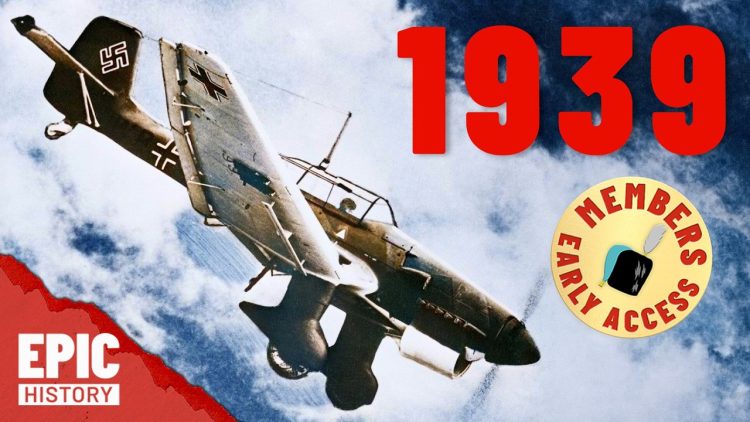
In January 1939, many Europeans dared to hope the worst was over. They were wrong. This is the story of the year that changed everything, told by Epic History TV in a 34-minute film that follows the world from a fragile peace to a war that would become the most devastating conflict in history. It is the first instalment of the channel’s telling of the Second World War, and it covers the year in which the war began.
The year opens with a Europe still living in the shadow of Munich. The agreement of September 1938, in which Britain and France allowed Germany to take the Sudetenland from Czechoslovakia, had been presented as peace in our time, and many people believed it. But Hitler had no intention of stopping, and in March 1939 German troops marched into the rest of Czechoslovakia, occupying Prague and destroying the idea that his ambitions could be satisfied by concessions.
Meanwhile, on the far side of the world, another war was already being fought. On the Soviet-Japanese frontier in Mongolia, Soviet and Japanese forces clashed at Khalkhin Gol, a battle that ran through the summer of 1939 and ended in a decisive Soviet victory. The film shows how that distant fight mattered in Europe, because it convinced Japan to turn its attention south, towards the Pacific, and left the Soviet Union free to look west.
The centre of the film is the secret pact that shocked the world. On 23 August 1939, Germany and the Soviet Union, two regimes that had spent years denouncing each other, signed the Molotov-Ribbentrop Pact, a non-aggression treaty with a secret protocol to carve up Eastern Europe between them. Poland was to be divided, the Baltic states were assigned to the Soviet sphere, and the last obstacle to Hitler’s invasion was removed. Eight days later, on 1 September, German forces invaded Poland, and on 3 September Britain and France declared war on Germany. The Second World War had begun.
The film follows the opening moves of the war itself: the Soviet invasion of Poland from the east on 17 September, the fall of Warsaw, and the Soviet Union’s invasion of Finland at the end of November, the Winter War, in which a small Finnish army held off a vastly larger Soviet force far longer than anyone expected. It closes with the Allies preparing for battle on the Western Front, in the strange quiet of the Phoney War, when the war had been declared but the great battle in the west had not yet come.
What the Film Explores
The film explores the failure of appeasement first, and the year in which it collapsed. It shows how the Munich agreement, far from satisfying Hitler, convinced him that Britain and France would not fight, and how the occupation of Prague in March 1939 finally changed minds in London and Paris. Britain and France gave a guarantee to Poland at the end of March, promising to defend it if Germany attacked, a promise that would be tested within six months.
It then turns to the war in the east, and to Khalkhin Gol, a battle that is often forgotten in European histories of the war. The film shows how the Soviet commander Georgy Zhukov surrounded and destroyed a Japanese force on the Mongolian steppe, and how that victory shaped the whole war: Japan decided against another attack on the Soviet Union, and Stalin was free to make his pact with Hitler. The film treats the battle as a hinge, a fight in a remote place that decided the shape of the war to come.
The film also explores the Molotov-Ribbentrop Pact in detail, and the cynicism of it. Two regimes that claimed to be mortal enemies divided a continent between them in secret, and the film shows how the pact freed Hitler to attack Poland without fear of a war on two fronts, and how it gave Stalin the territory he wanted in eastern Poland and the Baltic states. The pact held for less than two years, until Germany invaded the Soviet Union in June 1941, but in 1939 it made the war possible.
Finally, the film looks at the first months of fighting, and at the Winter War in particular. When the Soviet Union invaded Finland on 30 November 1939, it expected a quick victory. Instead, Finnish troops, fighting in deep snow and forest, inflicted heavy losses on the invaders and held out for more than three months. The film shows how the Winter War exposed the weaknesses of the Soviet army, lessons that would matter when Germany invaded two years later, and how it won Finland the sympathy of the world.
Key Themes
- The collapse of appeasement after Munich and the occupation of Prague.
- Khalkhin Gol, the Soviet-Japanese battle that shaped the war.
- The Molotov-Ribbentrop Pact and the secret division of Eastern Europe.
- The invasion of Poland on 1 September 1939 and the declarations of war.
- The Soviet invasion of Poland and the fall of Warsaw.
- The Winter War, and Finland’s stand against the Soviet Union.
- The Phoney War on the Western Front, and the wait for the battle to come.
- 1939 as the year the world changed, told with the guidance of historian Richard Overy.
Production and Background
World War 2: 1939 is an Epic History TV film, running for 33 minutes and 56 seconds, and it was published in September 2026. The series’ historical consultant is Professor Richard Overy of the University of Exeter, one of the leading historians of the Second World War, and the film’s recommended reading draws on his books, including The Inter-War Crisis, Why The Allies Won and Blood and Ruins, alongside Antony Beevor’s The Second World War and Max Hastings’ Inferno. The film is the opening chapter of the channel’s history of the war, and it sets the pattern for the series: maps, animation and a close attention to the decisions that turned a European crisis into a world war.
Recommended Companion Viewing
Explore authoritative investigative documentaries on related historical events and investigative subjects.

Hitler's Reich - Diaries of Nazi Supporters, Opponents and Victims (2/4)
Death Marches: The Third Reich's Final Crime
Lost Books and the Ancient Mysteries They Would Solve
Napoleon's Greatest Gamble: Return from Elba
Frequently Asked Questions
When did the Second World War begin?
Germany invaded Poland on 1 September 1939, and Britain and France declared war on Germany on 3 September. The film covers the whole of 1939, from the hope of peace to the outbreak of war.
What was the Molotov-Ribbentrop Pact?
It was a non-aggression treaty signed by Germany and the Soviet Union on 23 August 1939, with a secret protocol dividing Eastern Europe, including Poland, between them.
What happened at Khalkhin Gol?
Soviet and Japanese forces fought a battle on the Mongolian frontier in the summer of 1939. The Soviet victory convinced Japan to turn away from Siberia, which freed the Soviet Union to deal with Europe.
What was the Winter War?
The Soviet Union invaded Finland on 30 November 1939 and expected a quick victory. Finnish forces held out for more than three months, inflicting heavy losses on the invaders.
What was the Phoney War?
It was the period after Britain and France declared war in September 1939, when little fighting took place on the Western Front while both sides prepared for the battle to come.