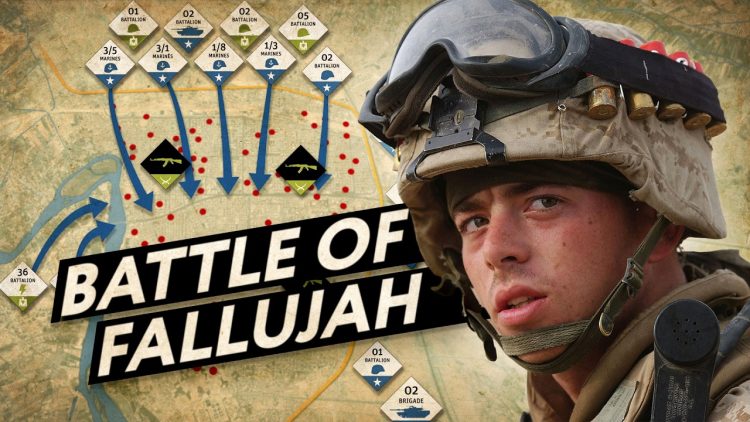
The Battle of Fallujah and the Iraq War 2003-04 (Documentary)
In May 2003, United States President George W. Bush announced the end of major combat operations in the Iraq War and declared that the mission was shifting to occupation and reconstruction. The invasion itself had been swift: American and British forces had toppled Saddam Hussein’s government in a matter of weeks. But as this film from Real Time History shows, the war was far from over. Almost as soon as the statues fell, an anti-American insurgency began to spread across the country, and Iraq began a rapid descent into violence.
The film takes the Battle of Fallujah as its focus, and Fallujah as the symbol of what went wrong. The city, west of Baghdad in Anbar province, became one of the centres of the insurgency, a place where the occupation met its fiercest resistance. The film traces how the occupation’s early decisions, the disbanding of the Iraqi army and the sweeping removal of Ba’ath Party members from public life among them, left thousands of armed and angry men with no stake in the new order, and how Fallujah became the place where that anger concentrated.
What the film does well is to show the gap between the announcement in May 2003 and the reality on the ground. The capture of Saddam Hussein in December 2003, hiding in a hole near his home town of Tikrit, was presented as a turning point, but the film shows that it did nothing to stabilise Iraq. The insurgency was not a one-man enterprise, and removing its former leader did not remove the grievances, the networks or the weapons that sustained it.
The documentary is built from authentic historical footage, maps and the research of its writers, Mark Newton and Jesse Alexander, and it draws on a shelf of serious histories, from Thomas Ricks’ Fiasco to Michael Gordon and Bernard Trainor’s Cobra II. The result is a short, dense account of a war that was declared won and then fought all over again, with Fallujah at its centre.
By the end, the film leaves the viewer with a picture of 2003 and 2004 as the years when the Iraq War changed its character. What had begun as a conventional invasion became a grinding occupation, fought street by street, and the city of Fallujah became the name that stood for that change.
What the Film Explores
The film explores the occupation first, and the speed with which it went wrong. In May 2003 the war was declared over and the task was said to be reconstruction, but the country was sliding into violence. Looting, the collapse of basic services and the absence of any functioning Iraqi state left a vacuum, and into that vacuum stepped armed groups of many kinds: former soldiers, nationalists, religious fighters and, increasingly, foreign volunteers. The film shows how an insurgency that began as scattered resistance became a movement.
It then turns to Fallujah itself, and to why this one city mattered so much. Fallujah had been a centre of support for Saddam’s regime, and its people had reason to fear the new order. The killing of demonstrators by American troops in April 2003, and the killing of four American contractors in the city in March 2004, turned it into a byword for resistance. The film follows the escalation that led to the first battle for the city in the spring of 2004, when American forces moved in and then, under political pressure, pulled back, leaving the insurgents in control.
The film also explores the wider war of which Fallujah was a part. The insurgency spread from Anbar province across the Sunni heartlands and into Baghdad, and it was joined by a growing sectarian conflict between Sunni and Shia communities. The film shows how the occupation’s forces, trained and equipped for conventional war, found themselves fighting an enemy that wore no uniform, held no ground in the conventional sense and could disappear into the population after every attack.
Finally, the film looks at the cost of the failure to stabilise Iraq. The capture of Saddam Hussein, the film argues, changed nothing on the ground, because the insurgency had its own momentum. By the end of 2004, Iraq was in the grip of a war that would last for years, and Fallujah, fought over twice in a single year, had become the symbol of a conflict that the announcement of May 2003 had claimed was already over.
Key Themes
- The announcement of May 2003, and the gap between the declared end of the war and the reality of the occupation.
- Fallujah as the centre of the insurgency, and why one city came to matter so much.
- The capture of Saddam Hussein in December 2003, and why it did not stabilise Iraq.
- The disbanding of the Iraqi army and the removal of Ba’ath officials, and the armed men those decisions left behind.
- The shift from conventional invasion to street-by-street counter-insurgency.
- The spread of the insurgency from Anbar province across Iraq.
- Sectarian violence, and how the occupation’s failures fed it.
- A war declared won, and then fought all over again.
Production and Background
The Battle of Fallujah and the Iraq War 2003-04 was produced by Real Time History, the channel presented by Jesse Alexander, and it runs for 31 minutes. It was published in August 2026. The film is written by Mark Newton and Jesse Alexander, directed and edited by Toni Steller, and fact-checked by Florian Wittig. Its sources include Ben Barry’s Blood, Metal and Dust, Ross Caputi’s The Sacking of Fallujah, and Thomas Ricks’ Fiasco, and like all of the channel’s work it uses only authentic historical footage, with no AI-generated imagery.
Recommended Companion Viewing
Explore authoritative investigative documentaries on related historical events and investigative subjects.

How Mandela Changed South Africa | From Prison To President
Women of the Third Reich: The Other Face of Nazi Germany
Road to WW2: 1931 - 34
The Best Archeological Finds From Roman Britain
Frequently Asked Questions
When was the end of major combat operations in Iraq announced?
President George W. Bush announced it in May 2003, aboard the aircraft carrier USS Abraham Lincoln, and declared that the mission was shifting to occupation and reconstruction.
Why did Fallujah become so important?
Fallujah, west of Baghdad in Anbar province, became one of the main centres of the insurgency against the occupation, and the scene of two major battles in 2004.
When was Saddam Hussein captured?
He was captured in December 2003, near his home town of Tikrit. The film shows that his capture did nothing to stop the insurgency.
What turned the occupation into an insurgency?
The film points to the collapse of the Iraqi state, the disbanding of the army and the removal of Ba’ath officials, which left armed men with no stake in the new order.
How long did the Iraq War last?
The invasion began in March 2003 and the occupation that followed lasted for years, with American combat troops remaining in Iraq until 2011.